Understanding the Adjudication and Stamping Request in Hong Kong's Intra-Group Transactions
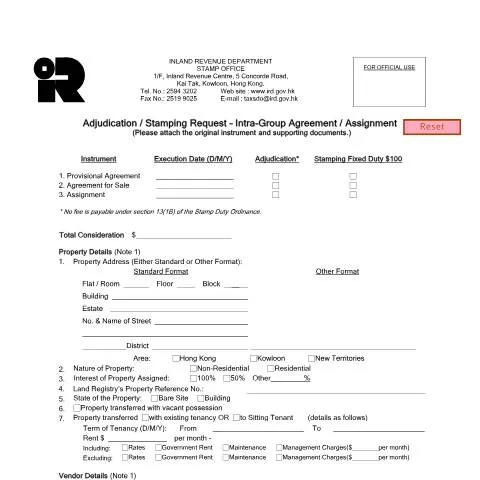
Navigating the labyrinth of administrative procedures in Hong Kong can be a daunting task, particularly when dealing with the nuances of stamp duty. Among the essential documents in this process is the Adjudication / Stamping Request - Intra-Group Agreement / Assignment (reference code IRSD 121(E)). This form plays a pivotal role in ensuring compliance with the Stamp Duty Ordinance, specifically for transactions involving intra-group agreements executed from 2 August 2004 onwards. This article will delve into the historical backdrop, the intricate details of the form, and the procedural steps required for successful submission.
The Historical Context of Stamp Duty in Hong Kong
Stamp duty has deep roots in Hong Kong’s taxation framework and has evolved in response to changing economic landscapes and administrative needs. Initially introduced in the late 19th century, stamp duty was primarily aimed at regulating property transactions and collecting revenue for the government. Over time, its scope expanded to include a variety of agreements, particularly those involving transfers within corporate groups.
The introduction of the IRSD 121(E) form came as part of a broader initiative to streamline the adjudication process related to intra-group transactions. By mandating that specific agreements be submitted for stamping, the Hong Kong government sought to enhance transparency and reduce tax evasion. Understanding this historical context is crucial for grasping the importance and implications of the form in question.
Diving Deep: The Structure and Sections of the IRSD 121(E) Form
The IRSD 121(E) form is structured to capture comprehensive details about the transaction in question. Each section is designed to gather critical information required for proper adjudication and stamping. Here, we will dissect each segment to illuminate what is required from applicants.
Initial Information: Instrument and Execution Date
- Instrument: Applicants must specify whether they are submitting a Provisional Agreement, Agreement for Sale, or Assignment. This is crucial as it dictates the nature of the transaction.
- Execution Date: Clearly stating the execution date (DD/MM/YYYY) is vital. Any discrepancies here could result in delays or rejections.
Adjudication and Stamp Duty Payment
In this section, the applicant must indicate whether they are applying for adjudication. Notably, a fixed stamping fee of $100 applies, as stipulated under the Stamp Duty Ordinance.
Property Details: The Heart of the Application
Providing comprehensive property details is one of the most crucial aspects of the form. Applicants are required to fill out information pertaining to:
- Property Address: Specify whether the property is located in Hong Kong, Kowloon, or the New Territories. Accurate details minimize the risk of administrative errors.
- Nature of Property: Indicate if the property is residential or non-residential, as these classifications can affect the stamp duty rate.
- Land Registry Reference: This is essential for validating property ownership and maintaining accurate public records.
Chronological Procedure: From Submission to Final Decision
Understanding the timeline from initiating the request to receiving the final stamp is essential for all stakeholders involved in the transaction.
- Preparation of the Document: Ensure all sections of the IRSD 121(E) form are accurately filled, and supporting documents are attached.
- Submission: The completed form should be submitted to the Inland Revenue Department (IRD) via the designated channels. E-services are available for online submissions.
- Processing Time: After submission, the IRD will typically process the application within a designated period. Applicants should be prepared for potential follow-up inquiries.
- Issuance of Stamped Document: Once the application is approved, a stamped document will be returned to the applicant, signifying compliance.
Special Scenarios: Navigating Unique Situations
While most applications will follow the standard procedure outlined above, certain complex scenarios can arise that may require additional consideration.
Foreign Entities Involved
When foreign entities are involved in intra-group agreements, they must provide additional verification documents, including proof of existence and registration in their home jurisdiction. This helps the IRD validate the legitimacy of the transaction.
Minor Participants
If a minor is involved in the agreement, additional documentation proving legal capacity must be submitted. This often includes consent from guardians or parents to ensure the transaction is enforceable.
Urgent Requests
In cases where urgent processing is required, applicants may request expedited service, though there may be additional fees involved. Supporting documentation to justify the urgency must also be provided.
Integrating the IRSD 121(E) Within Broader Administrative Processes
The IRSD 121(E) does not exist in isolation; it is part of a larger framework of compliance requirements when engaging in property transactions in Hong Kong. Understanding its place in this broader context is paramount.
For instance, once the stamping request is approved, the consequent steps often involve updating company records, notifying relevant stakeholders, and ensuring compliance with any other legal obligations stemming from the transaction.
Final Thoughts: Ensuring Compliance and Avoiding Pitfalls
In an environment where compliance is rigorously monitored, submitting the IRSD 121(E) form accurately is essential to avoid potential legal ramifications. Careful attention should be paid to every detail, from the execution date to the property details.
Moreover, applicants should remain vigilant about changes in regulations surrounding stamp duty and intra-group transactions. Keeping abreast of these changes can prevent missteps and ensure a smoother process.
The IRSD 121(E) form represents more than just a piece of paper; it is a crucial document that facilitates legal agreements within corporate structures in Hong Kong. Understanding its nuances will empower applicants to navigate their submissions confidently and efficiently.
Understanding the Adjudication Process for Intra-Group Agreements
The adjudication process for intra-group agreements in Hong Kong is not merely a procedural formality; it embodies significant legal implications, tax considerations, and compliance requirements. It's crucial to recognize that the process initiates with the submission of the Stamping Request to the Stamp Office, where applicants must provide comprehensive documentation supporting the transaction.
For intra-group agreements, the definition of "group" is important. According to the Inland Revenue Department, a group typically includes companies under common control, which can lead to different tax treatment. The parties involved in the intra-group agreement must establish their relationship clearly, ensuring they meet the definitions set out in local regulations.
Upon submission, the Stamp Office reviews the documentation to ascertain if the agreement qualifies for any exemptions or reduced duty rates, which are often available under specific circumstances. For instance, if the intra-group agreement pertains to the transfer of assets that are held for trading, it might be exempt from stamp duty. However, it's vital to comply with the statutory requirement of providing the appropriate forms — in this case, the 'Stamping Request for Intra-Group Agreements' (form ST1) — which outlines the particulars of the agreement clearly and comprehensively.
Furthermore, pay attention to timelines. The application must be submitted within 30 days of the agreement's execution; otherwise, a penalty fee may apply, compounded by the potential for interest to accrue. This could inadvertently increase the overall cost of the transaction. Therefore, timely submission and a thorough understanding of the nuances of intra-group agreements can safeguard businesses against undesirable financial repercussions.
Fill in your form directly online
No printing: type your details into the boxes of the official form, tick, then download the PDF ready to send.
- 1Type into the form boxes
- 2Tick in one click
- 3Save and download the PDF
Common Pitfalls and Misunderstandings in Stamp Duty Compliance
Many businesses encounter various pitfalls when navigating the complexities of stamp duty compliance for intra-group agreements. One of the most common misunderstandings is the assumption that all intra-group agreements are exempt from stamp duty. In reality, while certain agreements may qualify for reduced rates or exemptions, many still necessitate the payment of duty based on the terms of the transaction.
Another frequent issue arises from incomplete or inaccurately filled forms. The Stamp Office requires specific details, including the nature of the transaction, the valuation of the assets involved, and the parties' particulars. Failing to provide adequate information can lead to delays in processing the request or even a refusal. Businesses should ensure that they engage qualified professionals who understand the intricacies of the relevant forms, such as the 'Public Form for Stamping Request' (form ST2), as they navigate the application process.
Moreover, further complications can emerge from the timing of the submission. If the agreement is executed but not submitted for stamping within the stipulated 30-day period, a penalty fee will apply. The Stamp Duty Ordinance clearly outlines the consequences of late submissions, including increased financial liabilities. Businesses should implement internal controls to monitor and document the execution of agreements to prevent any lapses in compliance.
It's also essential to consider the implications of changes in property ownership or the restructuring of company capital. Intra-group agreements often involve complicated legal frameworks, and failure to re-stamp these agreements when modifications occur can lead to significant penalties. Understanding the ongoing obligations post-initial stamping is crucial to maintaining compliance.
Case Studies: Successful Navigation of Intra-Group Agreement Stamp Duty
To illustrate the importance of correctly navigating the stamp duty requirements for intra-group agreements, it is useful to examine real-world case studies that highlight both successful compliance and notable failures.
One successful case involved a multinational corporation that effectively utilized the intra-group agreement framework to optimize its tax position. By engaging local tax advisors before drafting their agreement, they identified eligible exemptions under the Stamp Duty Ordinance. The agreement was clearly articulated, and all required forms were submitted in a timely manner, leading to a smooth adjudication process. As a result, they not only minimized their stamp duty liabilities but also established a compliant procedure for future intra-group transactions.
Conversely, a case of mismanagement leads to significant financial repercussions for another company. They failed to recognize the need for stamping an intra-group agreement within the required timeframe. As a result, they incurred penalties amounting to a considerable sum, coupled with accruing interest on the unpaid duty. This situation underscores the necessity of diligent monitoring of compliance timelines and understanding the requirements set forth by the Stamp Office.
Learning from these case studies illustrates that proactive compliance, thorough documentation, and effective communication with tax authorities can lead to favorable outcomes for businesses engaging in intra-group agreements. This practice not only ensures regulatory adherence but also fosters a robust internal framework for handling similar transactions in the future.