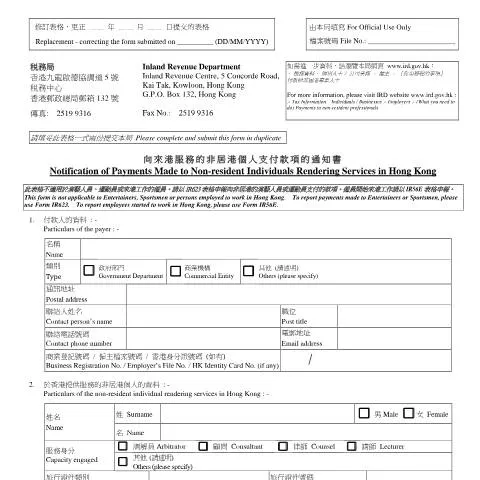
The Significance of IR 623P in Hong Kong's Tax Framework
The Notification of Payments Made to Non-resident Individuals Rendering Services in Hong Kong—commonly referred to by its code IR 623P—is not merely a bureaucratic formality; it serves as a crucial document for both non-resident service providers and their payers. Those who engage in business with non-resident individuals, ensuring compliance with local tax obligations, must navigate the intricacies of this form.
Understanding the importance of IR 623P is vital. It plays a key role in delineating the responsibilities of the payer and ensuring that the payment process adheres to the stipulations set forth by the Inland Revenue Department (IRD) of Hong Kong. This document is particularly relevant for entities that do not employ workers permanently in Hong Kong but engage with independent contractors, consultants, or professionals from abroad who deliver services within its jurisdiction.
Who Files the IR 623P and Under What Circumstances?
The IR 623P is typically submitted by business entities or government departments that make payments to non-resident individuals for services rendered in Hong Kong. The necessity to file this form arises when:
- The non-resident individual is not employed in Hong Kong.
- Services are rendered within Hong Kong but involve individuals who have no permanent residency status.
- Payments made are not subject to the standard salary tax, thereby necessitating a different reporting process.
By ensuring that the IR 623P is appropriately filled and submitted, the payer fulfills their obligations under the Basic Law of the Hong Kong Special Administrative Region. This proactive step safeguards against potential tax issues and penalties down the road.
Understanding the Filing Process: Steps to Complete IR 623P
Completing the IR 623P is a meticulous process that requires attention to detail. Here’s a structured approach:
- Gather Required Information: Collect details regarding the payer (name, type, contact information) and non-resident individual (full name, nationality, contact details).
- Detail the Services Rendered: Clearly describe the nature of the services provided, including the total contract amount and the specific periods during which the services were rendered.
- Payment Information: Document the payment dates and amounts, along with any deductions or taxes applicable.
- Verification: Confirm whether the contract made with the non-resident individual is attached, as mandated.
- Signature: Ensure that the form is signed by an authorized representative of the payer’s organization, which may include the company seal.
Potential Consequences of Non-filing or Errors in IR 623P
The implications of failing to file the IR 623P or inaccuracies within the form can be significant:
- Penalties and Fines: Entities may face financial penalties imposed by the IRD for non-compliance.
- Delayed Payments: Without proper documentation, payments to non-resident individuals may be withheld until compliance is ensured.
- Tax Liabilities: Misreporting may lead to unintended tax liabilities, complicating an entity’s financial standing.
Thus, a thorough understanding and careful completion of the IR 623P is paramount for businesses engaged with non-resident individuals to mitigate risks effectively.
Documentation and Evidence: Essential Papers to Compile
When submitting the IR 623P, there are essential documents that should accompany the form to support the claims made:
- Contracts and Agreements: Attach copies of contracts that define the terms of the services rendered, including specific deliverables and timelines.
- Invoices: Keep copies of invoices issued to substantiate payment amounts.
- Correspondence: Document any correspondence with the non-resident individual that might clarify the nature of the services or payment arrangements.
- Tax Identification Number: If applicable, include the non-resident individual's tax identification number from their home country.
Profiling Non-resident Individuals: Concerning Categories and Exceptions
The IR 623P is applicable to a range of non-resident service providers. However, it is essential to identify the specific profiles as well as any notable exceptions:
Categories of Non-resident Service Providers
- Consultants: Often hired for specialized knowledge in fields such as finance, IT, or management.
- Freelancers: Engaged for discrete projects or tasks that do not require a long-term commitment.
- Advisors: Typically involved in strategic roles, providing insights on navigating local regulations.
Exceptions to Filing
There are certain exceptions where the IR 623P may not be necessary:
- If the individual is classified as a permanent resident of Hong Kong.
- Payments made for services that fall under specific tax treaties that exempt certain categories from local taxation.
The Administration's Role: Processing and Tracking Your Submission
Once the IR 623P is submitted to the Inland Revenue Department, it enters a structured processing phase:
- Initial Review: The IRD conducts an initial analysis to ensure completeness and accuracy.
- Confirmation of Details: Discrepancies may lead to requests for additional information or clarification.
- Final Assessment: Upon successful review, the IRD will finalize the assessment, determining the tax implications related to the non-resident individual's payments.
Entities can track the progress of their submission through the IRD's online services, providing a transparent view of their compliance status.
Historical Context: The Framework Justifying IR 623P's Existence
The introduction of the IR 623P is rooted in Hong Kong's commitment to maintaining a transparent and fair taxation system. This framework is influenced by:
- The need to regulate payments made to non-resident individuals in the global economy.
- The facilitation of tax compliance as stipulated in the Basic Law of the Hong Kong Special Administrative Region.
- The management of diverse international business relationships, enhancing Hong Kong's attractiveness as a business hub.
Understanding this historical context provides insights into why the IR 623P is integral to the tax system, offering clarity and protection for both payers and service providers.
Final Thoughts: Navigating the Complexities of IR 623P
In the realm of international commerce, navigating the intricacies of tax documentation is essential for sustainable business operations. The IR 623P stands as a pivotal instrument in ensuring that non-resident individuals rendering services in Hong Kong comply with local regulations. By understanding the nuances of the form, the filing process, and the implications of errors, entities can better manage their obligations.
By fostering a culture of compliance, businesses not only adhere to legal standards but also contribute to the overall integrity of Hong Kong's financial system, securing their place in the global market.
Understanding the Notification Process for Payments to Non-Resident Individuals
The process of notifying the Hong Kong Inland Revenue Department (IRD) about payments made to Non-resident Individuals (NRIs) rendering services in Hong Kong is not only crucial for compliance but also for ensuring that both the payer and payee adhere to local tax regulations. This section delves deep into the nuances of the notification processes, exploring the obligations imposed on entities making such payments.
Firstly, it is essential to recognize that the notification is mandated under Section 51(4) of the Inland Revenue Ordinance (IRO). This section specifies that any person who makes a payment to a non-resident individual for services rendered in Hong Kong must notify the IRD within a specified timeframe. The primary aim of this requirement is to ensure transparency and proper taxation of income generated by NRIs within the jurisdiction.
In practice, to comply with this requirement, companies or entities making payments must submit the appropriate notification form, typically referred to as the 'NRI Notification Form' (specific form numbers may vary based on updates from the IRD). The submission should detail the nature of the services provided, the amount paid, and the tax residency of the individual. Failure to submit this notification can lead to penalties or increased scrutiny from the tax authorities.
It is also critical to understand the deadlines associated with these notifications. The IRD has established a strict timeline, and notifications must generally be submitted within one month from the date of payment. Entities must be diligent in tracking payment dates and ensuring submissions are made timely to avoid penalties.
Tax Implications and Withholding Tax Considerations
When engaging Non-resident Individuals (NRIs) for services rendered in Hong Kong, it is imperative to consider the tax implications that arise from such arrangements. One of the major considerations is the withholding tax that may be applicable to payments made to NRIs. The Hong Kong tax framework mandates that certain payments to NRIs are subject to withholding tax, and it is the responsibility of the payer to ensure compliance.
Withholding tax rates can vary based on the type of service rendered and whether there is a Double Taxation Agreement (DTA) in place between Hong Kong and the NRI's jurisdiction of residence. If a DTA exists, it may provide for reduced withholding tax rates or exemptions, allowing for more favorable tax treatment. Payers must conduct due diligence to confirm the existence of any applicable treaties and the specific terms that apply.
Entities should also be aware that the responsibility for withholding tax lies with them, and failure to withhold the correct amount can result in significant liabilities, including penalties and interest. It is advisable for companies to consult with tax professionals or legal advisors to ensure proper compliance and mitigate potential risks.
Another interesting aspect to explore is the implications of non-compliance. If a payer fails to withhold the requisite tax or does not notify the IRD, the tax authority may impose a penalty equal to the amount that should have been withheld, along with additional fines and interest. This creates a compelling incentive for companies to maintain accurate records and ensure that they execute all necessary notifications and withholdings correctly.
Best Practices for Compliance with NRI Payment Notifications
To navigate the complexities of compliance when making payments to Non-resident Individuals, companies must adopt best practices that ensure they meet their obligations under Hong Kong's tax laws. Here are some strategies that can help facilitate compliance:
1. Maintain Comprehensive Records: Keep meticulous records of all payments made to NRIs. This includes invoices, contracts, and correspondence that outlines the nature of the services provided. Having well-organized documentation will facilitate the completion of notification forms and provide a clear audit trail if needed.
2. Utilize E-Services: Take advantage of the Hong Kong government's e-services for tax-related submissions. Online platforms provided by the IRD allow for more efficient processing of forms and immediate confirmation of submissions, reducing the likelihood of administrative errors.
3. Train Staff on Compliance Requirements: It is essential that employees responsible for financial transactions are well-informed about the requirements concerning payments to NRIs. This can include training sessions or workshops that detail the forms, deadlines, and implications of non-compliance.
4. Consult Tax Professionals: Engaging with tax advisors or legal experts familiar with Hong Kong tax laws can provide valuable insights. They can assist in structuring contracts with NRIs to maximize tax efficiency and ensure all compliance obligations are met.
5. Regularly Review Tax Regulations: The tax landscape can change, and staying updated on any amendments to the Inland Revenue Ordinance or related tax treaties is crucial. Regular reviews will help companies avoid pitfalls associated with outdated practices or misunderstandings of current regulations.
By incorporating these best practices, companies can effectively mitigate risks associated with making payments to Non-resident Individuals in Hong Kong, ensuring adherence to local laws while fostering smooth operational workflows.