Navigating Form IRBR 61: A Practical Guide to Exemption from Business Registration Fees
When setting up a business in Hong Kong, navigating the myriad of required paperwork can be daunting. Understanding the intricacies of Form IRBR 61, also known as Form 3, which pertains to the claim for exemption from business registration fees, can significantly ease this process. This document is a vital part of the business landscape, especially for entrepreneurs seeking to minimize initial expenses as they launch their ventures.
Understanding the Role of Form IRBR 61 in Business Registration
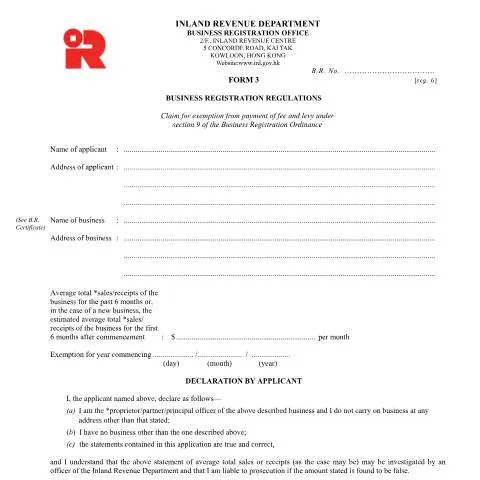
Form IRBR 61 serves a specific function within the larger framework of business registration in Hong Kong. It enables applicants to claim exemption from the payment of business registration fees and levies under Section 9 of the Business Registration Ordinance. This exemption is particularly pertinent for businesses whose average monthly turnover falls below a certain threshold, allowing them to redirect their limited resources toward growth rather than administrative costs.
The Eligibility Criteria
To successfully submit this form, applicants must satisfy certain criteria. These include:
- Business Type: The business can be an individual enterprise, a partnership, or a company that is not incorporated.
- Turnover Limits: The monthly average turnover must not exceed specific limits, usually defined in the supplementary notes accompanying the form.
- Operational Exclusivity: Businesses must not carry on multiple operations that could be viewed as a single enterprise, affecting their eligibility for exemption.
Delving into the Details: Completion of Form IRBR 61
Filling out the IRBR 61 form requires attention to detail. Each section serves a distinct purpose and must be accurately completed to avoid delays or rejections.
Section Breakdown
| Field | Description | Common Pitfalls |
|---|---|---|
| Name of Applicant | Enter your full name as per HKID. | Omitting middle names or using nicknames. |
| Address of Applicant | Provide your registered residential address. | Using an inaccurate or incomplete address which can lead to postal issues. |
| Name of Business | The official name under which you will operate. | Using a name not registered with the Business Registry. |
| Average Monthly Turnover | Estimated gross receipts for the past six months or projections for new businesses. | Failing to properly calculate actual turnover. |
| Declaration by Applicant | A confirmation of the truthfulness of the information provided. | Not understanding the legal consequences of false declarations. |
Submission Channels: Paper vs. Online vs. In-Person
Understanding submission channels is essential for ensuring your application is processed promptly. Each method offers distinct advantages and disadvantages.
Paper Submission
Submitting a hard copy via post involves mailing the completed form to the Business Registration Office. This method requires:
- Correct postage, ensuring documents reach their intended destination.
- Time for postal delivery, which can delay processing.
Online Submission
For those comfortable with technology, submitting through the online portal via GovHK provides a streamlined experience:
- Immediate confirmation of receipt.
- Access to e-services that provide updates on the status of your application.
In-Person Submission
Visiting the Inland Revenue Centre offers the benefit of personalized assistance. Applicants can:
- Ask questions to clarify any confusion regarding form details.
- Receive instant feedback on their application.
Timeline: Key Dates and Deadlines
A clear understanding of the timeline for submitting the IRBR 61 form is vital. Applications must be submitted in a timely manner to ensure compliance with local regulations.
Critical Dates for Submission
- For existing businesses: Applications should be submitted no later than one month before the expiry of the current business registration certificate.
- For new businesses: Submissions should occur within one month after business registration.
Missing these deadlines could lead to penalties or the need for re-registration, which can be both time-consuming and costly.
Comparative Analysis: Distinguishing Form IRBR 61 from Other Forms
Form IRBR 61 is often confused with other similar forms related to business registration fees. Understanding these differences can ensure you use the correct form for your needs.
Commonly Confused Forms
- Form IRBR 1: Used for general business registration. Unlike IRBR 61, it does not pertain to fee exemptions.
- Form IRBR 168: Also related to business registration, but focuses on updating business particulars rather than exemptions.
Choosing the correct form is crucial for the smooth operation of your business and adherence to local regulations.
After Submission: What to Expect Next
Once Form IRBR 61 is submitted, applicants may wonder about the subsequent steps and when they can expect feedback.
Processing Times and Notifications
Typically, processing times can vary based on the volume of applications. Applicants will usually receive:
- A Notification: Confirming the acceptance or rejection of their application.
- Further Instructions: If additional information is required, applicants may be contacted directly.
Conclusion: The Path Forward
Successfully navigating the complexities of Form IRBR 61 can set the stage for a smoother business operation in Hong Kong. By understanding its role, the completion requirements, and the various submission channels, applicants can position themselves for success as they embark on their entrepreneurial journey.
Ultimately, diligent preparation and adherence to legal obligations will ensure that businesses can thrive in Hong Kong's dynamic economic environment.
Understanding the Importance of IRBR Forms in the Hong Kong Tax System
The Hong Kong tax system operates on a self-assessment basis, emphasizing the accuracy and completeness of information declared by taxpayers. Forms IRBR 61 and IRBR 168 play a crucial role in this process, serving distinct yet interconnected purposes. Understanding these forms is essential for both individuals and corporations navigating tax obligations in Hong Kong.
Form IRBR 61 is primarily used by employers to report the salaries and wages paid to their employees, which is essential for the calculation of the salaries tax. Properly completing this form ensures compliance with the Inland Revenue Department (IRD) regulations and helps prevent penalties due to underreporting. Employers must familiarize themselves with the specific guidelines provided in the form, including the need to report not just base salaries, but also allowances, bonuses, and other forms of compensations.
On the other hand, Form IRBR 168 can be regarded as the "Employer's Return" for filing annual employer information. This form collects crucial data about an entity's employee remuneration, enabling the IRD to evaluate the salaries tax liability effectively. Understanding the nuances of these forms helps in ensuring that all required information is accurately reported, thus facilitating smoother interactions with the IRD.
Navigating Common Challenges with IRBR 61 and IRBR 168
While completing Forms IRBR 61 and IRBR 168 might seem straightforward, employers often encounter challenges that can complicate the filing process. One common issue is ensuring the accuracy of employee data. Employers must cross-verify the information for each employee, including HKID numbers, names, and remuneration details. Any discrepancies can lead to delays in processing or, in some cases, penalties.
Another challenge is related to the deadlines for submitting these forms. The IRD has specific due dates for filing, and failing to comply can incur financial penalties. For IRBR 61, employers must submit this form along with their annual profits tax return by the end of the tax year (31 March). In contrast, Form IRBR 168 is typically due by the end of April each year. Employers must actively manage their timelines to ensure on-time submission and avoid complications.
Additionally, the documentation required to support the information reported on these forms can often be extensive. Employers should maintain accurate records, including payroll details, employee contracts, and any supporting documents related to remuneration. This level of diligence not only assists in accurate reporting but also serves as a safeguard in the event of an audit by the IRD.
The Role of Digital Tools in Submitting IRBR Forms
With the ongoing digital transformation of governmental services in Hong Kong, the submission of IRBR 61 and IRBR 168 has been streamlined through e-services provided by the Inland Revenue Department. These digital platforms offer a more efficient way for employers to submit their forms, significantly reducing the paperwork associated with tax compliance.
Employers can take advantage of the eTax system, which allows for the electronic submission of these forms. This not only speeds up the process but also minimizes the potential for human error associated with manual entries. Furthermore, electronic submissions are generally acknowledged immediately, providing users with confirmation and peace of mind regarding their filings.
Moreover, the digital landscape offers various resources and support systems, including FAQs and user guides provided by the IRD. Utilizing these tools can significantly ease the burden of providing accurate information and foster compliance within the workforce. Employers are encouraged to stay updated on any changes to the digital submission process, including system maintenance schedules or updates to the forms themselves.