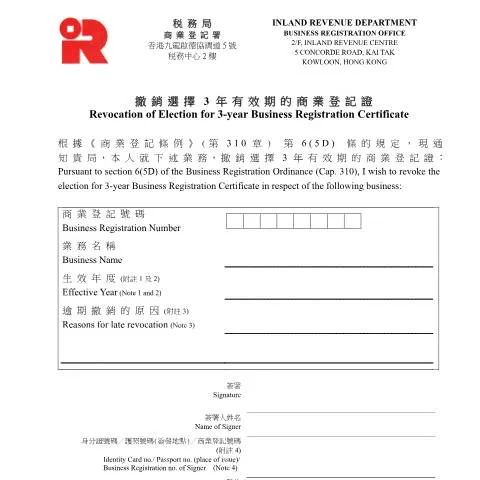
Contextualizing the Revocation of Election for 3-Year Business Registration Certificate
In the dynamic landscape of Hong Kong's business environment, every registered entity must maintain compliance with the Business Registration Ordinance (Cap. 310). When business owners opt for a 3-year Business Registration Certificate, they must be prepared for potential changes that may necessitate the revocation of this registration. This document, known as the Revocation of Election for 3-Year Business Registration Certificate, serves as a formal declaration to withdraw this election, providing clarity for both businesses and regulatory authorities.
Understanding Who Qualifies for Revocation and Under What Circumstances
Eligibility for revocation is generally predetermined by specific business circumstances. Businesses considering this action should evaluate the following scenarios:
- Change in Business Structure: If a business transitions from a partnership to a limited company, it may require a different registration approach.
- Business Cessation: Should a business cease operations due to financial constraints or market conditions, revocation becomes imperative.
- Change in Ownership: New partners or ownership structures can also prompt reconsideration of the business registration status.
It is crucial for businesses to consult with legal or administrative advisors to ensure they understand these conditions fully.
Practical Uses of the Revocation Document: Who Needs It?
The Revocation of Election for 3-Year Business Registration Certificate is not merely an administrative formality; it holds significant importance across various operational realms:
- Tax Compliance: The Inland Revenue Department (IRD) necessitates this revocation as part of the formal closure process for tax purposes.
- Legal Documentation: Other regulatory bodies, such as the Companies Registry, may require this certificate when a business undergoes transformation.
- Stakeholder Communication: Providing clarity to stakeholders, including employees and investors, about the status of business operations.
Each of these factors underscores the document's role in maintaining regulatory integrity and transparency within Hong Kong’s business framework.
Duration of Validity and Renewal Considerations
The revocation document remains valid under specific conditions, thus it is essential for business owners to be aware of related timelines:
| Action | Timeline | Remarks |
|---|---|---|
| Submit Revocation Notice | At least one month before expiry of current certificate | Failure to do so may result in automatic renewal of the 3-year certificate. |
| Effective Year Declaration | Specify effective year on the form | Must align with the business activities conducted. |
| Future Business Registration | As per new business structure | A new application must be submitted post-revocation. |
Understanding these timelines can significantly affect the operational capabilities of a business and its compliance status.
A Detailed Walkthrough of the Revocation Process
To ensure a seamless revocation process, follow these essential steps:
- Gather Required Information: Ensure you have the business registration number, the name of the business, and reasons for revocation.
- Complete the Revocation Form: Accurately fill in all required fields on the IRBR 199 form, including the signature of the authorized signatory.
- Submit the Form: Send the completed form to the Inland Revenue Department either by post or in person. Be mindful not to submit via fax or email.
Each of these steps is structured to ensure that all relevant details are clearly presented and processed without delay.
Legal Implications of the Revocation Document
While the Revocation of Election for 3-Year Business Registration Certificate may seem like a simple administrative step, it carries substantial legal weight:
- Liability Protection: Properly revoking your registration helps limit liability and protect stakeholders from potential legal repercussions.
- Tax Obligations: Completing this revocation is essential for freeing the business from ongoing tax obligations associated with the previous registration.
- Legal Records: The document serves as an official record of the business's operational changes, which can be crucial in legal contexts.
Understanding these implications is vital to navigate the legal landscape effectively and maintain compliance with the Basic Law of the Hong Kong Special Administrative Region.
Steps to Take in Case of Document Loss or Errors
Businesses must be prepared for potential complications, such as loss of the revocation document or errors in submission:
- Document Loss: Immediately notify the Inland Revenue Department to mitigate any risks associated with lost documentation.
- Correction of Errors: If mistakes are discovered after submission, promptly contact the appropriate department to rectify the issue.
- Formal Appeal: In cases of disputes or contestations regarding the revocation, a formal appeal may be necessary to clarify the situation.
Addressing these issues proactively can prevent further complications in business operations and regulatory compliance.
Conclusion: Maximizing the Value of the Revocation Process
The Revocation of Election for 3-Year Business Registration Certificate is not just a bureaucratic requirement—it is a strategic component of business management in Hong Kong. By understanding its implications, usage, and procedural requirements, businesses can navigate the revocation process effectively. Adhering to proper guidelines ensures compliance while safeguarding the interests of stakeholders, ultimately fostering a transparent and accountable business environment.
Understanding the Revocation Process for 3-Year Business Registration Certificate
The revocation of a 3-year Business Registration Certificate in Hong Kong can be a complicated process that involves multiple administrative steps and requirements. A revocation may occur for various reasons, including but not limited to non-compliance with the Business Registration Ordinance, failure to notify changes in business particulars, or not renewing the registration in a timely manner. It is crucial for business owners to understand the grounds for revocation and the implications it carries for their operations.
When a company registers for a Business Registration Certificate, it agrees to adhere to certain statutory obligations. A failure to comply with these obligations can lead to revocation. Authorities such as the Companies Registry (CR) and the Inland Revenue Department (IRD) can initiate revocation proceedings based on operational lapses. For instance, if a business fails to submit its annual returns or does not maintain accurate records, the CR may decide to revoke the registration.
The implications of revocation can be severe. Aside from ceasing normal operations, businesses may face legal penalties and difficulty in reopening or re-registering. Therefore, it is vital to manage your business records diligently and stay informed about any legal changes that may affect your registration status.
Circumstances Leading to Revocation and Associated Consequences
Several circumstances may lead to the revocation of a Business Registration Certificate, often revolving around compliance and information accuracy. One of the most common reasons is the failure to file a change of particulars, such as a change in business address or company structure. If the Companies Registry discovers that the registered information is outdated or incorrect, they may commence the revocation process.
Additionally, non-payment of business registration fees can lead to revocation. A business must ensure that all fees are paid within the stipulated timelines; otherwise, the CR may initiate revocation proceedings. In fact, failure to pay the annual registration fee, which is typically due every three years, can result in not only revocation but also further penalties.
From a financial perspective, a revoked Business Registration Certificate may hinder the business's ability to open bank accounts, sign contracts, or engage in any financial transactions. Any ongoing transactions or contracts could also become void, leading to financial losses and legal disputes. It’s essential for business owners to ensure their compliance with all registration requirements to avoid such severe consequences.
Steps to Take After Revocation of Business Registration Certificate
In the unfortunate event that your Business Registration Certificate is revoked, it’s crucial to take immediate action to address the situation. The first step is to contact the Companies Registry to inquire about the specific reasons for revocation and to gather information on the necessary steps for reinstatement. Understanding the grounds for revocation will guide you in addressing the underlying issues.
Once you have established the reasons for revocation, you should gather all required documentation to rectify any compliance issues. If the revocation was due to a failure to file annual returns or pay registration fees, ensure that these documents are prepared and submitted promptly. The CR allows for the reinstatement of businesses under certain circumstances, provided that all outstanding issues are resolved. However, it’s important to note that reinstatement may come with additional conditions or fees.
Additionally, after addressing the compliance issues, it may be wise to consult with legal or accounting professionals who specialize in Hong Kong business law. They can provide valuable advice on navigating the complexities of the reinstatement process and help ensure that your business remains compliant with all regulations moving forward. Establishing a proactive compliance strategy can prevent future situations that could lead to revocation.