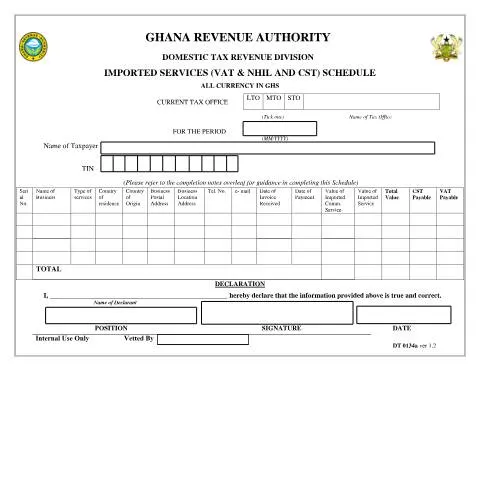
Understanding the Imported Service Schedule (DT-0134A)
The Imported Service Schedule, officially designated as DT-0134A, plays a crucial role in the tax ecosystem of Ghana, particularly concerning Value Added Tax (VAT) and National Health Insurance Levy (NHIL) for imported services. This document primarily facilitates the declaration of services acquired from non-resident suppliers and ensures compliance with tax obligations under the Ghana Revenue Authority (GRA).
With the rise of globalization and digital transactions, many businesses in Ghana increasingly rely on foreign service providers. This has led to the need for a structured way to account for such imports, ensuring that GRA collects the appropriate taxes and maintains the integrity of the national revenue.
In this landscape, understanding how to navigate the DT-0134A form is invaluable for businesses and individuals alike. This guide intends to provide thorough insights into its layers, nuances, and best practices in completing and submitting the schedule.
The Chronology of Steps: From Trigger to Submission
The process surrounding the Imported Service Schedule involves several key stages:
1. Identifying Tax Liability
The first step is understanding whether your business has a tax liability stemming from the acquisition of services from foreign suppliers. This typically arises when:
- A service is received from a non-resident supplier.
- The service is utilized within Ghana.
- The business is registered for VAT.
It’s essential to review past transactions as well, as the requirement to fill the schedule can be triggered retroactively based on service use.
2. Gathering Necessary Information
To accurately complete the DT-0134A form, gather pertinent information regarding the service transaction. This includes:
- Name of the business providing the service.
- Contact information of the supplier.
- Invoice dates and payment details.
- Service valuation based on the invoice.
Being thorough in this stage prevents complications and ensures that all necessary details are included during submission.
3. Completing the Schedule
Filling out the Imported Service Schedule requires attention to detail. Each section must be completed accurately. Key components include:
- Name of Taxpayer and TIN: Essential for identification.
- Business Name and Contact Details: Clearly state the supplier’s and your business’s information.
- Service Type: Specify whether the service is technical, management, etc.
- Values: Report the monetary values for the imported service and ensure that these are accurate according to invoices.
Utilizing the guidelines on the reverse side of the form is critical to avoid common pitfalls.
4. Declaration and Signature
A responsible officer within the business must sign the declaration section. This not only attests to the accuracy of the information provided but is also a legal affirmation under the GRA regulations.
5. Submission to the Tax Office
Once the form is completed and signed, it should be submitted to the appropriate Tax Office. Depending on the scale of the business, this could be a Large Tax Office (LTO), Medium Tax Office (MTO), or Small Tax Office (STO).
Ensure that you keep copies of the submitted schedules and any corresponding documents for your records.
Dissecting Each Section: Navigating Common Areas of Confusion
Understanding the nuances of each section of the DT-0134A can facilitate a smoother completion process. Let’s break down critical fields and highlight potential pitfalls:
Name of Business
This field requires the official name of the service provider. Common mistakes include:
- Omitting the full legal name.
- Incorrect spelling, which can lead to disqualification of the entry.
Type of Services
Here, you must select from options such as "Technical," "Management," etc. Misclassification can lead to issues in tax calculation and compliance. Always refer to GRA's guidelines for exact definitions of service types.
Country of Residence and Origin
These fields specify where the service provider operates and where the service originates. Confusion may arise when a service is provided in one country but originates from another. Ensure clarity to avoid inconsistencies.
Value of Imported Services
The value inputs must accurately reflect the transaction's worth, as indicated on the invoice. Calculating the total incorrectly may lead to auditing issues. Always double-check calculations against the original invoice.
Total Declaration Section
This final section must reflect total values for CST and VAT. It's vital to calculate these accurately, as misreporting can lead to penalties. Take care to use the correct tax rates applicable at the time of the transaction.
Regulatory Context: The Framework Behind the DT-0134A
The DT-0134A is governed by the wider tax framework established under various laws and regulations in Ghana. The basis for its implementation stems from provisions outlined in the 1992 Constitution of Ghana and subsequent parliamentary enactments.
Among these, the Value Added Tax Act and the National Health Insurance Levy Act are particularly relevant, as they dictate how taxation on imported services is structured. The GRA has set forth these requirements to enhance tax compliance and streamline the collection process for services obtained from non-resident entities.
Additionally, the delegation of responsibilities surrounding this schedule aligns with the decentralized governance model initiated by Act 936, which aims to make tax administration more efficient and accessible.
Distinct Features: What Sets DT-0134A Apart
In the realm of tax documentation, the Imported Service Schedule has specific features that distinguish it from other forms, such as:
- Focus on Non-Resident Services: While other tax forms might cater to domestic transactions, DT-0134A is tailored for services imported from non-Ghanaian suppliers.
- Integration with VAT and NHIL: This form specifically addresses the VAT and NHIL on services, linking to broader tax obligations under different regulations.
- Specificity in Service Types: Unlike general tax forms that may lack detail, DT-0134A requires precise delineation of the service type, essential for accurate tax assessment.
These features streamline the tax process and enhance compliance, providing clarity to taxpayers regarding their obligations.
Profiling the Users: Who Must Engage With This Document?
The DT-0134A is primarily relevant for businesses and individuals engaged in transactions involving imported services. Various profiles may find themselves needing to complete this form:
1. Registered VAT Entities
Entities registered as VAT payers must use the Imported Service Schedule to declare services received from non-residents. This requirement ensures that they adhere to their tax obligations appropriately. Furthermore, they are expected to monitor their declarations meticulously to avoid discrepancies.
2. Small and Medium Enterprises (SMEs)
SMEs representing a crucial component of the Ghanaian economy also fall under this requirement. As they often engage international service providers, understanding the complexities of the DT-0134A becomes essential for compliance.
3. Individuals and Professionals
Freelancers and independent contractors utilizing imported services must also be acquainted with the implications of the DT-0134A. This understanding empowers them to remain compliant and manage their tax liabilities effectively.
4. Multi-National Corporations
For larger entities operating across borders, navigating the DT-0134A is crucial. Their international dealings often involve multiple jurisdictions and may trigger complex tax situations that necessitate precise record-keeping and reporting.
5. Legal and Financial Professionals
Tax advisors and legal professionals specializing in Ghana’s tax law should also familiarize themselves with the specifics of the DT-0134A. Their expertise is critical in guiding businesses through compliance and understanding the implications of the forms they submit.
What Happens Next? Following Submission of the Schedule
Once the Imported Service Schedule is submitted, several actions unfold:
1. Review by Tax Officials
Upon submission, GRA officials will review the information provided in your schedule. They will ensure that all required fields are completed and calculations are accurate.
2. Verification Process
If any discrepancies are detected or if further information is needed, officials may reach out to the taxpayer for clarification. This can involve additional documentation or verification of the services rendered.
3. Tax Assessment
Based on the completed schedule, the GRA will assess the tax due. This includes calculating the VAT and NHIL owed based on the declared values.
4. Issuance of Tax Obligations
Finally, the GRA will issue a notification indicating the total tax obligations, including payment deadlines. It's imperative for taxpayers to adhere to these deadlines to avoid penalties.
5. Record Keeping for the Future
Taxpayers should maintain copies of their submitted schedules and any related correspondence. This documentation can be crucial for future audits or clarifications.
Engaging with the Authority: Support and Resources
While navigating the complexities of tax documentation can be challenging, the GRA offers various resources for assistance. Taxpayers are encouraged to utilize the following:
- Contact local Tax Offices for guidance.
- Refer to the GRA's official website for updates and resources related to tax legislation.
- Engage with tax professionals for personalized advice on compliance and obligations.
Staying informed about regulatory changes and best practices can significantly ease the burden of compliance and ensure that all tax obligations are met effectively.
This exploration of the Imported Service Schedule (DT-0134A) should equip individuals and businesses with the necessary knowledge to navigate this important aspect of tax compliance in Ghana. Understanding forms, processes, and regulations is key to effective financial management and adherence to national laws.
Understanding the Imported Service Schedule: Key Components
The Imported Service Schedule in Ghana serves as a crucial framework for evaluating and taxing services rendered by foreign entities within the local context. This system employs a structure that allows the Ghana Revenue Authority (GRA) to systematically assess the tax liabilities associated with imported services. It’s essential for businesses and individuals engaging in cross-border transactions to comprehend the key components of this schedule.
Firstly, services are categorized based on the nature of the service provided, the sector involved, and the complexity of the transaction. The GRA employs specific criteria to classify these services, which include professional services, consultancy, management services, and technical services among others. Understanding these classifications can greatly impact how businesses calculate their tax obligations.
The Imported Service Schedule also stipulates the need for businesses to maintain proper documentation regarding cross-border transactions. This includes contracts, invoices, and proof of payment. Such documentation is vital for compliance purposes and can serve as evidence in case of audits conducted by the GRA. Additionally, companies are required to furnish the GRA with a detailed breakdown of the service consumed, which further assists in the accurate assessment of taxes.
Furthermore, it is important to note that the Imported Service Schedule is periodically reviewed and updated to reflect changes in the global market and domestic economic conditions. As such, businesses must stay abreast of these changes to ensure compliance and avoid potential penalties. Familiarity with the schedule's updates can also provide opportunities for tax optimization.
Compliance Challenges and Solutions for Imported Services
Entities engaging in imported services often face various compliance challenges, which can impede their operational efficiency and financial health. One significant challenge is the complexity of the tax obligations arising from these transactions. The nuances in taxation laws, coupled with the foreign nature of the services, can lead to misunderstandings and miscalculations, resulting in inadvertent non-compliance.
To address these challenges, businesses are encouraged to invest in training for their financial and administrative personnel on the specifics of the Imported Service Schedule. Such training should include an overview of the legal framework, best practices for documentation, and strategies for efficient tax filing. Regular training not only empowers staff but also enhances the overall compliance culture within the organization.
Another solution involves leveraging technology. The use of accounting software that integrates tax compliance features can help businesses navigate the complexities of the Imported Service Schedule. These software solutions can automate calculations, generate necessary reports, and even alert businesses of upcoming filing deadlines, thereby minimizing the risk of non-compliance.
Moreover, seeking professional advice from tax consultants or legal experts who specialize in Ghana’s taxation framework can provide additional support. Such professionals can offer tailored advice based on the unique circumstances of a business, helping to navigate the intricacies of the Imported Service Schedule, ensuring that businesses meet their obligations while optimizing their tax positions.
The Role of the Ghana Card in Imported Services Transactions
The introduction of the Ghana Card has revolutionized various aspects of administration and identification in the country, notably in the realm of tax compliance and transactions involving imported services. As the primary identification document, the Ghana Card serves a pivotal role in ensuring that parties involved in imported services comply with tax requirements.
One of the key benefits of utilizing the Ghana Card in imported services transactions is the integration of the Tax Identification Number (TIN) with the Ghana Card. This integration simplifies the process for businesses and individuals by linking their tax profiles directly to their identification, thus streamlining compliance procedures. When filing taxes related to imported services, having a TIN linked to the Ghana Card expedites verification processes with the GRA, leading to improved efficiency.
Additionally, the Ghana Card enhances transparency in transactions. With its biometric features and secure data storage, the card assists in verifying the identities of parties involved in international service agreements. This verification is critical in ensuring that businesses engage with legitimate service providers and comply with local regulations, thereby reducing the risk of fraud and tax evasion.
Furthermore, as Ghana progressively moves towards a digital governance framework, the Ghana Card is expected to play a more significant role in online transactions concerning imported services. This includes the electronic submission of tax filings and documentation requirements associated with the Imported Service Schedule. As digital infrastructure improves, the Ghana Card will facilitate smoother interactions with the GRA and allow businesses to manage their tax obligations more effectively through online platforms.