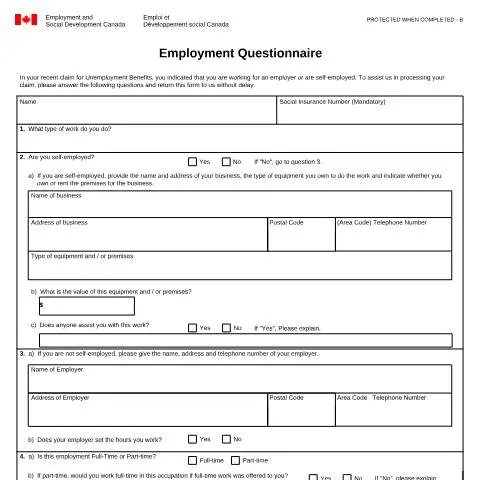
Understanding the Employment Questionnaire: A Key Step in Your Unemployment Benefit Journey
Imagine navigating the complexities of unemployment while trying to secure the financial support you need. The Employment Questionnaire (INS3977), administered by Employment and Social Development Canada (ESDC), is not just another piece of paper; it is a pivotal tool for many individuals seeking assistance in their time of need. This document collects vital information to help determine your eligibility for Employment Insurance (EI) benefits.
The Regulatory Environment: Why This Form Exists
The framework for the Employment Questionnaire is rooted in the Employment Insurance Act and related regulations, which were designed to ensure that Canadians have access to financial support during periods of unemployment. This Act outlines the requirements for eligibility, the types of benefits available, and the responsibilities of both the applicant and the ESDC. The Employment Questionnaire serves as a practical extension of this legislative framework, helping to capture the specific circumstances of each claimant.
A Brief History
The Employment Insurance program has evolved significantly since its inception in 1940. Originally created to address the economic challenges of the Great Depression, the program now encompasses a diverse range of support mechanisms for workers. The Employment Questionnaire plays a crucial role in this evolution, adapting to changing labor market conditions and the needs of Canadians.
The Chain of Processes: Where the Employment Questionnaire Fits In
The journey to securing EI benefits often begins with an application, but that’s just the start. Once you apply, the Employment Questionnaire becomes a key component of a series of steps that ensure your application is processed accurately. Here’s how it fits into the larger picture:
- Initial Application: You start by submitting a claim online or in person.
- Review Process: Employment and Social Development Canada reviews your claim, and if additional information is needed, the Employment Questionnaire is issued.
- Data Collection: You fill out the Employment Questionnaire to provide further details about your employment situation.
- Assessment: The information from the questionnaire is analyzed alongside your initial claim to determine your eligibility.
- Benefit Disbursement: If approved, you begin receiving benefits as outlined by your eligibility.
Key Components of the Employment Questionnaire: What to Prepare
Completing the Employment Questionnaire may seem straightforward, but it requires specific information that directly affects your eligibility. Understanding what to prepare is essential.
Critical Sections of the Form
- Type of Work: Describe your job duties and responsibilities clearly. This helps the ESDC assess your claim in relation to your previous employment.
- Self-Employment Details: For self-employed individuals, detailed information about your business, including business name, address, and type of equipment used is necessary to evaluate your situation.
- Employment Status: Indicate whether your work is full-time or part-time, and provide insight into your income sources. This section clarifies how your current employment may impact your benefit eligibility.
- Additional Assistance: If you receive non-monetary compensation, like room and board, this must be disclosed.
- Job Search Activities: If you are actively seeking employment, detail your efforts, as this can influence your benefits.
Consequences of Incomplete or Incorrect Submissions
Submitting the Employment Questionnaire is not merely a formality; it has real implications. Failure to provide accurate information or to submit the form on time can lead to serious consequences:
- Delay in Benefits: Your claim may be delayed, leaving you without necessary financial support.
- Ineligibility: Incorrect or missing information can result in a denial of benefits.
- Legal Repercussions: In cases of suspected fraud, the ESDC may take legal action, including penalties or repayment of benefits.
Distinguishing the Employment Questionnaire from Other Forms
The Employment Questionnaire is unique within the landscape of government forms related to Employment Insurance. It is often confused with other documents; however, understanding its specific purpose is crucial.
| Form | Purpose | Usage Context |
|---|---|---|
| Employment Questionnaire (INS3977) | Gathers detailed information about employment status | Post-application for EI benefits |
| Record of Employment (ROE) | Documents an employee's work history | Employer submission for EI claims |
| Application for Employment Insurance Benefits | Initial claim for EI benefits | Before filling out the Employment Questionnaire |
Identifying Who Needs to Complete the Employment Questionnaire
The Employment Questionnaire is designed for a specific demographic, including:
- Claimants with Employment Status Changes: If your job situation has changed since your initial application, you must provide this updated information.
- Self-Employed Individuals: Those who report self-employment must provide detailed insights about their business activities.
- Part-Time Workers: If you are working part-time while claiming EI, this form becomes critical to establish your earnings and job search efforts.
Sub-Cases and Exceptions to Consider
While the Employment Questionnaire serves a broad audience, certain scenarios may require additional considerations:
- Seasonal Workers: If your employment is seasonal, you may need to provide insights into your seasonal work habits and any interim employment.
- Workers in Transition: Those moving from full-time to part-time work may also have unique reporting requirements.
- Individuals with Multiple Jobs: If you hold more than one job, detailing income and hours from each role is necessary.
How to Submit the Employment Questionnaire: A Guide to Your Options
Once you’ve completed the Employment Questionnaire, understanding the submission process is crucial. There are various methods available, each with its own nuances.
Submission Channels
- Online Submission: The easiest and fastest method, allowing you to submit your form directly through the designated ESDC portal.
- Paper Submission: If you prefer traditional methods, you can print the form and mail it to the appropriate ESDC address.
- In-Person Submission: You may also drop off the completed form at your local Service Canada office, where staff can assist you with any questions.
Important Considerations for Each Method
When choosing your submission method, keep the following in mind:
- Processing Time: Online submissions are typically processed faster than paper submissions.
- Confirmation of Receipt: Online submissions often provide immediate confirmation, while paper submissions may require follow-up to ensure they were received.
- Accessibility: For those with disabilities or lacking internet access, in-person submission is a viable alternative.
A Final Note on the Importance of Accuracy and Timeliness
The Employment Questionnaire, while it may seem like just another bureaucratic step, holds the key to unlocking essential financial support during challenging times. The information you provide shapes the entire EI process, affecting not just your eligibility but the length and amount of benefits you may receive.
Taking the time to complete the questionnaire accurately and in a timely manner can significantly impact your financial stability. As you navigate through this process, remember that being well-informed is your best asset in ensuring a smooth transition through unemployment.
Understanding the Importance of the Employment Questionnaire
The Employment Questionnaire (EQ) is a critical component of various Canadian government programs designed to assess eligibility for Employment Insurance (EI) benefits and other social programs. Understanding the importance of this questionnaire can greatly enhance your chances of successfully navigating the system.
Primarily, the EQ seeks to clarify your employment history, earnings, and the reasons behind job separations. This process is vital because it allows Employment and Social Development Canada (ESDC) to determine your right to benefits accurately. For instance, if you're applying for EI after a layoff, the questionnaire will inquire about your last employer, the duration of your employment, and any severance package you might have received.
Moreover, the EQ can also highlight any self-employment history, which is particularly relevant for those who transitioned from traditional employment to freelance or contract work. In such cases, you might need to provide additional documentation, such as business registration details or proof of earnings. Failure to provide comprehensive information can delay your application or lead to an incorrect assessment of your eligibility.
It's also essential to note that the EQ is not a one-size-fits-all document. Different circumstances may lead to different questions being asked. For instance, if you were fired from a position, the questionnaire will probe into the reason for your dismissal, and whether it was with just cause or not. Understanding these nuances can prepare you to answer questions effectively and improve your chances of receiving the maximum benefits you are entitled to.
Navigating Common Challenges with the Employment Questionnaire
Completing the Employment Questionnaire may not be straightforward for everyone. Many applicants encounter common challenges that can complicate the process. Here are some of these issues and tips on how to navigate them effectively.
1. Missing Information: One of the most frequent issues is the unintentional omission of critical information. If you have worked for multiple employers in a short period, it can be easy to forget specific dates or job titles. To avoid this, keep a detailed record of your employment history, including positions held, responsibilities, and the contact information of your previous employers. This documentation can help you fill out the EQ accurately.
2. Understanding Employment Types: Many applicants struggle with what constitutes "employment" in the context of the EQ. For instance, casual work or gig economy jobs may not seem like traditional employment but must still be reported. If you’ve earned income through various non-standard arrangements, it’s crucial to include those details. If you're unsure whether your work qualifies, consult the guidelines provided by ESDC or speak with a Service Canada representative.
3. Proof of Earnings: Sometimes, applicants are not prepared to provide proof of earnings that may be necessary to validate the information submitted in the questionnaire. This is particularly true for freelance work, where income can vary greatly. Keep meticulous records of invoices, payment receipts, or tax documents (like T4As for self-employed individuals), which can support your claims and ensure you have the necessary documentation at hand.
4. Language Barriers: The EQ is available in both English and French, reflecting Canada's bilingual nature. However, if you feel more comfortable in one language over the other, make sure to complete the form in the language where you can express yourself most clearly. Additionally, if you require assistance understanding specific terms or questions, consider consulting with a local community resource center or even hiring a language service provider if needed.
By anticipating these challenges and preparing accordingly, you can streamline your experience with the Employment Questionnaire and avoid unnecessary delays in receiving your benefits.
After Submission: What to Expect During the Review Process
Once you've completed and submitted your Employment Questionnaire, the review process begins. Understanding what happens next can alleviate some anxiety and prepare you for the potential outcomes.
1. Timeline for Review: The time it takes to review your EQ can vary significantly based on several factors, including the complexity of your employment history and the volume of applications being processed at that time. While there is no specific timeline provided by ESDC, applicants typically should expect at least a couple of weeks for a preliminary review. If your case is straightforward, you might receive a response quicker, but more intricate situations will require a deeper dive by the reviewing officer.
2. Notification of Decision: After the review, you will receive a notification regarding the outcome of your application. This notification can come in the form of a letter or an online update through your Service Canada account. Pay close attention to this communication, as it will outline whether your claim has been approved or denied and provide the reasoning behind the decision. This information is crucial if you need to appeal or clarify specific points.
3. Appeal Process: In cases where your application is denied, you have the right to appeal the decision. The appeal process can vary based on the specifics of your case, but typically involves filling out a reconsideration request form (which is also available through Service Canada) within a designated time frame. Ensure you understand the reasons behind the denial, as your appeal will need to address these specific points effectively.
4. Potential for Follow-Up Questions: During the review, the ESDC may require additional information or clarification. This could result in a request for further documentation or even a telephone interview. Be responsive to these requests to streamline your application process.
By keeping these expectations in mind, you can approach the review phase with confidence and react proactively to any developments.