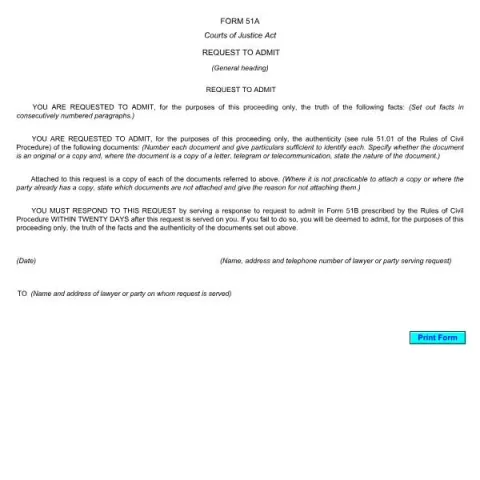
Understanding the Request to Admit (Form 51A) under the Courts of Justice Act
The Request to Admit, designated as Form 51A, is a formal document used within the Canadian legal system under the Courts of Justice Act. This form serves as a procedural tool that streamlines the litigation process by clarifying facts and documents that parties agree upon, thereby reducing the scope of disputes and expediting the case management.
Purpose and Typical Use Cases
The primary objective of the Request to Admit is to obtain a party’s formal acknowledgment of certain facts or the authenticity of specific documents for the purposes of a particular proceeding. This process can be instrumental in:
- Avoiding unnecessary disputes over uncontested facts or documents during trial.
- Facilitating the collection of evidence by narrowing the issues in dispute.
- Saving time and legal costs by simplifying the evidentiary process.
This form is particularly useful in civil litigation where parties seek to clarify which facts are agreed upon, thus allowing the court to focus on the contested issues.
Conditions and Eligibility
Any party involved in a proceeding under the Courts of Justice Act may serve a Request to Admit on another party. The request is limited to facts and documents relevant to the case at hand. It is essential that the facts and documents specified are clearly identified and directly related to the issues in dispute.
It is important to note that the request is made solely for the purposes of the current proceeding. The admitted facts or documents cannot be used as evidence in other proceedings unless explicitly agreed upon or ordered by the court.
Step-by-Step Procedure for Filling Out Form 51A
1. Identifying the Parties
Begin by filling in the date of the request, and clearly indicate the name and address of the party or lawyer on whom the request is served, as well as the name, address, and telephone number of the party or lawyer serving the request.
2. Listing Facts to be Admitted
Set out each fact that you wish the other party to admit in consecutively numbered paragraphs. Be precise and clear, avoiding ambiguity to ensure the recipient understands exactly what is being requested.
3. Listing Documents for Authentication
Number each document you seek to have admitted and provide sufficient details to identify each one. Specify whether each document is an original or a copy. If the document is a copy of a letter, telegram, or telecommunication, specify the nature of the document.
4. Attachments and Explanations
Attach a copy of each document listed, unless it is impractical or the party already possesses a copy. If a document is not attached, state the reason for its absence.
5. Submission and Response Timeline
Once served, the recipient has twenty days to respond by serving a Form 51B (Response to Request to Admit). Failure to respond within this period results in the party being deemed to have admitted the facts and the authenticity of the documents for the purposes of the proceeding.
Fill in your form directly online
No printing: type your details into the boxes of the official form, tick, then download the PDF ready to send.
- 1Type into the form boxes
- 2Tick in one click
- 3Save and download the PDF
After the Request is Served
Following service, the recipient must file their response within the prescribed timeframe. This response can either admit the facts or documents, deny them, or object to the request. If the recipient chooses to deny or object, they should specify their reasons clearly in their response.
Failure to respond or to properly object may lead to the court deeming the facts and documents as admitted, which can significantly influence the case’s outcome.
Legal Considerations and Best Practices
When preparing a Request to Admit, ensure that all facts and documents are relevant and clearly described. Vague or overly broad requests may be challenged or deemed invalid. Properly identifying documents and facts helps facilitate a smoother process and reduces the risk of disputes over admissibility or clarity.
Consultation with legal counsel is advisable to ensure compliance with procedural rules and to craft requests that are effective and appropriate for the specific case context.