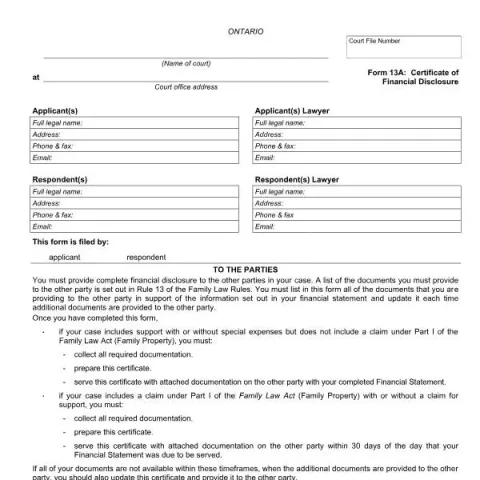
Understanding the Ontario Court Form 13A: Certificate of Financial Disclosure
If you are involved in a family law case in Ontario, you may be required to complete and submit a Form 13A, known as the Certificate of Financial Disclosure. This official document plays a crucial role in ensuring transparency regarding your financial situation and is essential for fair resolution of issues related to support, property, and other family law matters.
Purpose and Importance of the Form
The primary purpose of the Form 13A is to disclose all relevant financial information to the other party involved in the case. Ontario Courts require complete transparency to facilitate fair negotiations, settlement discussions, or court hearings. The form lists all documents supporting your financial statement, including income sources, expenses, and assets. Failing to provide accurate and complete disclosure can lead to court orders against you, including penalties or adverse inferences.
Who Needs to Complete the Form?
This form is mandatory for both applicants (the party initiating the case) and respondents (the opposing party). It must be filed and served in cases involving:
- Support claims, with or without special expenses
- Claims under Part I of the Family Law Act (Family Property)
The timing of submission depends on your role:
- If you are the applicant or moving party, you must file the completed Form 13A at least seven days before your case conference.
- If you are the respondent, you must serve the form four days prior to the case conference.
How to Fill Out the Form Step-by-Step
1. Basic Information
Begin by entering the court file number, the name of the court, and the court office address. You will also need to provide your full legal name, address, phone and fax numbers, and email address. If you have legal representation, include your lawyer’s details as well.
2. Listing the Parties
Identify all parties involved: applicants and respondents, along with their respective lawyers if applicable. For each, specify full legal names, addresses, and contact details.
3. Document Listing
List all financial documents you are providing to the other party. This includes:
- Tax returns and Notices of Assessment
- Pay stubs or income statements
- Bank statements, investment records, or trust documents
- Documents related to pensions, social assistance, or employment insurance
- Any other relevant financial records
For each document, record the description, date of the document, and the date it was provided to the other party.
4. Sources of Income
Specify your income sources, such as employment income, self-employment, partnership interests, dividends from corporation shares, trust income, social benefits, pensions, and other income. Be thorough to ensure complete disclosure.
5. Expenses and Special Costs
Detail any special or extraordinary expenses you incur, which could include childcare, medical costs, or educational expenses. This information assists the court in making support and property decisions.
Fill in your form directly online
No printing: type your details into the boxes of the official form, tick, then download the PDF ready to send.
- 1Type into the form boxes
- 2Tick in one click
- 3Save and download the PDF
Important Deadlines and Updates
Timely submission of the Form 13A is critical. If additional documents become available after the initial filing, you must update the form and serve the revised version on the other party. The court requires the most current disclosure to proceed fairly with your case.
After Filing the Form
Once completed, the form must be served on the other party along with supporting documentation. Remember, the documentation itself is not filed with the court but must be maintained for your records. Ensure you file the most recent version of the certificate with the court as required, particularly before case conferences or settlement meetings.
Consequences of Non-Compliance
Failure to provide complete financial disclosure can result in court orders against you, including adverse inferences or sanctions. Accurate and timely completion of the Form 13A helps ensure your case proceeds smoothly and fairly.