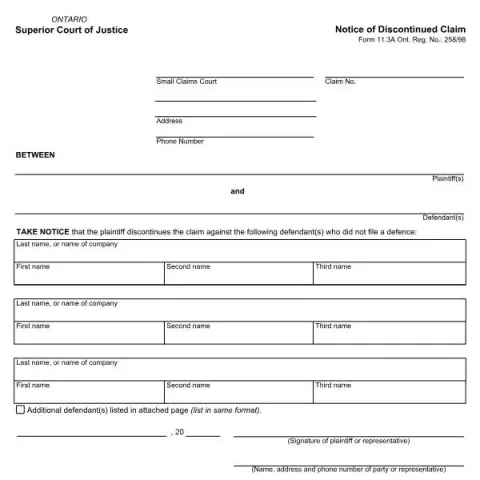
Understanding the Notice of Discontinued Claim (Form 11.3A) in Ontario’s Superior Court of Justice
If you are involved in a legal case within Ontario’s Superior Court of Justice, particularly in a Small Claims Court matter, you may encounter the Notice of Discontinued Claim form, known officially as Form 11.3A. This document is an essential part of the legal process when a plaintiff chooses to withdraw or discontinue their claim against one or more defendants. This article provides a comprehensive overview of what this form is, who should complete it, how to properly fill it out, and the procedural steps involved.
What is the Purpose of the Notice of Discontinued Claim?
The Notice of Discontinued Claim serves as a formal declaration by the plaintiff that they are withdrawing their claim against certain defendants. This is an official step that indicates the plaintiff no longer seeks legal remedy from those parties in the case. Discontinuing a claim can occur for various reasons, such as settlement outside court, strategic legal considerations, or a decision that pursuing the claim is no longer necessary.
Once filed and served on the relevant defendants, this notice effectively terminates the plaintiff’s legal pursuit against those parties, unless the court orders otherwise. It is an important document because it informs all involved parties of the change in the case status and ensures that the court record accurately reflects the current state of proceedings.
Who Should Fill Out the Form?
The plaintiff or their legal representative must complete the Form 11.3A. It is crucial that the person filling out the form has accurate details about the case, including the claim number, the names of all defendants, and their own contact information. If there are multiple defendants, each one who is being discontinued must be listed clearly on the form, including additional defendants on an attached page if necessary.
How to Properly Complete the Form
Step-by-step Filling Instructions
- Case Information: Enter the court address, claim number, and the names of the plaintiff(s) and defendant(s) as they appear in the original claim.
- Discontinuation Details: Clearly list the last name or company name of each defendant against whom the claim is being discontinued. Include their first, second, and third names if applicable.
- Additional Defendants: If there are more defendants, attach an additional page in the same format, listing their names accordingly.
- Signature: The form must be signed by the plaintiff or their authorized representative. The signature affirms that the discontinuation is made voluntarily and with knowledge of the legal implications.
- Contact Details: Provide the name, address, and phone number of the plaintiff or their representative for court records and correspondence.
Important Notes on Completing the Form
Ensure all details are accurate and legible. Incomplete or incorrect information can delay the processing of the discontinuation or lead to disputes about whether the claim was properly withdrawn. Remember that this form must be signed; unsigned forms are not valid.
Procedural Steps After Filling Out the Form
Once completed, the Form 11.3A must be:
- Served on all defendants: The notice must be served on every defendant named in the claim who has not yet been served or who was served with the original claim.
- Filed with the court: The original signed form, along with proof of service, must be filed with the court clerk handling your case.
It is important to note that a claim cannot be discontinued against or by a person under disability without prior court approval. This means that if a defendant is legally incapacitated, the plaintiff must seek the court’s permission before proceeding with the discontinuation.
Fill in your form directly online
No printing: type your details into the boxes of the official form, tick, then download the PDF ready to send.
- 1Type into the form boxes
- 2Tick in one click
- 3Save and download the PDF
Common Errors to Avoid
- Failing to list all defendants being discontinued, which can lead to incomplete legal records.
- Not signing the form, rendering it invalid.
- Incorrectly serving the notice, which can cause delays or legal challenges.
- Omitting proof of service when filing the form with the court.
Additional Resources and Accessibility
The Ontario Superior Court of Justice provides bilingual versions of its forms, including Form 11.3A, on their official website. For guidance on form formats and accessibility options, visit the Ontario Court Forms website at www.ontariocourtforms.on.ca.
Understanding and correctly completing the Notice of Discontinued Claim is vital for effectively managing your case and ensuring legal procedures are properly followed. If in doubt, consulting with a legal professional is recommended to avoid procedural errors and ensure your rights are protected.