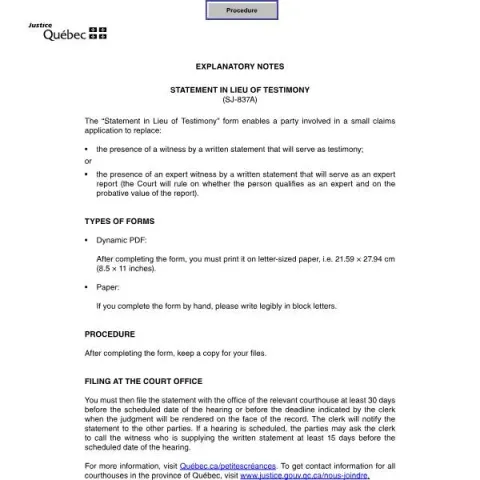
Understanding the "Statement in Lieu of Testimony" (Form SJ-837A) in Quebec Small Claims Court
If you are involved in a small claims case in Quebec, you might encounter the need to submit a "Statement in Lieu of Testimony" using the official form SJ-837A. This document allows parties to present written evidence instead of appearing in person to testify, streamlining the process and reducing the need for court appearances. Below, you'll find essential information on when and how to use this form, what it requires, and key points to consider to ensure proper submission.
When to Use the "Statement in Lieu of Testimony"
This form is designed for situations where a party involved in a small claims application cannot or prefers not to attend court in person to give testimony. Instead, they can submit a written statement that will serve as their testimony or expert report. This is particularly useful when:
- The witness or expert is unavailable to testify in person due to distance, health, or scheduling conflicts.
- The party wishes to provide a detailed account or professional opinion without the need for court appearance.
The court will review the submitted statement and determine its admissibility and probative value, especially if it concerns expert opinions or technical facts.
Key Components and Information Required on the Form
The SJ-837A form is structured to gather specific details about the declarant and the content of their statement. Here are the main sections:
- Identification of the Parties: The form requires the names of the plaintiff, defendant, or other involved parties, along with their respective addresses.
- Declarant’s Details: Your full name, domicile, and residence address must be provided.
- Type of Statement: You must specify whether the statement is factual testimony or an expert report. If it is an expert report, briefly describe the subject matter, such as damage assessment or technical analysis.
- Statement Content: Clearly outline the facts or expert opinions, ensuring you have personal knowledge of the facts presented.
- Signature and Date: The declarant must sign and date the form to validate the statement.
Additional sheets can be attached if necessary, especially for detailed explanations or extensive evidence.
How to Complete and Submit the Form
Completing the Form
The form can be completed electronically as a dynamic PDF or handwritten in block letters if printed. When filling it out:
- Ensure all information is accurate and legible.
- Write clearly in block letters if completing by hand.
- Attach any additional pages if your statement exceeds the space provided.
Filing the Form
Once completed, you should:
- Keep a copy for your records.
- File the original at the courthouse office relevant to your case at least 30 days before the scheduled hearing or the judgment date.
- The court clerk will notify the other parties of your submission.
If a hearing is scheduled, parties can request the clerk to call the witness or expert who provided the written statement at least 15 days before the hearing date.
Fill in your form directly online
No printing: type your details into the boxes of the official form, tick, then download the PDF ready to send.
- 1Type into the form boxes
- 2Tick in one click
- 3Save and download the PDF
Points of Attention and Practical Tips
- Timely Filing: Ensure the statement is filed at least 30 days prior to the hearing to avoid delays.
- Clarity and Accuracy: Be precise and truthful in your statement, as it will be considered evidence in your case.
- Legal Validity: Remember, the court will evaluate whether your statement qualifies as factual testimony or an expert report, especially if you claim expert status.
- Language and Legibility: Use clear language and legible handwriting if completing manually to prevent misunderstandings.
Additional Resources
For more detailed information about small claims procedures and to access the form SJ-837A, visit the official website of the Quebec justice system at quebec.ca/petitescréances. Contact details for local courthouses are available at www.justice.gouv.qc.ca/nous-joindre.
Using the "Statement in Lieu of Testimony" can significantly simplify your participation in a small claims case, especially when attending court in person is challenging. Proper preparation and adherence to filing deadlines are essential to ensure your evidence is considered effectively.