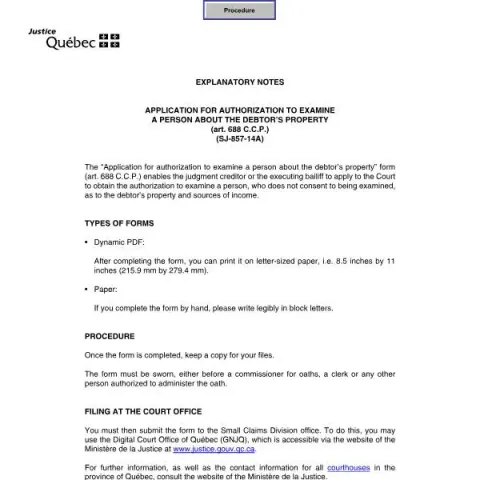
Understanding the Application for Authorization to Examine a Person About the Debtor’s Property (art. 688 C.C.P.)
The Application for Authorization to Examine a Person About the Debtor’s Property form, identified by the code SJ-857-14A, is an official document issued by the Canada Court of Québec, Ministère de la Justice. This form plays a crucial role in legal proceedings related to debt recovery, particularly when a judgment creditor or an executing bailiff needs to gather information about a debtor’s assets and income sources. It is designed for situations where the person to be examined does not consent to the process voluntarily.
When and Why to Use This Form
This form is typically used in civil cases where a creditor has obtained a judgment against a debtor and needs to enforce it. If the debtor refuses to cooperate or is uncooperative, the creditor or the bailiff can request court authorization to examine a third party—such as a witness or a third person who may have knowledge of the debtor’s property or income. The court’s authorization allows the examiner to question the individual under oath, facilitating the collection of vital information necessary for debt recovery.
It is important to note that this procedure is governed by article 688 of the Civil Code of Québec (C.C.Q.). The process ensures that the examination is conducted legally and that the information obtained can be used in subsequent enforcement actions.
Key Elements of the Application Form
Parties Involved
- Judgment creditor: The individual or entity seeking to recover the debt.
- Executing bailiff: The officer responsible for executing court orders and conducting examinations.
- Person to be examined: The individual who is believed to have information about the debtor’s property or income.
Information Required
The form requests detailed information about the parties, including:
- Name and address of the person to be examined
- Relationship to the debtor or reason for the examination
- Details about the debtor’s property and income sources that the examiner believes the person can disclose
Sworn Statement
Once completed, the form must be sworn before a qualified official, such as a commissioner for oaths, a court clerk, or another authorized person. The sworn statement affirms the truthfulness of the information provided and is essential for the legal validity of the application.
Procedure for Submission and Filing
Filling Out the Form
Applicants can complete the form either digitally or by hand. If filling it out by hand, ensure writing is clear and legible in block letters. The completed form must be signed and sworn in front of an authorized official.
Fill in your form directly online
No printing: type your details into the boxes of the official form, tick, then download the PDF ready to send.
- 1Type into the form boxes
- 2Tick in one click
- 3Save and download the PDF
Filing at the Court
After swearing the document, it should be filed at the Small Claims Division office of the Court of Québec. The Ministère de la Justice offers a Digital Court Office of Québec (GNJQ) platform accessible via their website for electronic submission. It is advisable to consult the official website for contact details of specific courthouses and additional procedural guidance.
Points of Attention and Practical Tips
- Keep copies: Always retain a copy of the completed and filed application for your records.
- Legal costs: The application includes a request for legal costs, which the court may grant as part of the order.
- Timeliness: Ensure the application is filed promptly to avoid delays in the enforcement process.
- Accuracy: Provide precise and truthful information to prevent challenges or delays in court proceedings.
Conclusion
The application form SJ-857-14A is a vital tool for creditors and bailiffs seeking to enforce judgments related to debts in Québec. By understanding the purpose, required information, and procedural steps, applicants can effectively utilize this form to gather essential information about a debtor’s property and income, ultimately facilitating the enforcement process within the bounds of the law.