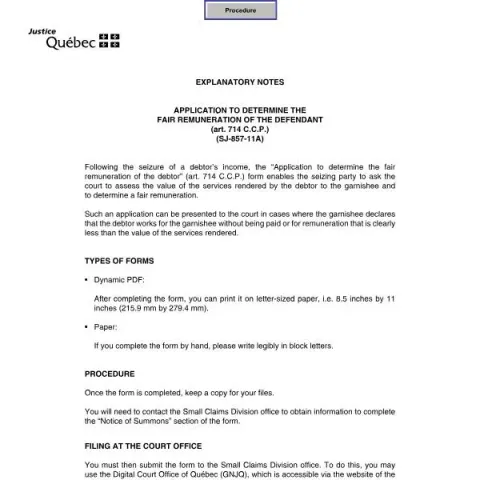
Understanding the Application to Determine the Fair Remuneration of the Defendant (art. 714 C.C.P.)
The Application to Determine the Fair Remuneration of the Defendant (form SJ-857-11A) is an official document used within Quebec’s civil justice system, specifically under the authority of the Canada Court of Québec and the Ministère de la Justice. This form is essential when a creditor or a party involved in a legal process seeks to establish the actual value of services provided by a debtor who is subject to income seizure or garnishment. It helps ensure that the debtor receives a fair remuneration for their work, especially when the garnishee (the entity holding the income) claims the debtor is unpaid or underpaid.
Who Should Fill Out This Form?
This form is typically completed by the party initiating the application, often the creditor or the party seeking to recover a debt. The applicant must provide details about the debtor (the defendant), the garnishee (the employer or income holder), and the nature of the income seizure. It is crucial that the person filling out the form has accurate information about the debtor’s employment status, income, and the services rendered, as this will form the basis for the court’s assessment of a fair remuneration.
How to Complete the Application
The form is available in both digital and paper formats. When filling it out, ensure that all information is accurate and legible. The main sections include:
- Case details: File number, district, and locality.
- Parties involved: Names and roles of the plaintiff, defendant, and garnishee.
- Income and services: Description of the debtor’s income, current salary, and the value of services rendered.
- Request for assessment: The specific legal requests, such as assessing the value of services and determining fair remuneration.
For handwritten forms, write clearly in block letters to avoid ambiguity. When completed, keep a copy for your records before submitting the original to the court.
Supporting Documents and Evidence
While the form itself captures essential information, it is advisable to attach relevant supporting documents, such as:
- Pay stubs or salary statements.
- Employment contracts or agreements.
- Any correspondence related to the employment or income dispute.
These documents can substantiate your claims and facilitate the court’s assessment process.
Filing the Application with the Court
Once completed, the application must be filed with the Small Claims Division of the Court of Québec. You can do this via:
- The Digital Court Office of Québec (GNJQ), accessible through the Ministère de la Justice website.
- In person at the courthouse, where the court clerk will process your application and schedule a hearing.
After filing, the court clerk will notify all parties involved, including the defendant and any intervening third parties, about the scheduled hearing. It is important to check the court’s contact information and procedures for further guidance.
Fill in your form directly online
No printing: type your details into the boxes of the official form, tick, then download the PDF ready to send.
- 1Type into the form boxes
- 2Tick in one click
- 3Save and download the PDF
What Happens Next?
Following submission, the court will review the application and may call for a hearing. During this hearing, both parties can present evidence and arguments regarding the debtor’s remuneration. The court will then assess the value of the services and determine a fair remuneration, which will be deemed to be the income earned by the debtor as of the date of the application.
Common Mistakes to Avoid
- Incomplete or illegible forms: Ensure all sections are filled out accurately and clearly.
- Missing supporting documents: Attach all relevant proof to strengthen your case.
- Incorrect contact information: Verify courthouse details to avoid delays.
By carefully preparing and submitting this application, you help facilitate a fair resolution regarding the debtor’s remuneration, ensuring compliance with Quebec’s civil procedures and legal standards.