Understanding the Tenant Proof of Service of Forwarding Address Form (RTB-41)
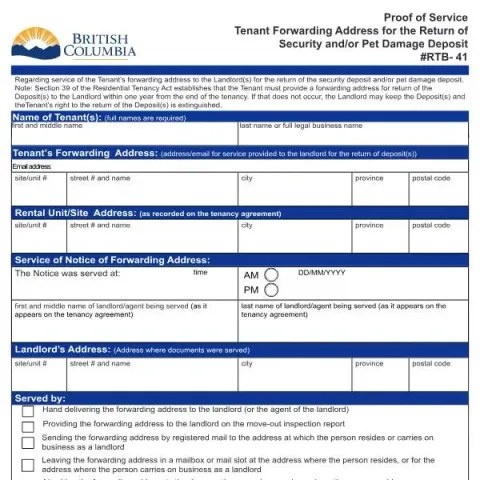
The Proof of Service of Forwarding Address form, identified as RTB-41, is an official document issued by the Residential Tenancy Branch of the Office of Housing and Construction Standards in British Columbia. This form is essential for tenants who need to formally provide their new address to their landlord or property manager for the return of their security deposit and/or pet damage deposit after moving out of a rental unit.
When Should You Use the RTB-41 Form?
This form is used when a tenant has moved out of a rental property and needs to ensure that their forwarding address has been officially communicated to the landlord or property manager. According to Section 39 of the Residential Tenancy Act, tenants are required to provide their forwarding address within one year of vacating the rental unit. Failure to do so may result in the landlord retaining the deposit(s), as the tenant's right to recover these funds could be extinguished.
Therefore, the RTB-41 form is particularly relevant in situations where:
- The tenant has moved out and wants to confirm that the landlord has received their new address.
- The landlord needs proof that the tenant's forwarding address was served properly.
- The tenant wishes to avoid disputes regarding the return of deposits.
Key Sections of the RTB-41 Form
Tenant and Property Details
At the beginning of the form, tenants are required to provide their full legal name, including first and middle names, as well as their last name or business name if applicable. The rental unit's address, as recorded in the tenancy agreement, must also be included to specify the property involved.
Service of Notice
This section records how the forwarding address was served to the landlord or agent. Several methods are available, including:
- Hand delivery to the landlord or their agent.
- Provision on the move-out inspection report.
- Registered mail sent to the landlord’s address.
- Leaving the address in a mailbox or mail slot.
- Attaching the address to the door or another conspicuous place.
- Faxing or emailing the address to the landlord’s contact details.
- As ordered by a court or the Director of the Residential Tenancy Branch, with appropriate documentation attached.
Tenant’s Forwarding Address
The tenant must clearly state their new address or email address for service purposes. This ensures the landlord can return the security deposit and/or pet damage deposit securely and efficiently.
Confirmation of Service
To validate the process, the form includes sections for confirmation of service, such as:
- Hand delivery receipt, including the recipient’s name, signature, and date.
- Witness statements, if applicable.
- Details of where and how the address was left or sent.
- Proof of email or fax communication, if used.
How to Transmit the Completed RTB-41 Form
Once filled out, the form should be transmitted to the landlord or property manager using one of the accepted methods listed above. It is advisable to keep copies of all documents and receipts, such as registered mail receipts or email confirmations, to serve as proof of service.
Fill in your form directly online
No printing: type your details into the boxes of the official form, tick, then download the PDF ready to send.
- 1Type into the form boxes
- 2Tick in one click
- 3Save and download the PDF
If service is made via registered mail, attaching the receipt with the date and time of mailing is recommended. For hand delivery, obtaining a signed acknowledgment or receipt from the recipient provides additional proof. When service is made electronically, retaining copies of sent emails or faxes is important.
Points of Attention and Best Practices
- Timeliness: Remember to provide your forwarding address within one year of vacating the rental unit to protect your deposit rights.
- Accuracy: Double-check all information, including your name, address, and contact details, to avoid delays or disputes.
- Proof of Service: Always keep documentation of how and when you served your forwarding address, as this may be required if a dispute arises.
- Legal Compliance: Ensure that the method of service complies with the Residential Tenancy Act and the specific instructions on the RTB-41 form.
Conclusion
The RTB-41 form is a vital administrative tool for tenants in British Columbia to formally communicate their new address for the return of deposits after moving out. Proper completion and timely service of this form help protect your rights and ensure a smooth deposit return process. Always retain copies of your submitted documents and proof of service to safeguard your interests in case of any future disputes.