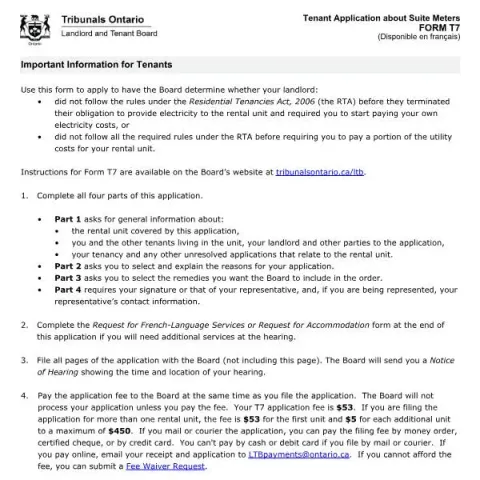
Understanding the Landlord and Tenant Board Form T7: Tenant Application about Suite Meters
If you are a tenant in Ontario and believe that your landlord has not followed the rules regarding utility billing, the Form T7 provides a formal way to request the Landlord and Tenant Board (LTB) to review your situation. This application is specifically designed for tenants who want the Board to determine whether their landlord improperly transferred the responsibility for electricity costs or failed to follow the legal procedures under the Residential Tenancies Act, 2006 (RTA).
Purpose of Form T7
The main goal of this form is to address concerns related to the installation and billing of suite meters. These meters measure the electricity used in individual rental units. If your landlord installed a suite meter without proper notice, or required you to pay utility costs without following legal procedures, this form allows you to seek an official determination from the Board.
Specifically, tenants can use Form T7 if they believe that:
- The landlord did not provide adequate notice before interrupting electricity supply or installing suite meters.
- The landlord did not obtain proper consent or did not give necessary information before requiring tenants to pay for utility costs.
- The suite meter was installed by an unauthorized provider.
Preparing Your Application
Completing the Four Parts
The form consists of four main sections:
- Part 1: General Information — This section requires details about the rental unit, tenant(s), landlord, and any related applications. You must provide the address, your contact information, and details about your tenancy.
- Part 2: Reasons for Filing — Here, you select the specific reasons for your application, such as improper notice or unauthorized installation of suite meters, and explain the circumstances.
- Part 3: Remedies Requested — You specify what outcomes you want from the Board, like clarification of utility responsibilities or orders to rectify the situation.
- Part 4: Signature — You or your representative must sign the form, along with providing contact information if applicable.
Additional Services and Filing
If you need hearing accommodations or services in French, you should complete the relevant request form included at the end of the application. All pages of the completed application must be filed with the Board, either online or in person. The Board will then issue a Notice of Hearing, indicating when and where your case will be heard.
Filing Fees and Payment Options
The current fee for filing Form T7 is $53. If you are applying for multiple units, the fee is $53 for the first unit and $5 for each additional unit, up to a maximum of $450. Payment methods depend on how you file:
- Online submissions: Payment can be made via credit card, and you should email your receipt along with your application to [email protected].
- Mail or courier: Payment options include money order or certified cheque. Cash and debit are not accepted by mail or courier.
If you cannot afford the fee, you may request a fee waiver by submitting a separate application.
Important Considerations
Before submitting your application, ensure all sections are fully completed, and all relevant documents are attached. If you have unresolved related applications, include their file numbers to provide the Board with a complete picture of your case.
Fill in your form directly online
No printing: type your details into the boxes of the official form, tick, then download the PDF ready to send.
- 1Type into the form boxes
- 2Tick in one click
- 3Save and download the PDF
For questions or assistance, contact the Board at:
- 416-645-8080
- 1-888-332-3234 (toll free)
Or visit the official website at tribunalsontario.ca/ltb.
Summary
Form T7 is an essential tool for tenants who suspect their landlord has not complied with legal requirements regarding suite meters and utility billing. Proper completion and timely filing of this form can help ensure your rights are protected and that the landlord adheres to the rules set out in the Residential Tenancies Act, 2006.