Understanding the Official Form for Lease Termination Due to Violence in Canada
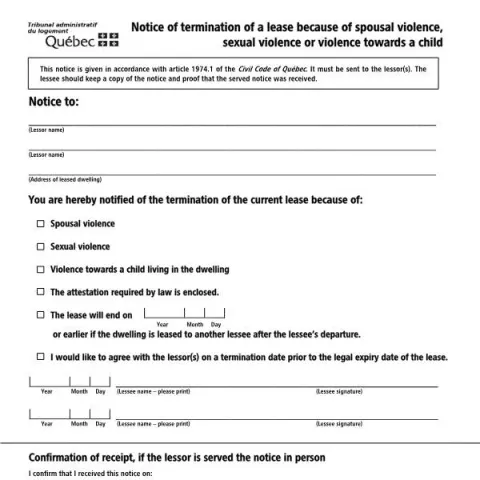
This official form, identified as TAL-818A-E, is a legal document used in the context of housing disputes managed by the Tribunal administratif du logement (Housing Tribunal) in Quebec. It is specifically designed for tenants who need to terminate their lease because they or a child living in the dwelling are victims of spousal violence, sexual violence, or violence towards a child. This article provides a detailed overview of the form’s purpose, eligibility criteria, step-by-step filling instructions, and subsequent procedures.
Purpose and Scope of the Form
The Notice of termination of a lease because of spousal violence, sexual violence or violence towards a child serves as an official declaration by a tenant to their landlord that they are ending their lease due to safety concerns stemming from violence. The form is grounded in article 1974.1 of the Civil Code of Québec, which recognizes the rights of victims to terminate their lease early without penalty when their safety is threatened.
The form must be completed and sent to the lessor(s) to legally inform them of the tenant’s intention to end the lease early. It also acts as proof that the tenant has formally notified the landlord of the situation, which is crucial if any disputes arise later regarding lease termination or rent obligations.
Eligibility Conditions
To qualify for the use of this form, the tenant must be experiencing violence—whether spousal, sexual, or towards a child—within the dwelling. The safety threat must be substantiated by an official attestation, such as a judgment, affidavit, or documentation from a public officer designated by the Minister of Justice. The law emphasizes that the tenant’s safety or that of a child in the dwelling is at risk, which justifies early lease termination.
It is important to note that the tenant must continue paying rent until the lease officially ends, unless specific services or costs are involved that were provided before vacating the premises.
Step-by-Step Procedure for Filling Out the Form
- Identify the Lessors: Fill in the full names and addresses of the landlord(s) or lessor(s) at the top of the form.
- Specify the Reason for Termination: Check the box(es) indicating the type of violence experienced: spousal, sexual, or towards a child.
- Provide the Lease End Date: Indicate the proposed date when the lease will end. This date is typically two months after the notice is sent for leases of 12 months or more, or one month for shorter or indefinite leases, unless an earlier date is agreed upon.
- Attach Attestation: Include the official attestation or supporting documentation confirming the violence situation.
- Sign the Notice: The tenant must print and sign their name, and date the document.
- Send the Notice: The completed form should be sent to the landlord, with proof of delivery, such as registered mail or personal service with acknowledgment of receipt.
After Sending the Notice
Once the landlord receives the notice, they are required to confirm receipt by signing the section designated for acknowledgment. This acknowledgment can be done in person or via other accepted means of service. The date of receipt is important, as it triggers the countdown for the lease termination period.
During this period, the tenant must continue paying rent until the lease officially terminates. If the landlord leases the dwelling to another tenant during this period, the lease may end earlier. The law also allows for the parties to agree on an earlier termination date, providing flexibility based on mutual consent.
Fill in your form directly online
No printing: type your details into the boxes of the official form, tick, then download the PDF ready to send.
- 1Type into the form boxes
- 2Tick in one click
- 3Save and download the PDF
Additional Support and Legal Considerations
Victims of violence seeking to terminate their lease can also contact relevant organizations, such as the office of the Director of Criminal and Penal Prosecutions or local Crime Victims Assistance Centres, for assistance in obtaining the necessary attestations. Furthermore, victims may be eligible for compensation through programs like the Indemnisation des victimes d’actes criminels (IVAC), which can reimburse rent payments and moving expenses incurred during this process.
In summary, this form provides a legal pathway for tenants in Quebec to safely and legally exit their lease agreements when their safety is compromised due to violence. Proper completion and timely submission of the form are essential to ensure the tenant’s rights are protected under the law.