Understanding the Official Notice of Eviction for Subdivision, Enlargement or Change of Destination of a Dwelling in Quebec
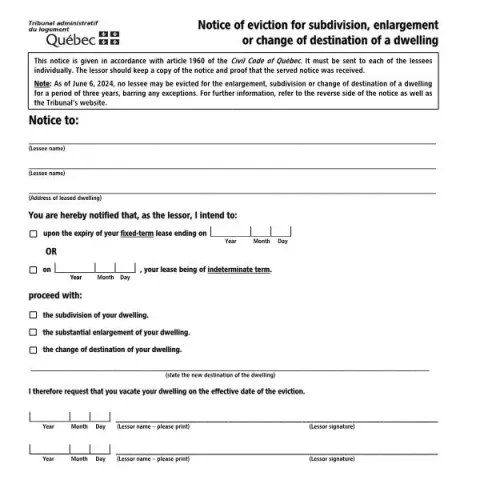
If you are a tenant in Quebec and receive a notice titled "Notice of eviction for subdivision, enlargement or change of destination of a dwelling," it’s important to understand the purpose of this document, who must fill it out, and the steps involved in the process. This official form is issued by the Tribunal administratif du logement (TAL), the authority responsible for overseeing residential tenancy issues in Quebec.
What is this notice and why is it issued?
This notice is a formal communication from the lessor (landlord) to the lessee (tenant) indicating an intention to proceed with significant modifications to the dwelling. Specifically, it concerns:
- Subdivision of the dwelling,
- Substantial enlargement,
- Change of the destination of the dwelling (for example, converting a residential unit into a commercial space).
The purpose of this notice is to inform tenants of the landlord’s plans and to initiate the legal process for eviction if necessary. It is issued in accordance with article 1960 of the Civil Code of Quebec.
Who must complete this form?
The lessor (landlord) must fill out this form when they intend to subdivide, enlarge, or change the use of a dwelling that is currently rented. The form must be sent to each tenant individually, either in person or by other authorized means. The landlord must keep a copy of the completed form and proof of delivery to each tenant.
How to fill out the form
The form requests essential information to be completed clearly:
- Lessee information: full name(s) and address of the rented dwelling.
- Notice of intent: specify whether the lease is fixed-term or indefinite, and the expiry date if fixed-term.
- Type of action: check the appropriate box to indicate whether the landlord intends to subdivide, enlarge, or change the destination of the dwelling.
- Effective date of eviction: specify the date on which the tenant is expected to vacate.
- Landlord’s details: print name(s), sign, and date the form.
It is crucial to fill out all sections accurately to avoid delays or legal issues. The form also includes a section for tenants to acknowledge receipt if served in person, which must be signed and dated by the tenant.
Required pieces to attach and submit
While the form itself is the primary document, the landlord should retain proof of service—such as a signed acknowledgment of receipt or delivery receipt. There are no specific additional documents mandated to be attached when submitting the form to the Tribunal, but keeping records is essential in case of disputes.
Where and how to submit the form
The completed form must be submitted to the Tribunal administratif du logement. Submission can be done via mail or through the Tribunal’s digital platform, depending on their current procedures. It is advisable to consult the Tribunal’s website for detailed instructions and to ensure compliance with current submission methods.
Fill in your form directly online
No printing: type your details into the boxes of the official form, tick, then download the PDF ready to send.
- 1Type into the form boxes
- 2Tick in one click
- 3Save and download the PDF
Important legal considerations and deadlines
As of June 6, 2024, a temporary prohibition against evicting tenants for these reasons is in effect for three years, unless specific exceptions apply. Landlords must be aware of these restrictions and ensure that their notices comply with the applicable legal framework.
Tenants who receive this notice and believe the eviction is unjustified or that their rights have been violated can challenge the eviction by applying to the Tribunal. Conversely, landlords must adhere to the legal process, including providing proper notice and supporting documentation, to proceed with eviction for subdivision, enlargement, or change of destination.
Summary
This official notice form is a critical step in the process of modifying a rental dwelling in Quebec. Proper completion, timely service, and adherence to legal restrictions are essential for both landlords and tenants to protect their rights and obligations under Quebec’s residential tenancy laws.