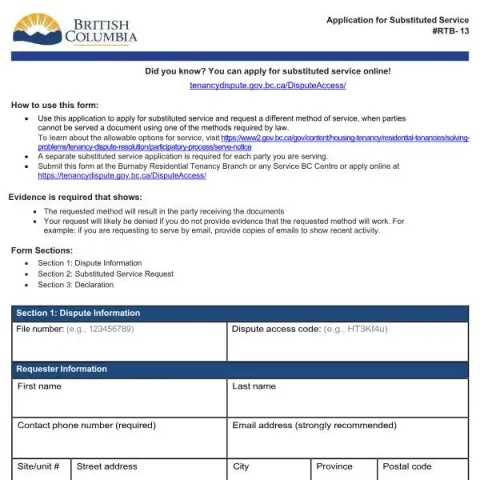
Understanding the Application for Substituted Service (Form RTB-13)
If you're involved in a residential tenancy dispute in British Columbia and find that traditional methods of serving legal documents are ineffective, the Application for Substituted Service (Form RTB-13) provides a legal pathway to ensure your documents reach the other party. This form is essential for parties seeking to serve notices, decisions, or dispute resolution packages when standard service methods are not feasible.
When to Use This Form
This application is designed for situations where the usual methods of service—such as registered mail, personal delivery, or email—are unlikely to succeed. For example, if the tenant or landlord is avoiding service or cannot be reached through conventional means, you may request an alternative method of service approved by the Residential Tenancy Branch (RTB). The form is applicable for serving documents related to:
- Notice of Dispute Resolution Proceedings
- Decisions following a review or hearing
- Other legal notices or documents associated with tenancy disputes
Key Sections of the Form
Section 1: Dispute Information
This section requires details about the dispute, including the dispute file number and access code, as well as your contact information. You will also need to specify the address of the property involved and your personal details, such as your name, phone number, and email address. This information helps the RTB identify the case and contact you if needed.
Section 2: Substituted Service Request
The core of the application, this section asks you to:
- Select the type of document you wish to serve and the relevant proceedings
- Identify the party you intend to serve
- List the service methods you have already tried and confirmed are ineffective (e.g., regular mail, email, posting on door)
- Explain why these methods are unsuitable
- Describe the alternative service method you are requesting, such as email, social media, or other platforms, including specific details like email addresses or social media usernames
- Provide reasons why you believe the party will receive the documents using this alternative method, supported by evidence such as recent communication proof
Section 3: Declaration
By signing this section, you certify that all information provided is correct and that you have authority to submit the application. You acknowledge that providing false information is a legal offence and authorize the RTB to process your request based on the details supplied.
Submitting the Application
You can submit your completed form either online through the RTB dispute portal or in person at designated locations such as the Burnaby Residential Tenancy Branch or any Service BC Centre. When submitting online, you can also upload supporting evidence, but note that evidence cannot be sent via email. Ensure you have documented proof that the alternative service method will reach the party, such as recent email exchanges or social media interactions.
Fill in your form directly online
No printing: type your details into the boxes of the official form, tick, then download the PDF ready to send.
- 1Type into the form boxes
- 2Tick in one click
- 3Save and download the PDF
Points to Consider and Tips
- Provide clear evidence: Your application will likely be approved only if you demonstrate that the proposed method of service is reasonable and effective.
- Separate applications: A separate RTB-13 form must be completed for each party you intend to serve.
- Accuracy is crucial: Double-check all information, especially contact details and the reasons for choosing an alternative service method.
- Legal compliance: Remember that the RTB's decision on substituted service is based on legal criteria, and the request must be justified with supporting evidence.
Final Notes
This form is an important tool in tenancy dispute resolution, ensuring that parties can be properly notified even when standard service methods fail. Properly completing and submitting Form RTB-13 helps uphold legal processes and facilitates the resolution of tenancy issues in British Columbia.