Understanding Compassionate Care Benefits: A Deep Dive into INS5217
When faced with the daunting challenge of supporting a seriously ill family member, financial assistance can provide much-needed relief. The Compassionate Care Benefits, encapsulated in the INS5217 form, serve as a lifeline during such difficult times. This article explores the intricate details of this document, including its purpose, completion guidance, submission channels, and what to do if challenges arise.
Historical Context and Regulatory Framework
The Compassionate Care Benefits program was established under the Employment Insurance Act to aid individuals who need to take time off work to care for a gravely ill family member. This initiative reflects Canada's commitment to family values and support systems, recognizing that during times of critical health challenges, caregivers often face financial burdens.
The Employment and Social Development Canada (ESDC) oversees this program, ensuring that eligible Canadians receive necessary assistance. The framework surrounding this initiative has evolved, particularly with amendments aimed at broadening eligibility criteria and increasing benefit durations. This historical backdrop is vital to understanding how INS5217 fits into the broader landscape of social support in Canada.
Navigating the Sections of INS5217
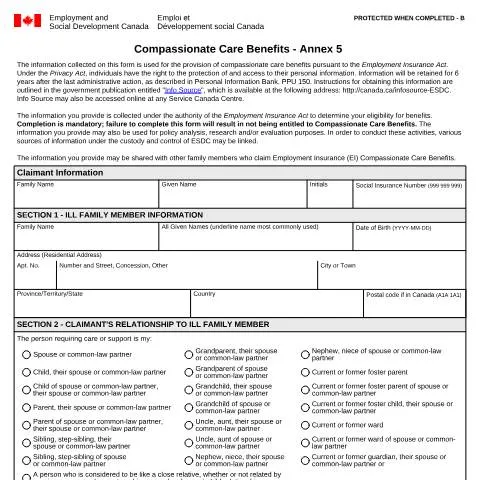
INS5217 is structured into several sections, each requiring careful attention to detail. Below, we will unpack each section and highlight common pitfalls to avoid.
Section 1: Identifying the Ill Family Member
In this section, you’ll provide information about the family member who requires care. This includes their full name, date of birth, and address. Ensure that the details align with official documents to avoid discrepancies.
- Full Name: Use the name as shown on their legal documents.
- Date of Birth: Format is YYYY-MM-DD; accuracy is crucial.
- Address: Include all relevant details such as apartment numbers.
Section 2: Relationship to the Ill Family Member
This section specifies your relationship to the individual needing care. Accurate completion is vital, as it directly impacts eligibility. Choose the correct option from the list provided. Misclassification can lead to delays or denials.
Section 3: Duration of Benefit
Here, indicate how many weeks you wish to claim benefits. You may apply for up to 26 weeks of Compassionate Care Benefits. Ensure that the week count matches your care plan, as inconsistencies may complicate your application.
- Specify the start date for benefit claims.
- Clearly indicate the number of weeks you intend to claim.
Submission Channels: Digital, Mail, or In-Person
Once you've meticulously filled out INS5217, the next step is submission. You have multiple options to send your application, each with its pros and cons.
Online Submission
Submitting the form online is generally the fastest method. You need to log into your Service Canada account, where you can fill out the form digitally and submit it with minimal wait times. This option offers immediate confirmation of receipt, providing peace of mind.
Mail Submission
If you prefer a physical copy, you can mail your completed form. It’s crucial to send it via a traceable service to confirm delivery. Bear in mind that this method may involve longer processing times.
In-Person Submission
For those who prefer face-to-face interactions, visiting a Service Canada Centre is an option. In-person submissions allow for immediate clarification on any concerns. However, be mindful of potential wait times at the center.
Essential Documentation: Preparing for a Successful Claim
Along with INS5217, you may need to submit additional documentation. Understanding the requirements based on different situations will streamline your application process.
Medical Certificate
A crucial component of your application is the Medical Certificate for Employment Insurance Compassionate Care Benefits. This certificate validates the serious medical condition of your family member. It must be signed by a qualified medical professional.
- If another family member has already submitted a medical certificate, you typically do not need to provide another.
- Ensure that the certificate is complete and accurately describes the condition; incomplete information can lead to denial.
Additional Supportive Documents
Depending on your situation, you might also find it beneficial to include:
- Proof of relationship (e.g., birth certificates, marriage licenses).
- Any relevant past medical records that substantiate the claim.
Addressing Challenges: What to Do in Case of Issues
While the goal is a smooth application process, complications can arise. Here’s how to navigate potential challenges.
Handling Refusals
If your claim is denied, do not lose hope. You have the right to appeal the decision. Carefully read the refusal notice to understand the reasons for denial and gather any necessary documentation to address the concerns raised.
Correcting Errors
Should you discover an error in your submission, contact Service Canada immediately. Depending on the nature of the error, you might need to submit a corrected form or provide additional information.
Missing Documentation
In cases where documentation is incomplete or missing, Service Canada will notify you. They may provide a deadline for submission of the necessary documents. Act promptly to avoid delays in processing your claim.
The Role of INS5217 in the Compassionate Care Benefits Process
Understanding the significance of INS5217 is crucial. This document serves as the foundation for your Compassionate Care Benefits claim. It initiates the process, allowing Service Canada to assess your eligibility based on the provided information.
The Interplay with Other Employment Insurance Programs
INS5217 is interconnected with various Employment Insurance programs. For instance, if you’re also applying for parental leave or sickness benefits, timely submission of INS5217 can streamline your claims across multiple programs.
Practical Considerations and Tips for Successful Application
As you prepare to navigate the submission process for INS5217, consider the following practical tips to enhance your chances of a successful claim:
- Keep Copies: Always retain copies of all submitted documents for your records.
- Follow Up: Don’t hesitate to reach out to Service Canada for status updates after submission.
- Be Transparent: If your circumstances change during the claim process, inform Service Canada immediately.
By understanding the intricacies of the Compassionate Care Benefits program and the INS5217 form, you empower yourself to navigate this challenging time with clarity and confidence.
Understanding the Eligibility Criteria for Compassionate Care Benefits
Compassionate Care Benefits (CCB) are designed to provide financial support to individuals who need to take time off work to care for a critically ill family member. To qualify for these benefits, you must meet specific eligibility criteria imposed by Employment and Social Development Canada (ESDC). It's crucial to understand these requirements to navigate the application process effectively.
First, let's explore the definition of a "family member" under the CCB program. This term encompasses various relationships, including a child, spouse, common-law partner, or any individual who is a parent, grandparent, brother, sister, aunt, uncle, nephew, or niece of the claimant or their spouse or common-law partner. Each situation is assessed individually, and it's essential to clearly establish the familial connection when applying for these benefits.
Next, the individual requiring care must have a medical condition that is considered critical. This generally means they are at risk of death, and a healthcare professional must provide a medical certificate (Form RC66) confirming this condition. The medical certificate must also specify the duration for which care is required, which can range up to 26 weeks for the CCB.
Furthermore, you need to have accumulated sufficient insurable hours of work to qualify for the benefits. Generally, this involves having at least 600 insured hours of work in the qualifying period — the 52 weeks preceding your claim or since your last claim, whichever is shorter. There are provisions in place to adjust this requirement for those who have experienced a layoff or other employment interruptions.
Lastly, it's important to note that CCB claims are made through Service Canada, and you must provide all necessary documentation. Incomplete submissions can lead to delays or rejections, so ensure that everything from your application form to the medical certificate is filled out accurately and comprehensively.
How to Apply for Compassionate Care Benefits
Applying for Compassionate Care Benefits can seem daunting, but with a clear understanding of the process, you can navigate it with ease. The application process begins by gathering all required documents and information to support your claim. You can apply online through the Service Canada website or in person at your local Service Canada Centre.
To begin, ensure you have your Social Insurance Number (SIN) at hand, as it will be required throughout the application. You will also need to provide details about your employment history, including your Record of Employment (ROE) from your employer. If your employer hasn't issued an ROE, you will need to request it as it outlines your insurable hours and earnings.
Once you have gathered your documents, it’s time to fill out the application form for Compassionate Care Benefits (Form EI-Caregiving). This form will require you to provide information about the critically ill family member, including their full name, date of birth, and the nature of their illness. You must also submit a medical certificate from a qualified healthcare professional, as mentioned earlier. It's essential for this certificate to be filled out accurately and signed, as it serves as the backbone of your application.
After submitting your application, you should expect to receive a decision from Service Canada within a few weeks. They may contact you for additional information if required, so be prepared to provide further documentation if necessary. Throughout this waiting period, you can track the status of your application through your Service Canada online account, which provides updates and notifications about your claim.
Balancing Work and Caregiving: Tips for Managing Your Responsibilities
Caring for a critically ill family member while managing your professional obligations can be challenging. It requires careful planning and a supportive environment at work. Here are some practical tips to help you balance both responsibilities.
First, communicate openly with your employer about your situation. It's important to inform them of your need for compassionate care leave as soon as possible. Discussing temporary adjustments to your workload or flexible hours could alleviate some stress during this challenging time. Many employers are understanding and willing to work with you to accommodate your situation, especially when they recognize the importance of family care.
Additionally, consider utilizing resources available in your community or through local organizations that offer support for caregivers. These organizations often provide services such as respite care, counseling, or support groups that can help you manage your emotional and physical well-being while caring for a loved one.
It's also vital to prioritize self-care. Caring for someone with a critical illness can be physically and emotionally draining. Make sure to carve out time for yourself, whether it’s engaging in hobbies, exercising, or simply taking breaks to recharge. This will not only benefit you but also ensure you can provide better care to your loved one.
Lastly, keep track of your caregiving duties and the time you spend each week. This can be helpful for both your application process for the Compassionate Care Benefits and for understanding your own capacity. It will also provide clarity when discussing your situation with your employer and any support services.