Understanding the Application to Vary or Revoke an Intervention Order in Queensland
If you are involved in a domestic or family violence situation in Queensland, and you need to change or cancel an intervention order, the official Application to Vary or Revoke an Intervention Order form (Form DV9) is the document you must complete. This legal form is governed by the Domestic and Family Violence Protection Act 2012 and is essential for making formal requests to the Queensland Courts.
When to Use the Form DV9
This form is applicable in situations where:
- You wish to request a change to an existing intervention order. For example, altering the conditions or the duration of the order.
- You seek to revoke or cancel an intervention order that is currently in place.
It is important to note that applications to vary or revoke an intervention order are serious legal actions. They require careful consideration and, in some cases, legal advice to ensure the process aligns with your circumstances and legal rights.
Who Can Complete the Form?
The form can be completed by different parties depending on the situation:
- The Applicant: The person requesting the variation or revocation, which could be the respondent or another involved party.
- The Respondent: If the respondent is applying to vary or revoke the order, they must complete Part A of the form.
- A Police Officer: In some cases, a police officer involved in the case may complete Part B of the form.
Key Sections of the Form
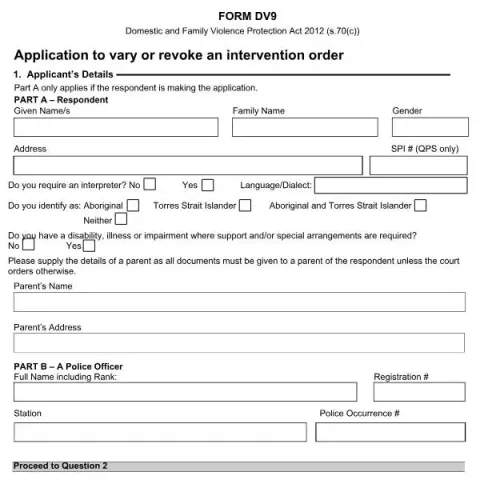
Part A – Respondent Details
This section captures personal information such as name, gender, address, and whether an interpreter is required. It also asks if the respondent identifies as Aboriginal or Torres Strait Islander and if they have any disabilities or special needs.
Part B – Police Officer Details
If a police officer is completing the form, they must provide their full name, rank, registration number, and occurrence details.
Existing Order Details
This section requires information about the original intervention order, including the date it was made, the court and location, and the respondent's details as listed in the original order. A copy of the original order must be attached to the application.
Details of Variation or Revocation
Applicants must specify whether they are requesting a variation or revocation of the order. For variations, detailed reasons and specific changes are required. For revocations, clear reasons for the request must be provided.
Fill in your form directly online
No printing: type your details into the boxes of the official form, tick, then download the PDF ready to send.
- 1Type into the form boxes
- 2Tick in one click
- 3Save and download the PDF
Legal Declaration and Witnessing
Applicants must sign a statutory declaration affirming that the information provided is true. This declaration must be witnessed by a Justice of the Peace, Commissioner for Declarations, solicitor, or other authorized witness under the Oaths Act 1867. If the application is urgent, an applicant may submit an unverified application, but it must be verified before a final decision is made.
Important Points and Tips
- Accurate Information: Ensure all details are correct and up-to-date to prevent delays or rejection.
- Attach Supporting Documents: Include a copy of the original intervention order and any relevant evidence to support your application.
- Legal Advice: Consider consulting a legal professional, especially if the reasons for variation or revocation are complex.
- Witnessing: Remember that the statutory declaration must be signed in front of an authorized witness to be valid.
Submitting the Application
The completed Form DV9 can be lodged with the Queensland Courts either in person or via the online system, depending on the court's facilities. The court will then schedule a hearing where both parties can present their case. If the respondent does not attend, the court may proceed in their absence, and a domestic violence order could be made or varied without their presence.
Final Considerations
Applying to vary or revoke an intervention order is a formal legal process that can significantly impact the safety and well-being of those involved. It is crucial to understand the legal implications and ensure all information is truthful and comprehensive. For further guidance, consult the official resources or seek legal advice to navigate the process effectively.