Understanding the Application Process for a Family Violence Intervention Order in Victoria
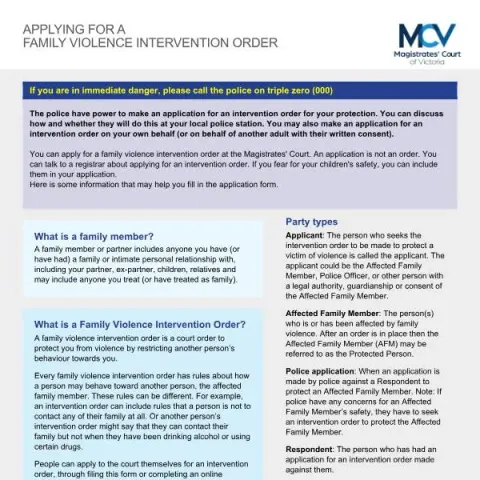
If you or someone you know is experiencing family violence, it is crucial to understand how to seek protection through the legal system in Victoria. The Family Violence Intervention Order is a court order designed to prevent further violence and ensure safety. This article provides a comprehensive overview of how to apply for such an order using the official application form, FVIO1, issued by the Magistrates' Court of Victoria.
What is the FVIO1 Application Form?
The FVIO1 form is an official document used to request a Family Violence Intervention Order. It is a legal application that, once filed and accepted by the court, initiates the process of obtaining protection from family violence. It is important to note that submitting this form does not automatically grant an order; it is the first step in a legal process that involves court hearings and decisions.
When and Why to Use the FVIO1 Form
This form should be used when you are experiencing family violence and need legal protection. It can be filled out by the affected individual (the applicant), a police officer, or a guardian acting with legal authority. You can apply for an intervention order if you are in immediate danger or if you want the court to address ongoing threats or violence from a family member or partner.
If you fear for your safety or that of your children, submitting the FVIO1 form is a vital step. The application can be made online via the official website or in person at your local Magistrates' Court. Remember, if you are in urgent danger, you should contact the police immediately by calling triple zero (000).
Key Parties Involved in the Application
- Applicant: The person seeking protection through the intervention order. This could be the victim, police officer, or guardian.
- Affected Family Member: The individual who has been or is being impacted by family violence. Once an order is in place, they are referred to as the Protected Person.
- Respondent: The individual against whom the application is made, typically the person accused of family violence.
- Police Application: When police apply on behalf of a victim, especially when immediate intervention is necessary.
Filling Out the FVIO1 Form
The form requests detailed information to support your case, including:
- Your personal details and contact information
- Details of the respondent (the person you are applying against)
- Descriptions of the family violence incidents, including dates, times, and locations
- Information about any children involved
- Specific orders or restrictions you are requesting, such as no contact or proximity conditions
It is essential to provide accurate and comprehensive information to enable the court to make an informed decision. If you need assistance, you can speak with a court registrar or seek legal advice.
Types of Orders and Court Hearings
Interim Intervention Order
This is a temporary order issued by a magistrate to provide immediate protection until a full hearing can be conducted. It becomes effective once it is served on the respondent.
Final Intervention Order
After considering the evidence, the court may issue a final order that remains in effect for a specified period or indefinitely, depending on the circumstances.
Fill in your form directly online
No printing: type your details into the boxes of the official form, tick, then download the PDF ready to send.
- 1Type into the form boxes
- 2Tick in one click
- 3Save and download the PDF
Hearing Types
- Mention Hearing: An initial court appearance where the magistrate discusses the case with the parties.
- Directions Hearing: A procedural hearing to determine evidence and next steps.
- Contested Hearing: A full court hearing where evidence is presented, and a decision is made regarding the need for a final order.
Points of Attention and Legal Considerations
Applying for a family violence intervention order is a serious legal process. It is important to:
- Provide truthful and detailed information in your application.
- Understand that breaching the order is a criminal offence, and police can take enforcement actions if the conditions are violated.
- Seek legal advice or support services if you are unsure about the process or your rights.
- Remember that the application process is separate from the order itself; the court will decide whether to grant the protection order based on the evidence presented.
Final Advice
If you believe you need protection from family violence, completing the FVIO1 application form is a crucial step towards safety. You can submit the form online or at your local Magistrates' Court, and support is available from court staff, legal professionals, and community services. Always prioritize your safety and seek immediate help if you are in danger.