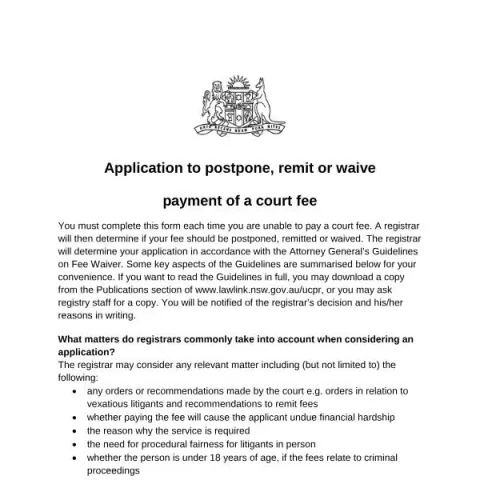
Understanding the Application to Postpone, Remit or Waive Court Fees in New South Wales
If you are involved in legal proceedings at the Local Court of NSW and are unable to pay the required court fees, you can submit an application to postpone, remit, or waive these fees. This process is designed to ensure access to justice for individuals facing financial hardship or other qualifying circumstances. This article provides a comprehensive overview of the application process, eligibility criteria, and key considerations to help you navigate this important legal procedure.
Purpose and Scope of the Application
The application form is used each time you seek to delay, reduce, or eliminate a court fee associated with your proceedings. This might include fees for filing documents, obtaining copies, or other court services. The registrar at the Local Court will review your application based on the guidelines set by the Attorney General, considering your financial situation and the circumstances of your case.
Key Criteria and Considerations
When assessing your application, the registrar will consider various factors, including:
- Any orders or recommendations previously made by the court, such as orders relating to vexatious litigants or fee remissions.
- Whether paying the fee would cause undue financial hardship.
- The purpose of the service or document you need to access.
- The need to ensure procedural fairness, especially for litigants representing themselves.
- If you are under 18 years of age or in custody, which may influence the decision.
- Any compassionate grounds or special circumstances you may have.
- Alternative options available, such as viewing documents at the registry.
Eligibility for Fee Relief
The registrar generally grants fee relief in cases where applicants:
- Depend on social security payments and lack sufficient income or assets to pay the fee.
- Are unable to obtain credit on reasonable terms due to debt or financial hardship.
- Have been granted legal aid for their proceedings.
Conversely, applications are typically refused if:
- The applicant has the ability to pay or secure credit to cover the fee.
- The applicant is a corporation or business entity.
- There has been a previous default or false/misleading information provided in prior applications.
- The applicant has recently received a fee waiver or postponement without exceptional reasons.
How to Complete the Application Form
The application form requires detailed information about the applicant and the case. Key sections include:
Applicant Details
- Full name and date of birth.
- Details of legal assistance, if applicable, including lawyer’s name.
Grounds for Application
- Indicate whether you are on a pension with a Commonwealth health concessions card, experiencing financial hardship, or relying on other compassionate grounds.
- Specify the type and amount of fee, along with a description of the case and court file number if known.
Terms of Payment or Waiver
- Choose whether to pay in instalments, pay the full amount at case finalisation, or seek a full or partial waiver.
- If applying for instalments, specify the amount and payment schedule.
Important Deadlines and Submission Process
The form must be completed fully and truthfully, as false statements may lead to legal consequences. The application should be submitted to the court registry where your case is being heard. It is advisable to include supporting documentation, such as proof of income or pension card, to substantiate your claim of financial hardship.
Post-Submission: What to Expect
After submitting your application, a registrar will review it in accordance with the Attorney General’s Guidelines. You will be notified in writing of the decision, along with reasons for approval or refusal. If your application is granted, the court will specify the terms, which may include a waiver, postponement, or payment plan.
Fill in your form directly online
No printing: type your details into the boxes of the official form, tick, then download the PDF ready to send.
- 1Type into the form boxes
- 2Tick in one click
- 3Save and download the PDF
In cases where your application is refused, you may have the opportunity to appeal or reapply if your circumstances change. It is important to adhere to any payment obligations or conditions set by the court to avoid further legal issues.
Conclusion
Applying to postpone, remit, or waive court fees is a vital process for individuals facing financial difficulties in NSW. By understanding the eligibility criteria, completing the form accurately, and providing necessary documentation, you can improve your chances of obtaining fee relief and ensuring your access to justice.