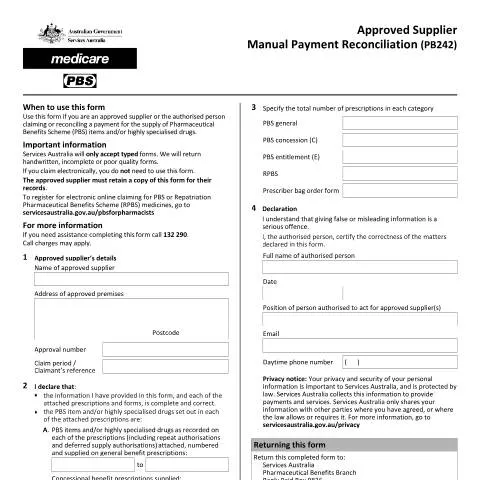
Understanding the Approved Supplier Manual Payment Reconciliation Form (PB242)
In the intricate realm of healthcare financing in Australia, professionals often encounter various forms and documents that facilitate their operations within the relevant systems. The Approved Supplier Manual Payment Reconciliation Form, designated as PB242, stands out as a crucial element for health professionals dealing with payment reconciliations. This document is designed to streamline the financial interactions between healthcare providers and Services Australia, particularly in the context of approved suppliers. But what does it encompass, and how can it be effectively utilized?
Scope and Purpose: What PB242 Covers
The PB242 form is not merely a transactional tool; it is a comprehensive guide that outlines the procedures related to payment reconciliations for suppliers registered under Services Australia. It details the stages of reconciling payments and offers insights into the expectations and responsibilities of healthcare providers during this process. The form encompasses:
- Payment reconciliation: The process of verifying and matching payments made to approved suppliers against the services rendered.
- Guidelines for documentation: Clear instructions on how to maintain and submit the necessary documentation to ensure compliance.
- Reporting requirements: Details on how and when to report discrepancies and adjustments to payments.
However, it is essential to recognize that while PB242 provides invaluable guidance, it is not an exhaustive manual that covers every conceivable scenario in payment reconciliations.
The Target Audience: Who Benefits from PB242?
Primarily, the PB242 form is tailored for health professionals and approved suppliers under the Services Australia umbrella. This includes a wide array of practitioners across various specialties who are part of the Medicare system. Situations where this document becomes indispensable include:
- Healthcare providers reconciling their Medicare payments with the services provided to patients.
- Practitioners seeking clarity on outstanding payments or discrepancies noticed in their financial records.
- Administrative staff within medical practices tasked with ensuring accurate financial accounting and compliance.
Understanding who the primary users of the PB242 form are helps contextualize its application and relevance within the healthcare finance ecosystem.
Navigating the Reconciliation Process: Practical Steps
Utilizing the PB242 form effectively requires familiarity with the reconciliation process itself. Here is a step-by-step guide on how to navigate this crucial task:
- Gather Documentation: Collect all relevant financial records, including invoices, patient records, and previous payment statements.
- Review Payment Statements: Compare the payments received with the records of services rendered to identify any discrepancies.
- Complete the PB242 Form: Fill out the form accurately, ensuring all information aligns with your gathered documentation.
- Submit Supporting Documents: Attach any necessary documentation that supports your reconciliation efforts, as outlined in the PB242 guidelines.
- Keep Copies: Maintain copies of all submitted documents for your records in case of future inquiries or audits.
Following these steps can help streamline the reconciliation process and minimize financial discrepancies.
Common Misinterpretations: Avoiding Pitfalls
As with any official document, misinterpretations can lead to significant complications. Some common misconceptions regarding the PB242 form include:
- Assuming it's only for large practices: While larger healthcare providers may process vast amounts of claims, the PB242 form is equally important for smaller practices, ensuring that all providers maintain accurate payment records.
- Believing all discrepancies can be adjusted retroactively: It's critical to understand the timelines and restrictions related to adjustments. Some discrepancies may need to be reported promptly to adhere to compliance regulations.
Avoiding these pitfalls can save time and resources and ensure a smoother financial operation.
Key Terminology for Successful Navigation
Understanding the terminology associated with the PB242 form can significantly enhance your experience when dealing with reconciliation processes. Here are some essential terms:
| Term | Definition |
|---|---|
| Reconciliation | The process of ensuring that two sets of records (invoices and payments) are in agreement. |
| Approved Supplier | A healthcare provider or organization that has met the criteria set by Services Australia to offer specific services under Medicare. |
| Discrepancy | A difference noted between expected payments and actual payments received. |
| Documentation | All supporting paperwork required to substantiate claims and payments. |
Familiarity with these terms lays the groundwork for effectively engaging with the PB242 form and its associated processes.
Linking with Other Documentation: A Comprehensive Approach
To facilitate a seamless payment reconciliation process, it is vital to recognize the interconnections between the PB242 form and other related documents and guidelines. Here are some key links:
- Payment Summary Statements: These documents provide a comprehensive overview of the total payments received over a specified period and can be crucial for filling out the PB242 form accurately.
- Medicare Guidelines: Familiarity with the overarching Medicare guidelines can provide context to the requirements set out in the PB242, ensuring that professionals adhere to the necessary regulations.
- Audit Reports: Regular audits may highlight areas for improvement in your financial practices, including reconciliation processes.
Utilizing these linked documents enriches the understanding and application of the PB242 form, offering a more holistic approach to payment reconciliation.
Maximizing Effectiveness: Practical Tips
To ensure the effective utilization of the PB242 form, consider the following practical tips:
- Regular Training: Stay updated with regular training sessions on financial procedures to keep abreast of any changes in policies or practices.
- Engage with Peers: Connect with other healthcare professionals to share insights and best practices regarding reconciliation and compliance processes.
- Seek Guidance from Services Australia: Don’t hesitate to reach out to Services Australia for clarity or assistance when dealing with complex reconciliation issues.
Implementing these tips can significantly enhance the efficiency and accuracy of your payment reconciliation efforts, fostering a more effective financial environment within your practice.
Conclusion: The Role of PB242 in Financial Management
In a healthcare landscape that increasingly relies on precise financial management, the Approved Supplier Manual Payment Reconciliation Form (PB242) serves as a cornerstone for health professionals. By understanding its scope, applications, and the intricate procedures it encapsulates, providers can navigate the complexities of payment reconciliation with confidence. Engaging with the PB242 form is not just about compliance; it's about enhancing the financial integrity of health services delivered to the community.
Understanding the Importance of the Approved Supplier Manual Payment Reconciliation Form (PB242)
The PB242 form plays a crucial role in the reconciliation process for approved suppliers within the Australian government framework. It serves as a formal mechanism for recording and reconciling manual payments made to suppliers who may not have access to standard electronic payment systems. Understanding the nuances of this form is essential for both suppliers and governmental entities, as it ensures accuracy in financial reporting and compliance with regulations.
As part of the broader financial governance framework, the PB242 form facilitates transparency and accountability in public expenditure. It allows for timely tracking of payments, enabling the relevant departments to monitor their financial commitments and maintain accurate records. This not only aids in budget management but also helps prevent fraud and misallocation of funds, ensuring that taxpayer money is used judiciously.
Suppliers must recognize the significance of accurately completing the PB242 form to avoid delays in payment processing. Common pitfalls include incorrect details or incomplete information, which could lead to rejected submissions and a lengthy reconciliation process. Therefore, suppliers are encouraged to collaborate closely with the responsible department to ensure all entries are correct and complete before submission.
Common Challenges and Solutions in Using PB242
Despite its importance, the PB242 form presents several challenges for both suppliers and government agencies. One major issue is the potential for discrepancies between the information provided on the form and the existing records in the government’s financial systems. Such discrepancies can arise due to human error, outdated supplier information, or changes in payment terms that have not been adequately communicated.
To mitigate these challenges, it is essential that both parties establish a robust communication channel. Government departments can provide clear guidelines and training sessions for suppliers on how to fill out the PB242 form accurately. Additionally, adopting a proactive approach in updating supplier records can help close the gap between expected and actual payment details, ensuring that all parties are on the same page.
Another common challenge is the timeframe for reconciliation. For suppliers, delays in processing the PB242 form can cause cash flow issues, particularly for small businesses heavily reliant on timely payments from government contracts. Therefore, it is advisable for suppliers to submit their forms as early as possible in the payment cycle and to maintain regular follow-ups with the relevant departmental contacts to track the status of their submissions.
Furthermore, implementing a digital record-keeping system can streamline the reconciliation process. Suppliers should maintain their own records of all submitted forms and correspondence with government agencies. This not only aids in quickly addressing any discrepancies that may arise but also serves as an audit trail for both the supplier and the government, enhancing overall transparency.
The Future of Manual Payment Reconciliation in Australia
As Australia continues to embrace digital transformation, the future of manual payment reconciliation, particularly through forms like the PB242, may see significant changes. Current trends indicate a shift towards more automated systems that reduce the reliance on manual processes. However, while digital solutions are undoubtedly advantageous, it is unlikely that forms like the PB242 will become obsolete in the near future.
One potential development is the integration of the PB242 form into the myGov system, which would allow for seamless submission and tracking of payment reconciliations within a centralized digital platform. Such an initiative would simplify the process for suppliers and government agencies alike, as it would streamline data entry, reduce miscommunication, and enhance the speed of processing.
Moreover, with the growing emphasis on data analytics, agencies could leverage insights gained from PB242 submissions to identify trends, improve supplier relationships, and enhance financial oversight. For instance, analyzing common errors in form submissions could inform targeted training programs, ultimately reducing the rate of discrepancies and improving overall efficiency in the payment reconciliation process.
While the digital future is promising, it is crucial that stakeholders remain vigilant about maintaining the principles of transparency and accountability that underpin the PB242 form. Any transition towards automation must not compromise these fundamental values, ensuring that the reconciliation process continues to be robust and reliable as it evolves over time.