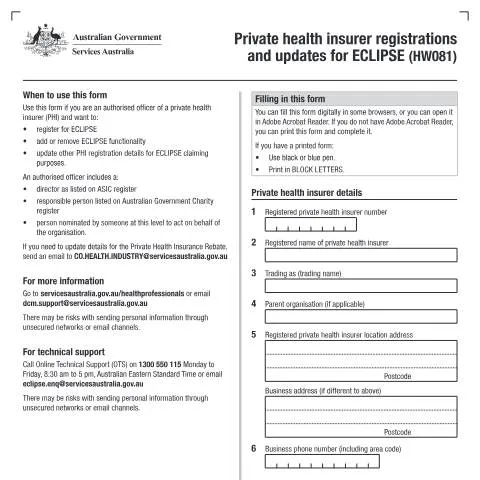
Navigating the HW081 Form: A Guide for Health Professionals
For health professionals in Australia, the path to maintaining compliance and secure registration with private health insurers is often paved with paperwork. The HW081 form, officially titled Private health insurer registrations and updates for ECLIPSE, is an essential document that plays a critical role in this process. It is crucial to understand not only how to fill out this form correctly, but also the implications of its submission and the subsequent steps involved.
Who Needs to Engage with the HW081?
The HW081 form is designed for a specific audience within the healthcare sector, particularly those involved in private health insurance. This includes health professionals such as:
- Medical practitioners
- Allied health professionals
- Private hospitals and clinics
- Health service providers
Individuals who are either registering for the first time or updating their existing details with ECLIPSE — the electronic claims system — are required to navigate this form. It’s essential to note that while the primary users are health professionals, organisations submitting on behalf of multiple practitioners can also use this form.
Unique Circumstances
There are specific scenarios where the completion of the HW081 form may differ or require additional details. For instance:
- New Registrations: Practitioners establishing their practice or moving to a new service location will need to ensure all sections are filled accurately to avoid delays.
- Updating Information: Any changes in practice details, such as a new address, contact number, or accreditation status, must be promptly updated to maintain compliance.
- Multiple Providers: Organisations with several health professionals must ensure that each practitioner’s information is distinct and current to facilitate seamless claim processes.
Breaking Down the HW081 Form
Understanding each section of the HW081 form can significantly reduce the likelihood of errors and accelerate processing times. Below is a breakdown of the key sections that need careful attention.
Section 1: Provider Details
This section requires the inclusion of your practice name, ABN (Australian Business Number), and your Tax File Number (TFN). Any discrepancies here can lead to delays. It is paramount that these details are consistent with the records held by the Australian Taxation Office (ATO).
Section 2: Contact Information
Health professionals must provide accurate contact details. A common pitfall is entering outdated or incorrect email addresses or phone numbers, which can hinder communication regarding claims or updates.
Section 3: Service Provider Type
Identifying the correct service provider type is critical. Options can range from individual practitioners to multi-disciplinary health practices. Selecting the wrong category may result in claims being rejected, leading to financial implications for the health professional.
Section 4: Registration with Private Health Insurers
This section is where you specify which private health insurers you’re registered with. Ensure that the list is comprehensive, as insurers might need a complete log when processing claims.
Section 5: Declaration and Signature
The declaration confirms the accuracy of the provided information and acknowledges compliance with relevant legislation. A common oversight is not signing the form before submission, which can cause processing delays. Double-check that all required fields are completed and that you’ve included your signature.
The Importance of Timeliness in Submission
Submitting the HW081 form in a timely manner is essential for ensuring continuous eligibility in the ECLIPSE system. There are a few key points to consider:
- Registration Deadlines: Be aware of specific time frames for registration or updates to avoid lapses in insurance coverage.
- Claim Processing Times: Early submission can lead to faster processing of claims, ensuring that services provided are reimbursed promptly.
From Submission to Decision: What Happens Next?
Once the HW081 form is submitted, several important steps follow:
- Acknowledgment of Receipt: You should receive an acknowledgment confirming that your form has been received.
- Review Process: Services Australia will conduct a thorough review of the submitted details. This may take several weeks, depending on the volume of applications.
- Notification of Outcome: You will receive a notification regarding the success of your registration or updates. If there are issues, you may be asked to provide further information.
Potential Outcomes
Upon completion of this process, the potential outcomes may include:
- Successful Registration: Your details are confirmed and updated in the ECLIPSE system.
- Request for More Information: If details are incomplete or unclear, you will be notified to provide additional documentation.
- Refusal of Registration: If there are significant discrepancies or non-compliance with guidelines, registration may be denied, necessitating a review and re-application.
A Regulatory Framework Supporting the HW081
The HW081 form operates within a larger regulatory framework that ensures that private health insurance practices in Australia are governed appropriately. The Administrative Decisions (Judicial Review) Act 1977 plays a significant role here, as it allows for merits review via the Administrative Appeals Tribunal (AAT). This means that if a practitioner believes a decision made regarding their registration was unfair, they have the right to seek reconsideration.
The Role of Services Australia
Services Australia is the key administrative body overseeing the processes related to health professional registrations. Their role includes ensuring compliance with health regulations and facilitating access to necessary resources. Understanding how this body operates can clarify the complexities involved in using the HW081 form.
Distinguishing the HW081 from Other Forms
It’s important to recognize how the HW081 form differs from other submissions within the health sector. For instance, many may confuse it with forms related to patient registration or billing submissions.
| Form Type | Purpose | Key Users |
|---|---|---|
| HW081 | Registration/Update for Providers | Health Professionals, Clinics |
| Claim Submission Forms | Reimbursement for Services Rendered | Health Professionals, Providers |
| Patient Registration Forms | Registering Patients for Care | Clinics, Hospitals |
By understanding these distinctions, professionals can ensure they are using the correct documentation, thereby improving their efficiency and compliance within the healthcare system.
Practical Tips for Navigating the HW081 Process
To assist in effectively managing the HW081 form, consider the following practical tips:
- Keep Documentation Handy: Always have your ABN, TFN, and contact information readily accessible before starting the form.
- Utilize Online Resources: Leverage any available online resources or guidelines from Services Australia to aid in your understanding.
- Seek Assistance: If you’re uncertain about filling out any section, don’t hesitate to seek help from colleagues or professional associations.
- Track Your Submission: Keep a copy of your completed form and any confirmation received to track your submission and follow up if necessary.
Successfully navigating the HW081 form is an essential step for health professionals looking to maintain their standing within the private health insurance landscape in Australia. By understanding the nuances and following a structured approach, practitioners can ensure a smooth registration process and focus on what truly matters: providing quality care to their patients.
Understanding the ECLIPSE Process for Private Health Insurers
The ECLIPSE system (Electronic Claim Lodgement Information Processing System) is an essential component for private health insurers in Australia, facilitating the seamless exchange of claims processing data. This system is designed to support the electronic submission of health insurance claims, significantly reducing the time it takes for providers to receive reimbursement. However, understanding how to navigate the ECLIPSE process for registrations and updates can be complex.
Firstly, private health insurers must ensure they are registered with the ECLIPSE system, which involves submitting the HW081 form. This form requests comprehensive details about the insurer’s business operations and contact details, as well as information about their claims processing capabilities. Insurers are required to provide their ABN (Australian Business Number), policy details, and any other relevant identifiers.
Additionally, keeping insurer details updated is crucial. Changes in business structure, contact information, or claims processing methods must be reported to Services Australia promptly. Failure to do so can disrupt the claims process and lead to potential financial penalties. Insurers should maintain an internal compliance schedule to ensure all updates are made promptly, leveraging the myGov platform for efficient access to the necessary forms.
Furthermore, it is advisable for insurers to engage in regular training for staff on the ECLIPSE system, as the electronic submission processes may undergo updates or changes. Staying informed about these developments can enhance overall efficiency and compliance.
Challenges and Solutions in ECLIPSE Registration and Updates
While the benefits of the ECLIPSE system are evident, private health insurers often face challenges when registering and updating their information. One of the primary challenges is the technical complexities associated with electronic submissions. Insurers may encounter issues with their IT systems, which can lead to delays in the registration process.
To mitigate these challenges, insurers are encouraged to engage IT professionals with expertise in health insurance claims processing systems. They can assist in troubleshooting issues and ensuring that software is compatible with ECLIPSE requirements. Additionally, regular checks for software updates and compliance with the latest ECLIPSE specifications can prevent technical difficulties.
Another common challenge is ensuring that all required documentation is complete and accurate. Incomplete submissions can lead to processing delays and potential rejections. To address this, insurers should establish a checklist of necessary documents and details required for the HW081 form. Implementing a quality control process before submission can significantly reduce errors and improve the likelihood of a successful registration or update.
Lastly, ongoing communication with Services Australia can help address any uncertainties regarding the registration process. Insurers are advised to contact the relevant department for advice or clarification, which can help preempt issues before they arise.
The Future of ECLIPSE and Its Impact on Private Health Insurance
As the Australian healthcare landscape evolves, so does the ECLIPSE system. Future developments are likely to involve enhanced data analytics capabilities, allowing insurers to gain deeper insights into claim patterns and trends. This could lead to more tailored services and improved risk management strategies.
Additionally, there is a growing emphasis on interoperability between different healthcare providers and insurers. The push for a more integrated health system may require private health insurers to adapt their processes to ensure seamless data exchange not just within their own systems, but with other stakeholders in the healthcare ecosystem.
Insurers will also need to keep an eye on legislative changes that could impact the ECLIPSE system. Regulatory advancements surrounding data privacy and cybersecurity must be navigated carefully to protect sensitive information while remaining compliant with Australian laws.
In summary, as private health insurers continue to engage with the ECLIPSE system, a proactive approach to registration and updates is necessary. By understanding the intricacies of the process, addressing common challenges, and adapting to future changes, insurers can leverage ECLIPSE to enhance their operational efficiency and improve service delivery to their clients.