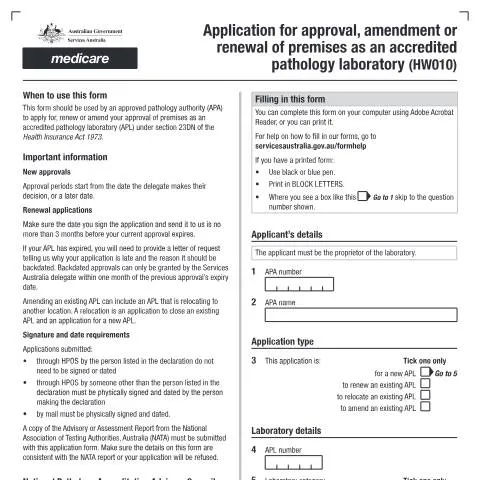
Navigating the HW010 Form: Your Path to Accreditation as a Pathology Laboratory
In the realm of healthcare in Australia, ensuring that pathology laboratories meet stringent standards is paramount. The Application for Approval, Amendment or Renewal of Premises as an Accredited Pathology Laboratory Form (HW010), issued by Services Australia, plays a crucial role in this process. For those seeking accreditation, understanding this form is essential—not just for compliance, but for the smooth operation of their healthcare services.
The Regulatory Landscape: A Foundation for Quality
The journey of the HW010 form is steeped in the broader regulatory framework that governs healthcare practices in Australia. Accreditation of pathology laboratories is not merely a bureaucratic requirement; it serves a higher purpose of safeguarding public health. This form aligns with national standards set forth in various legislative guidelines, ensuring that laboratories provide reliable and accurate testing services.
One must recognize that the National Pathology Accreditation Advisory Council (NPAAC) provides guidance on the standards required for pathology services. These standards are pivotal in evaluating laboratories for accreditation. The HW010 form allows laboratories to demonstrate their adherence to these standards, thereby reinforcing trust in the Australian healthcare system.
Who Should Complete the HW010 Form?
The HW010 is primarily aimed at proprietors of pathology laboratories—be they existing facilities seeking renewal or new entities aiming for first-time accreditation. Specific scenarios warrant the completion of this form:
- New laboratory establishment: If you are setting up a new pathology lab, this form is your first step toward being recognized as an accredited facility.
- Renewal of accreditation: Existing laboratories whose accreditation is nearing expiration must submit the HW010 to continue operations without disruption.
- Amendments to existing premises: Any significant changes to the laboratory’s physical location or operational capacity necessitate an application through this form.
Failure to submit the HW010 in a timely manner could result in lapses in accreditation, exposing the laboratory to potential legal ramifications and operational challenges.
Diving into the HW010: A Section-by-Section Breakdown
Completing the HW010 requires careful attention to detail. Each section of the form has been designed to capture critical information relevant to the laboratory’s operations. Below, we will dissect the form into its component parts, highlighting key elements and common pitfalls.
Section A: Laboratory Information
This section demands comprehensive details about the laboratory. Key information includes:
- Laboratory name and address
- Contact details of the responsible person
- Details of the governing body or ownership structure
Common mistakes in this section include providing outdated contact information or failing to include all necessary ownership details. Ensure that this information is current and accurate, as it will be verified during the accreditation process.
Section B: Accreditation History
Here, the laboratory must detail its accreditation history. Information required may cover:
- Previous accreditations and holders of these accreditations
- Details on any past non-compliance issues and resolutions
Avoiding ambiguities in this section is crucial. Incomplete or vague responses can delay the approval process, as they may raise concerns about the laboratory's track record.
Section C: Compliance with NPAAC Standards
Laboratories must demonstrate adherence to the NPAAC standards. This section includes:
- A checklist of compliance with laboratory standards
- Supporting documentation or references
Documentation provided must be thorough and verifiable. Inadequate compliance evidence is a common reason for application denials, so ensure documentation is robust and readily accessible.
Section D: Operational Procedures
This part of the form captures the laboratory’s operational protocols. Key areas of focus include:
- Sample handling and storage procedures
- Staff training and qualifications
- Quality assurance measures in place
Be clear and detailed in describing procedures. Failing to adequately showcase operational diligence can raise red flags during the review process.
Submitting Your Application: Choices and Channels
While the HW010 form can be completed and submitted through various channels, understanding the best approach for your laboratory is vital. Services Australia provides several options:
- Online Submission: Utilizing the myGov platform, laboratories can submit their application digitally. This method is typically faster and allows for real-time tracking of the application status.
- Paper Submission: For those preferring a traditional route, printed forms can be sent via mail. However, this method may involve longer processing times.
- In-person Submission: Certain regional offices of Services Australia accept walk-in applications, providing an opportunity for immediate assistance.
Regardless of the method chosen, ensure the application is complete. Incomplete submissions can lead to delays or outright rejection of your application.
The Aftermath: What Happens Next?
Once submitted, the HW010 form enters the review process, and understanding what follows is crucial for laboratory owners. Typically, the timeline for review can vary, and tracking progress is advisable.
Monitoring Your Application
Using the myGov platform allows for easy tracking of your application status. If you opted for paper submission, consider keeping a record of the submission date and tracking any correspondence from Services Australia. In cases of prolonged silence, a follow-up inquiry can be initiated via the provided contact details.
Responding to Requests for Additional Information
It’s not uncommon for Services Australia to request further details or clarification during the review process. Respond promptly to any such requests to avoid unnecessary delays. Ensure that any additional documentation requested is submitted in a timely manner, as these requests are often time-sensitive.
Pitfalls to Avoid: Ensuring a Smooth Process
Even small oversights in the HW010 form can lead to significant delays or outright denial of your application. Here are some pitfalls to be mindful of:
- Incomplete Forms: Always double-check that all sections are fully completed before submission.
- Incorrect Information: Providing outdated or incorrect contact details can lead to miscommunication and delays.
- Lack of Supporting Documents: Ensure that any claims made in the application are backed by proper documentation.
Handling Rejections and Next Steps
In the unfortunate event that your application is rejected, understanding your options is critical. You will receive notification detailing the reasons for denial, which often include:
- Insufficient compliance evidence
- Incomplete or incorrect form submission
- Failure to meet accreditation standards
In such cases, you may appeal the decision by providing additional evidence or correcting any oversights. The appeal process is guided by the Administrative Decisions (Judicial Review) Act 1977 (Cth), and merits review can be sought through the Administrative Appeals Tribunal (AAT). It is advisable to seek guidance on how best to present your appeal.
Final Thoughts: Preparing for a Successful Accreditation Journey
Successfully navigating the HW010 process is a concrete step towards ensuring your pathology laboratory is recognized as a credible and compliant entity within the Australian healthcare landscape. By understanding the intricacies of the application process, adhering to NPAAC standards, and staying vigilant through the submission and review stages, laboratory owners can position themselves for success.
Prepare thoroughly, keep communication lines open, and approach each stage of the process with diligence. The HW010 is not just a form; it is a gateway to maintaining the high standards of pathology services that the Australian public deserves.
Understanding the Role of Accredited Pathology Laboratories in Australia
Accredited pathology laboratories play a crucial role in the Australian healthcare system, providing essential services in diagnostics and medical testing. These laboratories are responsible for performing a wide range of tests that help in the diagnosis, monitoring, and treatment of diseases. To ensure the integrity and reliability of the results they provide, pathology laboratories must adhere to strict regulatory standards set by the National Association of Testing Authorities (NATA) and must obtain accreditation from the relevant authorities. This involves not only demonstrating compliance with technical standards but also undergoing regular assessments and audits.
In Australia, the accreditation process typically requires laboratories to keep up with the latest advancements in medical technology and testing methodologies. The roles they play extend beyond just diagnostics; they contribute to public health surveillance, epidemiology, and research, thereby supporting broader health initiatives. When applying for accreditation, amendments, or renewals using Form HW010, laboratories must clearly outline the scope of their services, laboratory capabilities, and any changes they wish to implement.
Common Obstacles and Considerations in the Accreditation Process
Applying for accreditation, amendment, or renewal as a pathology laboratory can present several challenges. One of the most common obstacles is the requirement for comprehensive documentation that supports the laboratory's compliance with regulatory standards. Laboratories must prepare a multitude of records, including but not limited to, quality assurance protocols, personnel qualifications, and equipment maintenance logs. These documents not only demonstrate adherence to technical standards but also establish a baseline of the laboratory's operational capabilities.
Another significant consideration is the laboratory's ability to handle potential changes in workload or scope of services. For instance, if a laboratory plans to introduce new testing methods or expand its service offerings, it must submit a detailed plan demonstrating that appropriate training will be provided to staff and that sufficient resources are in place to manage the increased demand. This must be clearly articulated in the application, as failure to do so may result in delays or rejections of the application.
Moreover, laboratories are often required to engage with stakeholders, including health professionals and patients, to gather feedback and ensure that the services provided meet the community's needs. This engagement can be crucial in justifying the relevance and necessity of proposed amendments or new services in the application submitted using Form HW010. Furthermore, staying abreast of changes in legislation and guidelines is vital, as non-compliance with updated requirements can hinder the accreditation process.
Future Trends and Innovations in Pathology Laboratory Accreditation
The landscape of pathology laboratories in Australia is continually evolving, driven by advancements in technology and changing healthcare needs. Digital health solutions, including telepathology and electronic reporting of lab results, are becoming increasingly prevalent. As these technologies advance, laboratories must adapt not only their testing capabilities but also their accreditation strategies.
Future accreditation processes may integrate more digital components, allowing for online submissions and real-time tracking of application statuses. Laboratories seeking to maintain accreditation will need to invest in training staff on these new technologies and updating their procedures to align with digital innovations. It’s also essential that they demonstrate how these innovations improve patient outcomes or enhance operational efficiency as part of their accreditation application.
Additionally, there is an increasing focus on sustainability and environmental responsibility within healthcare. Accredited pathology laboratories may soon be expected to address environmental impacts as part of their accreditation. This could involve adopting eco-friendly practices and demonstrating their commitment to reducing waste and energy consumption in their operations. Laboratories should begin to prepare for these potential changes by implementing sustainable practices and documenting these efforts, so they can be included in their accreditation applications.
The shift toward personalized medicine is another trend that could influence the landscape of accreditation. As treatments become more tailored to individual patients based on genetic testing and biomarkers, laboratories may need to adapt their testing capabilities and accreditation strategies to align with these advancements. This could necessitate additional training and a commitment to staying updated with the latest developments in biomedical technology.