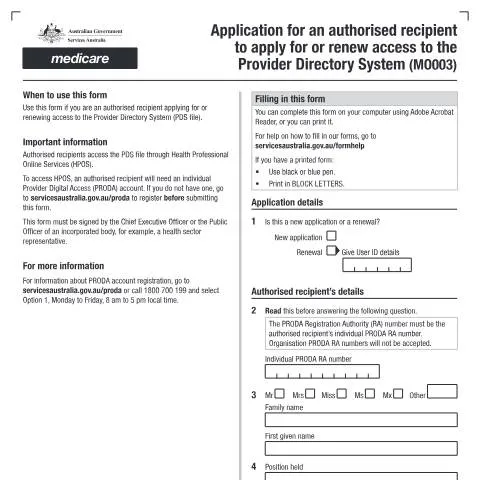
The Significance of the MO003 Form in Healthcare Access
When navigating the complex landscape of healthcare services in Australia, obtaining access to the Provider Directory System (PDS) can be a pivotal step for health professionals. The Application for an authorised recipient to apply for or renew access to the Provider Directory System form (MO003) plays a crucial role in this process. This document ensures that healthcare providers can efficiently manage the flow of information and resources essential for delivering quality healthcare.
The necessity for an authorised recipient to apply reflects the importance of secure access and data management in the healthcare sector. To effectively utilise this form, applicants must understand not only its purpose but also the specific procedures involved in completing and submitting it.
Understanding the Profiles of Relevant Applicants
This section focuses on the types of individuals who typically engage with the MO003 form. Understanding who needs to apply can streamline the process and clarify the requirements associated with each profile.
Health Professionals and Administrative Representatives
- Health Practitioners: Medical practitioners, nurses, and allied health professionals often need to apply to gain access to the PDS.
- Administrative Staff: Those managing health services may also be eligible to apply as authorised recipients.
Each profile has its own set of implications and responsibilities. For instance, medical practitioners may require the PDS for patient referrals and billing purposes, while administrative staff might need access to streamline office operations and ensure compliance with regulatory requirements.
Breaking Down the MO003 Form: Key Sections and Common Pitfalls
Completing the MO003 form necessitates careful attention to detail. The form is structured to gather specific information about the applicant, their role, and the justification for accessing the PDS. Below, we dissect the key sections of the form.
Section 1: Applicant Details
This section requests fundamental information such as the name, contact details, and professional qualifications of the applicant. A common pitfall here is the inclusion of outdated or incorrect information, leading to processing delays. It is crucial to double-check all entries and ensure they match official documentation.
Section 2: Authorisation Scope
In this section, applicants must specify the extent of their authorisation. Misunderstanding the scope can result in incomplete applications. Applicants should clearly articulate their role and why they need access to the PDS, providing clarity to the reviewing authority.
Section 3: Supporting Documentation
Many applicants overlook the necessity of attaching supplementary documents that validate their request. This could include proof of identity, professional registration, or any other relevant credentials. Failing to provide sufficient documentation can lead to a rejection of the application.
Navigating the Submission Process: Tips for a Smooth Experience
Once the MO003 form is completed, the submission process becomes the next hurdle. Applicants should be aware of the various channels through which they can submit their forms, with emphasis on the electronic submission through myGov.
Online Submission via myGov
Utilising myGov for submitting the MO003 form is often the most efficient choice. To do this, applicants must have an active myGov account linked to Services Australia. Once logged in, navigate to the appropriate section to upload the completed form and any associated documents.
It’s advisable to keep a copy of everything submitted and take note of any confirmation received. This serves as a record of the application and provides a reference for future inquiries.
What Happens After Submission? Understanding the Review Process
Upon submission, the application enters a review phase where Services Australia evaluates the documentation provided. Understanding this process can alleviate anxiety and set realistic expectations.
Review Timeline and Possible Outcomes
| Outcome | Description | Next Steps |
|---|---|---|
| Approved | The application has been accepted, and access to the PDS is granted. | Follow the instructions for accessing the PDS. |
| Pending | Further information is needed. | Respond to any requests promptly to avoid delays. |
| Rejected | The application did not meet the necessary criteria. | Review the reasons provided, and consider reapplying with corrected information or new documents. |
Understanding these outcomes can empower applicants to respond appropriately and prepare for any necessary follow-up actions.
Handling Errors and Addressing Rejections
Encountering difficulties during the application process, such as errors or a rejection, can be daunting. However, knowing how to effectively address these issues is crucial.
What to Do If Your Application Is Rejected
In the event of a rejection, applicants should carefully review the feedback provided by Services Australia. Common reasons for rejection include:
- Inadequate supporting documents
- Incomplete information
- Failure to meet eligibility requirements
Once the reasons for rejection are identified, applicants can make the necessary adjustments and resubmit. It's also wise to reach out to Services Australia for clarity on specific concerns or to seek advice on how to enhance the application.
Establishing Communication with Services Australia
Maintaining open channels of communication can significantly enhance the experience when dealing with the MO003 form. Applicants should be aware of the various ways to engage with Services Australia for support and updates.
Contacting Services Australia
Whether it's seeking clarification on the form or checking the status of an application, knowing how to contact the right department is vital. Applicants can:
- Call the dedicated helpline for direct assistance
- Use online chat services available through the Services Australia website
- Visit a local office if face-to-face interaction is preferred
When reaching out, having the application details on hand can streamline the discussion and lead to quicker resolutions.
The Broader Context: Integration of MO003 in Health Service Delivery
Understanding the MO003 form's place within the larger framework of health service delivery reveals its significance beyond just an administrative task. It is part of a network of forms and systems that ensure healthcare professionals can perform their duties effectively.
The Role of the Provider Directory System
The PDS serves as a central hub for health professionals to access critical information, including referrals and service availability. By facilitating access to this system, the MO003 form ultimately contributes to enhanced patient care and streamlined operations within healthcare settings.
As Australia’s healthcare landscape evolves, the incorporation of digital resources becomes increasingly critical. The MO003 form embodies this transition, ensuring that healthcare providers can leverage the benefits of technology while adhering to regulatory standards.
Final Thoughts on Efficiently Managing Your MO003 Submission
Completing the MO003 form with diligence and understanding the subsequent steps can significantly influence the success of your application. By familiarising yourself with the requirements, maintaining accurate records, and engaging with Services Australia proactively, you can navigate the process with greater efficiency.
Incorporating these strategies will not only expedite your access to the Provider Directory System but also foster a more collaborative environment within the healthcare sector, ultimately benefiting practitioners and patients alike.
Understanding the Role of an Authorised Recipient in the Provider Directory System
The Provider Directory System (PDS) plays a crucial role in Australia's healthcare framework, linking providers with necessary resources and information. Within this system, the role of an Authorised Recipient is vital in ensuring that sensitive health information is accessed and managed appropriately.
An Authorised Recipient is typically an individual or entity that has been granted specific authority to act on behalf of a healthcare provider in accessing various services available through the PDS. This might include healthcare professionals such as general practitioners, specialists, or administrators who need to coordinate care for patients. By designating an Authorised Recipient, healthcare providers can streamline processes, ensuring that vital information is accessed safely and efficiently.
To qualify as an Authorised Recipient, certain criteria must be met. These may include:
Professional Qualifications: The individual should possess relevant qualifications in the healthcare sector, affirming their capability to handle sensitive patient data.
Organisational Affiliation: The applicant must be associated with a registered healthcare service provider, ensuring that they are acting within a legitimate context.
Compliance with Privacy Standards: Authorised Recipients must adhere to strict privacy norms as outlined in the Privacy Act 1988 (Cth), ensuring that patient information is used solely for intended purposes.
The application process for becoming an Authorised Recipient involves filling out the MO003 form, which details the applicant's professional background, their relationship with the organisation, and the scope of access required. Once submitted, it is subjected to a review process by the Department of Health and relevant governing bodies, ensuring that only qualified individuals gain access to the PDS.
Common Challenges Faced by Applicants and How to Overcome Them
Navigating the application process for the MO003 form can present various challenges for potential Authorised Recipients. Understanding these challenges, as well as how to effectively address them, is essential for a smooth application experience.
Complexity of Required Documentation: One significant hurdle applicants often face is the need to gather and submit extensive documentation. This may include proof of qualifications, professional registrations, and organisational affiliations. To streamline this, applicants should develop a checklist of required documents based on the guidelines provided along with the MO003 form. It’s advisable to double-check the requirements on the official website of the Department of Health to ensure that no documentation is overlooked.
Clarifying Scope of Access: Applicants must clearly outline the type of access they require within the PDS. This can sometimes be ambiguous, leading to delays in the review process. To mitigate this, potential recipients should consult with their organisation's compliance officer or legal advisor to accurately define the scope of access needed. Providing specifics not only enhances application clarity but also demonstrates a responsible approach to data management.
Meeting Deadlines: Like many government processes, timelines for submitting applications and receiving responses can be strict. Missing a deadline can set an application back significantly. To avoid this, applicants should mark important dates on their calendars and consider submitting their applications well in advance. Utilizing digital tools or reminders can help ensure that key deadlines are not overlooked.
Understanding Review Criteria: The criteria that the Department of Health uses to evaluate applications may not always be transparent. It can be beneficial for applicants to seek feedback from peers or supervisors who have previously gone through the process. Learning from their experiences can provide insights into what specific aspects the review team prioritises, thus increasing the chances of a successful application.
Responding to Requests for Additional Information: If the reviewing body requires further information, timely responses are crucial. Establishing a dedicated point of contact within the organisation to handle these requests can facilitate quicker responses. This ensures that any queries are addressed efficiently and helps maintain communication lines open with the Department of Health.
By anticipating these challenges and equipping themselves with strategies to address them, applicants can enhance their chances of successfully becoming an Authorised Recipient within the Provider Directory System.
The Importance of Continuous Education and Compliance for Authorised Recipients
Once an individual becomes an Authorised Recipient, the responsibility does not end with the approval of the MO003 application. Continuous education and compliance with regulations are essential for maintaining access to the Provider Directory System and ensuring the safe handling of sensitive information.
Ongoing Training: Authorised Recipients should engage in regular training programs focused on data protection laws, ethical guidelines, and new developments within the PDS. The healthcare landscape is constantly evolving, with updates to privacy regulations and technology. Participating in workshops or seminars offered by industry bodies or professional associations can help recipients stay informed and prepared to adapt to changes in compliance requirements.
Understanding Changes in Legislation: It is crucial for Authorised Recipients to be aware of any amendments to relevant legislation, particularly the Privacy Act 1988 (Cth) and the Healthcare Identifiers Act 2010 (Cth). Governments periodically update laws that affect how personal information is collected, stored, and shared. Staying abreast of these changes helps ensure that compliance is maintained and reinforces the recipient's commitment to safeguarding patient data.
Implementing Best Practices: The implementation of best practices for data management is vital. Authorised Recipients should foster a culture of compliance within their organisation, leading by example. This includes setting up robust protocols for accessing, storing, and transmitting patient information. Regular audits and reviews of these practices will help identify potential gaps and improve overall data governance.
Establishing Communication Protocols: Maintaining open lines of communication with the Department of Health is essential. Authorised Recipients should ensure that any updates regarding their professional status, changes in their role, or alterations in their organisational structure are duly reported. Being proactive in communication helps in building a trustworthy relationship with regulatory bodies and demonstrates a commitment to responsible data management practices.
Engaging in Peer Networking: Joining networks or forums of fellow Authorised Recipients can be an invaluable resource. Sharing experiences and discussing challenges can lead to enhanced understanding and better practices. Networking provides opportunities for collaboration, fostering an environment where best practices can be shared and developed collectively.
In summary, the journey of an Authorised Recipient extends beyond the initial application process. Emphasizing continuous education, compliance, and proactive engagement with the regulatory environment is crucial for maintaining access to the Provider Directory System and ensuring the integrity of Australia’s healthcare system.