Navigating the MO008 Form: A Lifeline for Health Professionals
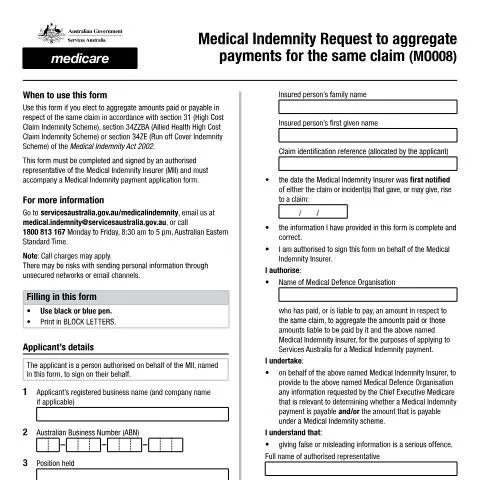
When facing the intricacies of medical indemnity payments, health professionals in Australia often find themselves navigating a labyrinth of paperwork and regulations. The Medical Indemnity Request to Aggregate Payments for the Same Claim Form (MO008) serves as a vital tool, providing a structured way to seek the aggregation of payments pertaining to identical claims. It is not merely a form; it embodies the complexity of medical indemnity and the essential need for clarity in financial transactions within the healthcare system.
Understanding the Context of the MO008 Form
The need for the MO008 form arises primarily within the context of medical indemnity, which safeguards healthcare providers against claims of negligence. This form is particularly relevant for health professionals who have incurred multiple payments for the same claim but wish to consolidate these into a single request.
Primarily, this form is utilized by:
- Doctors and specialists seeking to aggregate payments for claims they have already submitted.
- Health professionals who are aware of the legal and administrative processes involved.
- Practitioners navigating the complexities of medical indemnity insurance and related claims.
By understanding the role of this form, health professionals can better prepare themselves to manage their indemnity claims efficiently.
Deciphering the Sections of the MO008 Form
The MO008 form contains several crucial sections that must be meticulously completed to ensure that the request is processed without delay. Each section has specific requirements, and overlooking any detail could result in complications.
Section 1: Personal Details
This section requires the applicant to provide personal identification details, including:
- Full name
- Contact information
- Tax File Number (TFN)
Health professionals must double-check entries in this section to avoid mismatches that could cause processing delays.
Section 2: Claim Details
Here, the applicant must provide comprehensive information regarding the claims in question. This includes:
- The claim reference numbers
- The dates when claims were submitted
- A brief description of the services rendered
It is critical to ensure that all claim details align with previously submitted documentation. Inconsistencies may lead to complications or outright refusals.
Section 3: Aggregation Request
This pivotal section is where the aggregation intent is clearly communicated. The applicant must explain why aggregation is necessary. This could involve detailing how multiple payments relate to a singular event or circumstance. Providing a well-articulated rationale improves the chances of acceptance.
Section 4: Signatories and Authorisations
The final section requires the signature of the health professional as well as any relevant authorisations. Here, it's essential to confirm that all designated signatories have been appropriately informed and that their consent has been duly obtained.
Preferred Submission Channels: Paper vs. Online
Submitting the MO008 form can be done through various channels, each with distinct advantages and considerations. Understanding these can enhance the efficiency of the submission process.
Online Submission through myGov
The preferred method for many health professionals is online submission via myGov, which promotes efficiency and real-time tracking. Here’s what makes it advantageous:
- Speed: Online submissions are typically processed faster.
- Tracking: Applicants can monitor their request status directly through the myGov portal.
- Convenience: Submissions can be completed from anywhere, eliminating the need for physical paperwork.
Paper Submission
Despite the push for digital, some may prefer or require paper submissions. This method, while traditional, carries its own set of challenges:
- Time-Consuming: The processing time can be significantly longer.
- Delivery Risks: There’s always a risk of documents being lost in transit.
- No Tracking: Applicants cannot track the status of a paper submission as easily.
It’s essential for applicants to weigh these options carefully based on their circumstances and preferences.
Critical Timelines: When to Apply and What Happens Next
Timing is integral to the submission of the MO008 form. Understanding the deadlines associated with submitting this request can prevent unnecessary delays.
Generally, applications for aggregation should be made as soon as the health professional becomes aware of multiple payments related to a single claim. Failing to submit promptly may lead to complications in processing or even potential financial losses.
Once submitted, health professionals can expect a timeline including:
- Initial Acknowledgment: Typically received within a few working days.
- Processing Time: This can vary, but a standard window often falls anywhere from several weeks to a few months.
- Final Decision: Once processed, the applicant will receive notification regarding the outcome of their request.
The Role of the MO008 Form Within a Larger Framework of Claims
It's crucial to recognize that the MO008 form does not exist in isolation. It plays a significant role within a larger framework of claims and indemnity processes.
For health professionals, the aggregation of payments via this form is often the culmination of a series of steps involving:
- Initial claim submissions to medical indemnity insurers.
- Engagement with Services Australia for claims processing.
- Sequential requests for additional information or documentation as needed.
Understanding how the MO008 fits into this landscape allows health professionals to anticipate subsequent steps and prepare accordingly.
Addressing Challenges: What to Do if Your Request is Rejected
The potential for rejection is a reality that health professionals must prepare for when submitting the MO008 form. Understanding the recourse available can demystify the process and empower applicants.
In the event of a rejection, applicants should:
- Review the Reason for Rejection: The notification will typically outline the grounds for the decision.
- Gather Supporting Documentation: It may be necessary to compile additional evidence or clarification regarding the claims in question.
- Resubmit or Appeal: Depending on the circumstances, applicants may either resubmit the application with the necessary adjustments or file an official appeal through the relevant channels.
Effective communication with Services Australia is paramount during this process to ensure that all parties have clarity on the issues at stake.
Tracking Your Application Progress: Best Practices for Follow-Up
Once the MO008 form has been submitted, maintaining awareness of its status is crucial for health professionals. Monitoring the application helps ensure timely processing and an understanding of any further requirements.
Here are some best practices for tracking your application:
- Regularly Check myGov: For those who submitted online, logging into the myGov account can provide real-time updates.
- Maintain Records: Keeping copies of all submitted documents ensures you have a reference in case of queries.
- Direct Communication: If delays arise, reaching out to the appropriate contact at Services Australia can often provide clarity and expedite the process.
Healthcare professionals should remain proactive in their approach to tracking their claims and communicating with Services Australia.
Who Really Needs to Fill Out the MO008?
While the MO008 form is aimed primarily at health professionals, it is important to delve into the specifics of who benefits most from this aggregation request process.
Typically, the following profiles may find the form indispensable:
- Specialists with Multiple Claims: Doctors dealing with complex cases and multiple indemnity claims will find this form essential for financial clarity.
- Practitioners in High-Risk Fields: Health professionals in areas such as surgery or obstetrics may face higher frequencies of claims, making the aggregation process vital.
- Health Services Administrators: Those managing the financial and administrative aspects of health services can leverage this form to streamline payment processing and enhance financial oversight.
By identifying the right audience for the MO008 form, health professionals can ensure that they utilize the tool effectively to navigate their indemnity claims.
Final Thoughts: Empowering Health Professionals Through Knowledge
Understanding the nuances of the MO008 form is essential for health professionals in successfully managing their medical indemnity claims. By grasping the intricacies of each section, knowing the submission channels, and preparing for potential challenges, applicants can significantly enhance their chances of a smooth process. The gathering of this knowledge not only empowers individuals but strengthens the healthcare system as a whole by ensuring that practitioners are adequately protected against potential liabilities.
Understanding Medical Indemnity Insurance in Australia
Medical indemnity insurance serves as a safety net for healthcare professionals and institutions, protecting them against legal claims made by patients for negligence or malpractice. In Australia, the landscape of medical indemnity insurance is governed by various regulatory frameworks, with each state and territory having its specific requirements and guidelines. Understanding these nuances is crucial for medical practitioners and administrators alike.
One of the key components of medical indemnity is the process for making claims, including the ability to aggregate payments for the same claim. This not only streamlines the process but also helps ensure that practitioners receive timely compensation for any valid claims lodged against them. The Medical Indemnity Request Form (MO008) facilitates this consolidation, allowing practitioners to submit multiple claims related to the same incident in a single request.
When submitting an MO008, it is essential to provide clear documentation supporting the claims, including detailed incident reports, patient communication records, and any legal correspondence. Each claim must be accurately detailed in the form, clearly identifying the nature of the claims and how they relate to one another. This level of detail is necessary for the respective agency, such as Services Australia, to evaluate the claims effectively and determine the appropriate course of action.
Navigating the Aggregation Process for Multiple Claims
Aggregating payments for the same claim can significantly simplify the administrative burden on healthcare providers. To navigate this process effectively, it's important to understand the steps involved in the MO008 submission and the criteria for successful aggregation.
Firstly, ensure that each component of the claim is documented separately before merging them under a single MO008 request. This includes the date and nature of each incident, the specific medical services involved, and the corresponding costs associated with each claim. Be aware that not all claims may be eligible for aggregation; claims must stem from the same incident or closely related incidents to qualify.
Additionally, it’s advisable to consult with your medical indemnity insurer and legal advisors. They can provide insights into how previous similar cases have been handled, which can inform your aggregation strategy. Also, ensure that all deadlines for submitting claims are adhered to, as delays can result in claim rejections or reduced compensation.
Finally, follow up after submission to verify that your request is being processed correctly. Making use of Services Australia’s online services through your myGov account can streamline this process, allowing you to track the status of your claim and receive timely updates directly related to your submission.
Common Challenges and Solutions in Claim Aggregation
While navigating the medical indemnity claim aggregation process, practitioners may encounter several challenges that can hinder their ability to receive timely compensation. Knowing these challenges and understanding potential solutions can enhance the claims experience.
One common issue arises from incomplete documentation. Claims submitted without sufficient supporting evidence are often delayed or rejected. To overcome this, practitioners should maintain meticulous records of all patient interactions and ensure that any documentation related to the claims is complete and accurate before submission. Regular training in documentation best practices can also help staff minimize errors.
Another challenge is understanding the nuances of what constitutes a ‘related’ incident. For example, if multiple patients are involved due to a single event (such as a surgical complication), practitioners must clearly establish how each claim is interconnected. Seeking clarification from your indemnity insurer on aggregation rules can help illuminate these connections.
Practitioners may also face delays in processing times due to administrative bottlenecks within Services Australia or other governing bodies. To mitigate this, it is advisable to submit all claims as early as possible and to use electronic submission channels when available, as these are typically processed more efficiently than paper submissions.
Finally, understanding the legal framework, such as the Administrative Decisions (Judicial Review) Act 1977 (Cth), can help in appealing decisions related to claims or in case of disputes. Consulting with legal professionals who specialize in medical indemnity can provide strategic insights into navigating these bureaucratic challenges.