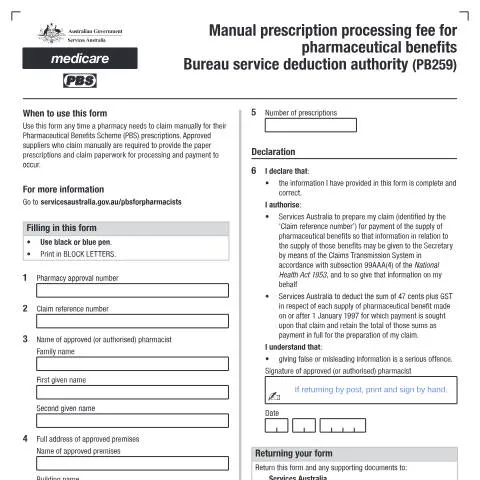
Navigating the Manual Prescription Processing Fee: Understanding PB259
In the world of health care in Australia, the Manual Prescription Processing Fee (PB259) is a key document for health professionals engaging in the provision of prescription services. This guide offers a comprehensive breakdown of the PB259 document, outlining its relevance, practical implications, and the nuanced aspects that health professionals need to consider when utilizing this resource.
Defining the Scope of PB259: What’s Inside?
The PB259 document is not merely a set of instructions; it represents a vital piece of the puzzle for health professionals involved in prescription management. Understanding its content is crucial for practitioners aiming to navigate the often-complex intersection of patient care and administrative requirements.
- Fee Structure: The document details the various fees associated with manual prescription processing, including different scenarios that might affect the cost.
- Eligibility Criteria: It outlines who qualifies for these fees, ensuring that only eligible patients or services are billed accordingly.
- Processing Guidelines: The PB259 provides frameworks for how prescriptions should be processed manually, ensuring compliance with relevant standards.
- Limitations: It’s important to note what the document does not cover, particularly in relation to other billing systems or procedures.
Integrating PB259 with Other Official Documents
Understanding how PB259 fits into the broader administrative landscape is essential for effective practice. This document does not exist in isolation; it interconnects with various other forms and guidelines provided by Services Australia as well as state-based health regulations.
- Comparison with Electronic Processing: While PB259 pertains to manual processing, the characteristics of electronic processing documents should be understood for a complete overview.
- Cross-reference with Medicare Guidelines: Many of the principles contained within PB259 are further elaborated in Medicare's broader guidelines, particularly regarding eligibility and billing procedures.
- Link to Child Support Services: In cases where prescriptions may intersect with child support considerations, it’s crucial to refer to related documents for comprehensive understanding.
Who Benefits from PB259? Identifying Key Stakeholders
This document primarily serves a range of health professionals, including general practitioners, specialists, and pharmacists. Understanding the specific challenges and contexts in which these stakeholders operate can illuminate why PB259 is indispensable.
- General Practitioners: Often at the forefront of patient care, GPs rely on PB259 to facilitate proper billing for their services.
- Pharmacists: They must adhere to the guidelines set forth in PB259 to ensure accurate claims for prescriptions.
- Healthcare Administrators: Administrators often utilize PB259 to guide staff in procedural compliance and financial management within their practices.
Avoiding Misinterpretations: Common Concerns with PB259
Health professionals engaging with PB259 may encounter several areas of confusion. Addressing these misunderstandings can prevent costly errors and ensure adherence to best practices.
It is crucial to ensure that the manual processing fee is only applied in appropriate contexts as defined within the document.
- Fee Application: Misunderstanding when to apply the fees can lead to incorrect billing practices.
- Documentation Requirements: Failing to maintain proper documentation can result in disputes with Services Australia over billing claims.
- Overlapping Services: Confusion can arise when other services overlap with those covered under PB259, leading to potential double billing or omissions.
Step-by-Step Guide: Effectively Using the PB259 Document
For health professionals seeking to utilise PB259 to its fullest potential, a clear procedural approach is essential. Here’s a practical step-by-step guide to assist in navigating the process.
- Familiarize Yourself with the Content: Read through the PB259 document entirely to understand the guidelines and stipulations.
- Determine Eligibility: Assess whether the services you provide qualify for the manual prescription processing fee.
- Document Services Rendered: Keep detailed records of all relevant services that might invoke the fees outlined in PB259.
- File Claims Appropriately: Ensure that claims are submitted in accordance with the stipulations outlined within PB259.
- Follow Up on Claims: If claims are disputed or denied, refer to PB259 to determine the correct course of action.
Real-world Scenarios: Applying PB259 in Practice
To contextualize the use of PB259, consider scenarios where health professionals may directly apply its guidelines. These examples can help clarify the document's practical implications.
- Scenario 1: Prescriptions for Chronic Illness: A GP managing patients with chronic illnesses can leverage PB259 to ensure that the manual processing fee is correctly charged for repeat prescriptions.
- Scenario 2: New Medication Regulations: A pharmacist navigating new drug regulations will need to understand how PB259 impacts the billing of these medications during manual processing.
- Scenario 3: Integrated Health Services: In a multidisciplinary team, different professionals need to be aligned on the use of PB259 to avoid misbilling when multiple services are provided.
Becoming Proficient: Enhancing Your Knowledge of PB259
Continuous education is key to ensuring that health professionals remain proficient in the use of PB259. Engaging with ongoing training sessions or workshops offered by relevant health services can provide valuable insights.
- Engage with Professional Bodies: Many health professional organisations offer resources focused on administrative guidelines.
- Attend Workshops: Participating in workshops can facilitate peer discussions, allowing for the sharing of best practices regarding the use of PB259.
- Utilize Online Resources: Leverage online platforms that share updates and interpretations of administrative guidelines to stay informed about any changes in PB259.
Conclusion: Making PB259 Work for You
Understanding and effectively using the Manual Prescription Processing Fee (PB259) is critical for health professionals within the Australian healthcare system. By mastering this document and employing it in real-world scenarios, you can enhance not only your administrative efficiency but also the quality of care you provide to your patients. As the landscape of healthcare continues to evolve, keeping abreast of documents like PB259 will empower you to navigate challenges with confidence and clarity.
Understanding the Manual Prescription Processing Fee: When and Why it Applies
In Australia, the Manual Prescription Processing Fee (MPPF), specifically referred to as PB259, is designed to cover the administrative costs associated with the manual processing of prescriptions that cannot be handled through standard electronic systems. This fee is particularly relevant for healthcare providers who might encounter situations where automated systems fail or when patients present prescriptions that diverge from the standard formats or protocols.
Understanding when this fee applies is crucial for both healthcare providers and patients. Typically, the MPPF comes into play when:
- A prescription is handwritten without the necessary details or clarity.
- Prescriptions are submitted that do not meet the usual electronic submission criteria.
- There are discrepancies in a patient’s medication history that require manual verification.
Providers must ensure that they are familiar with what necessitates manual processing to avoid unexpected fees. Patients, on the other hand, should be made aware of the implications of submitting prescriptions that require manual intervention. A clear dialogue between healthcare providers and patients about the potential for this fee can lead to better understanding and preparation, ultimately improving patient satisfaction and compliance.
How to Navigate the Application Process for PB259
Completing the PB259 form requires careful attention to detail and adherence to specific guidelines outlined by Services Australia. Here’s a step-by-step breakdown of the application process to ensure that your submission is processed smoothly:
- Preparation of Documents: Collect all necessary documentation that supports the need for manual prescription processing. This includes the original prescription, any prior correspondence regarding the prescription, and relevant patient identification details.
- Accessing the Form: The PB259 form can typically be accessed online through the myGov portal. Users must have their myGov credentials ready, as this will be the primary means of submission.
- Filling Out the Form: When completing the PB259 form, accuracy is paramount. Ensure that all fields are filled out completely, with special attention to patient details and the specifics of the prescription. Errors or omissions can lead to delays or rejections of the application.
- Submitting the Form: After filling out the form, submit it electronically through the myGov platform. If you are unable to access myGov, contact your local Centrelink office for alternative submission methods.
- Follow-Up: After submission, keep a record of your application and any reference numbers provided. It’s advisable to follow up within a few weeks to confirm the status of your application and to address any potential issues that may arise.
This structured approach ensures that applicants have a clear pathway to successfully navigate the administrative proceedings associated with the MPPF, thus minimizing downtime in patient care and medication access.
The Financial Implications of PB259 for Patients and Providers
The Manual Prescription Processing Fee can carry significant financial implications for both patients and healthcare providers. For patients, the fee may represent an unexpected out-of-pocket expense that can alter their approach to seeking medication. Providers, on the other hand, face the challenge of balancing service delivery with the additional costs incurred by frequent manual processing.
Providers must be cognizant of how often they encounter situations necessitating the PB259 fee. Frequent occurrences may indicate a need for better training or changes in operational procedures to minimize manual handling. Additionally, providers should communicate transparently with patients regarding the potential for this fee, especially if their practice often involves prescriptions that may not be straight-forward or are frequently handwritten.
Patients should be informed of their rights regarding prescription handling, and the importance of ensuring prescriptions are filled out correctly to avoid unnecessary charges. Understanding the fee structure can also empower patients to advocate for more efficient prescription handling practices, potentially impacting the way healthcare services operate in the future.
Ultimately, the financial implications of the PB259 are multifaceted and require cooperative management between healthcare providers and patients to ensure a balance between operational efficiency and patient satisfaction.