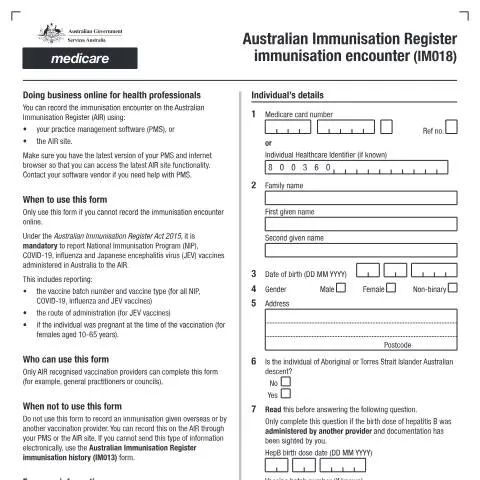
Understanding the IM018: Navigating the Australian Immunisation Register
In the landscape of Australian healthcare, keeping track of immunisations is crucial for both public health and individual well-being. The Australian Immunisation Register (AIR) plays a pivotal role in this tracking, and the immunisation encounter form (IM018) is a key document for health professionals. This form is not merely a bureaucratic hurdle; it serves as an essential tool for recording immunisations, ensuring compliance with health regulations, and facilitating better health outcomes.
The Journey of Documentation: From Encounter to Registration
When a patient receives an immunisation, the process begins with the healthcare provider completing the IM018 form. This document should be filled out immediately following the administration of the vaccine. Key steps involved in this process include:
- Patient Information: Accurate patient details must be recorded, including name, date of birth, and address.
- Immunisation Details: The type of vaccine administered, along with the date and the batch number, are crucial. This ensures traceability.
- Provider Information: The healthcare provider must sign the form, affirming the administration of the vaccine.
Once completed, the healthcare provider submits the IM018 form to Services Australia through the appropriate channels, either electronically or by mail, depending on the available systems.
Significance of Timely Submission
Submitting the IM018 promptly is essential for several reasons. First, it ensures that the patient's immunisation record is updated in the AIR, allowing for accurate tracking of vaccination statuses. Missing the submission deadline can lead to significant delays in record-keeping, which may affect eligibility for certain government services related to healthcare.
Furthermore, a delay in recording immunisations can impact the health of the community. If immunisation rates drop due to inaccurate records, the risk of vaccine-preventable diseases increases. Therefore, healthcare providers have not just an obligation but a responsibility to process the IM018 without delay.
Understanding the Process: What Happens to the IM018?
Once the IM018 is submitted, it enters a systematic review process at Services Australia. Here’s how the journey unfolds:
| Step | Description |
|---|---|
| 1. Submission Review | Services Australia checks the completeness of the form and verifies the information provided. |
| 2. Data Entry | Once validated, the data is entered into the AIR database, updating the patient’s vaccination record. |
| 3. Notification | Patients and providers may receive a notification confirming the record update. |
Consequences of Non-Submission or Errors
Omitting to submit the IM018 or providing incorrect details can lead to serious consequences. Patients may find themselves without the necessary documentation to access certain healthcare services or benefits. Furthermore, healthcare providers and immunisation clinics could face compliance inquiries if records do not match the AIR data.
In these scenarios, it is crucial to rectify the situation promptly. The first step involves contacting Services Australia to understand the nature of the discrepancy. If the error lies within the clinic's documentation, a new IM018 can be submitted to correct the records. However, if there are issues related to Services Australia’s processing, a careful review of the submission process may be required.
Addressing Unique Circumstances: Special Cases and Considerations
There are instances where the IM018 may be particularly relevant or nuanced. These include:
- Minors: When immunisations are given to children, parental consent is mandatory. The IM018 must include the guardian's details.
- Visitors and Migrants: Temporary residents and visitors may require specific forms if they receive immunisations while in Australia.
- Emergency Situations: In cases of emergency vaccinations, such as during outbreaks, expedited processes may be available for submitting the IM018.
For each of these situations, additional documentation may be required to support the immunisation record. Health professionals must be aware of these nuances to ensure compliance with legal and health standards.
Abstracting Data for Future Use: Research and Monitoring
The IM018 does more than just serve individual health needs; it contributes to broader public health initiatives. Data collected through the AIR can be pivotal for health authorities in monitoring vaccination rates, conducting epidemiological research, and planning immunisation programs.
This aggregated data helps identify trends and inform policy decisions, ensuring that vaccination programs are efficient and effectively addressing community health needs. Therefore, each time a healthcare provider fills out the IM018, they are participating in a larger public health strategy, even if that isn’t immediately apparent.
Final Thoughts: The Role of Health Professionals in Vaccination Reporting
Healthcare providers have a critical role in the immunisation reporting process. Their accurate and timely completion of the IM018 not only affects their patients but also contributes to the overall health of the community. By understanding the intricacies of this form and the implications of their responsibilities, health professionals can navigate the immunisation landscape more effectively.
In a world where vaccination has become a cornerstone of public health, awareness of every aspect of the reporting process aids in bolstering the system that protects individuals and communities alike. Therefore, familiarity with the contents and procedures of the IM018 is imperative for anyone involved in administering vaccinations.
Understanding the Importance of the Australian Immunisation Register (AIR)
The Australian Immunisation Register (AIR) plays a pivotal role in tracking the immunisation status of individuals across Australia. This national register is essential for public health surveillance, allowing health authorities to monitor vaccination coverage and manage immunisation programs effectively. Through the AIR, healthcare providers can access up-to-date immunisation records, ensuring that patients receive the necessary vaccines on schedule.
One key aspect of the AIR is its ability to support immunisation data reporting for various programs, including childhood vaccinations, adult vaccinations, and the National Immunisation Program (NIP). The data collected helps in identifying gaps in vaccination coverage, enabling health departments to target specific communities and demographics that may be under immunised. This targeted approach is vital for preventing outbreaks of vaccine-preventable diseases, thereby safeguarding the broader community.
Healthcare providers are required to report vaccination data to the AIR to ensure accurate records are maintained. This process not only supports individual patient health but also contributes to the overall health of the population. By understanding the importance of the AIR, individuals and healthcare providers can work together to improve vaccination rates and public health outcomes.
How to Navigate the Immunisation Encounter Form (IM018)
The Immunisation Encounter Form (IM018) is a critical document that healthcare providers use to record details of the immunisation administered to a patient. It is particularly important for ensuring that all necessary information is captured accurately and submitted to the AIR. Completing the IM018 accurately is essential as it directly impacts the immunisation records maintained in the AIR.
When filling out the IM018, healthcare providers must include key information, such as the patient’s name, date of birth, address, and their unique identifier—typically the Medicare number or the patient’s Tax File Number (TFN). Additionally, the form requires details about the vaccine administered, including the type of vaccine, batch number, and the date of administration. It is important to ensure that all entries are legible and that any corrections are made following the correct procedures to avoid confusion or inaccuracies in the AIR.
Providers should also be aware of the various exemptions and circumstances under which a patient may not receive certain vaccines. This includes medical contraindications, which should be clearly documented in the IM018. By adhering to these guidelines, healthcare providers can facilitate the seamless integration of immunisation data into the AIR, supporting national health initiatives and contributing to the safety and well-being of the community.
Furthermore, digital submission of the IM018 through online platforms associated with myGov can expedite the process, ensuring faster updates to the AIR. Providers using electronic health record systems may find that they can directly upload immunisation data to the AIR, streamlining the process even further and reducing the likelihood of errors.
Challenges and Considerations for Healthcare Providers
While the AIR and its associated forms, such as the IM018, are designed to facilitate the immunisation process, healthcare providers may face several challenges when navigating this system. One significant challenge is ensuring compliance with reporting requirements, as failure to submit accurate data can lead to discrepancies in patients' immunisation records. This can be particularly concerning for individuals needing vaccinations for school entry or travel purposes.
Moreover, with the rollout of new vaccines, such as those for COVID-19, healthcare providers must stay updated on the latest requirements and protocols for recording immunisation encounters. This situation can create additional pressure, as providers must juggle their regular patient loads while ensuring their documentation meets the latest standards set by health authorities.
Another consideration is patient education. Providers play a crucial role in educating patients about the importance of immunisation and ensuring they understand the reporting process. This includes discussing why their immunisation records are vital and how this information contributes to public health initiatives. By fostering open communication, healthcare providers can encourage patients to participate actively in their health management and maintain an updated immunisation record.
In summary, while the AIR and IM018 form are essential tools for managing immunisation records in Australia, they come with their own set of challenges. Healthcare providers must remain vigilant in their reporting duties, stay informed about new vaccines and updates to the system, and actively engage with patients to promote understanding and compliance. Doing so will not only enhance individual patient care but also strengthen the overall public health framework in Australia.