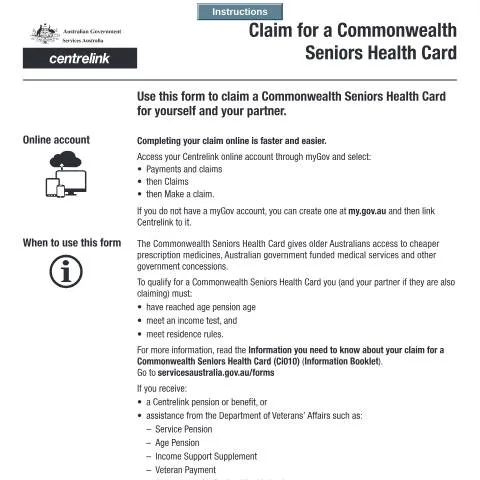
Navigating the Commonwealth Seniors Health Card Claim Process
Imagine being a senior citizen, feeling the weight of medical expenses as you navigate the complexities of healthcare in Australia. The Commonwealth Seniors Health Card (CSHC) can be a lifeline, providing essential health benefits to older Australians. Understanding how to claim this vital support through the SA296 form is crucial for making the most of your entitlements. This guide aims to demystify the claiming process, ensuring that eligible individuals can easily access the benefits they deserve.
Understanding Eligibility for the CSHC
Before embarking on the claim process, it’s important to identify who qualifies for the Commonwealth Seniors Health Card. This card is specifically designed for Australian seniors who meet certain residency and income criteria. The following profiles typically align with eligibility:
- Age Requirement: Applicants must be 66 years of age or older.
- Residency Status: Must be an Australian citizen or hold a permanent resident visa.
- Income Thresholds: Income limits apply, which can vary based on dependent status.
- Previous Claims: Individuals who previously held the CSHC but have since lost it may be eligible to reapply under specific conditions.
Diverse Profiles and Their Nuances
While the eligibility criteria may seem straightforward, variations exist depending on personal circumstances:
- Single Individuals: Must meet specific income limits set by Services Australia.
- Couples: Joint income assessments apply, creating different thresholds.
- Recently Arrived Residents: Generally, individuals must reside in Australia for a certain duration before qualifying.
Each profile may have nuanced requirements that could affect your eligibility. Therefore, a thorough review of your financial situation is recommended before submitting your claim.
Getting Started: The Essentials of the SA296 Form
The SA296 form plays a pivotal role in your journey toward obtaining the Commonwealth Seniors Health Card. It serves as the primary document through which individuals can assert their need for health concessions. Understanding how to accurately fill out this form is essential.
Form Sections Breakdown
The form consists of several crucial sections, each designed to gather specific information related to your identity and financial status. Here’s a brief overview:
- Personal Details: This includes your full name, address, date of birth, and contact information.
- Income Information: Here, you will declare your income sources, including pension payments, investments, and other income types.
- Residency Details: This section confirms your citizenship or residency status in Australia.
- Declaration: You will need to sign and date the form, affirming the accuracy of the information provided.
Compiling Supporting Information
While the form itself is crucial, providing supporting documentation can strengthen your claim. Here are some examples of documents that may be required:
- Proof of income, such as payslips or bank statements.
- Identification documents, including a driver's license or passport for identity verification.
- Evidence of residency, such as utility bills or rental agreements.
Submission Options: Flexibility in Claims
When it comes to submitting the SA296 form, Services Australia offers several channels to cater to different needs. Each method has its own unique advantages.
Online Submissions via myGov
For those who are tech-savvy, submitting your claim through the myGov portal can be the quickest and most efficient option. Once you have set up your myGov account, navigate to the Services Australia section to access the CSHC application. Benefits of online submission include:
- Real-time updates on the status of your application.
- Immediate access to additional resources and support.
Paper Submissions through Traditional Mail
For individuals who prefer a tangible approach, mailing a completed hard copy of the SA296 form is an option. Ensure that you send it to the correct address provided by Services Australia. Key considerations when opting for this method include:
- The potential for delays due to postal services.
- Keeping a copy of your submitted form for personal records.
In-Person Submissions at Service Centres
If you need additional assistance, visiting a Services Australia centre can provide direct support. This option allows for immediate clarification and guidance on filling out the form. Keep in mind:
- It may be necessary to book an appointment in advance.
- Bring all required documentation and identification for efficient processing.
From Claim Submission to Decision: The Timeline
The journey from submitting the SA296 form to receiving your CSHC can be navigated with a better understanding of the timeline involved. Once your claim has been submitted, Services Australia will undertake the following steps:
Claim Processing Steps
- Initial Review: Services Australia will first verify that all necessary information and documentation have been provided.
- Assessment of Eligibility: Your declared income and residency status will be assessed against the eligibility criteria.
- Communication of Outcome: You will receive a notification regarding your claim outcome, typically via your preferred contact method (mail or online message).
What Happens Next?
If your claim is successful, you will receive your Commonwealth Seniors Health Card, which can be utilized for various health concessions. In case of a negative decision, you have the right to seek a merits review through the Administrative Appeals Tribunal (AAT). This process allows you to contest the decision, providing additional information or clarifications as necessary.
The Broader Context: Integrating the CSHC into Your Lifestyle
Receiving the Commonwealth Seniors Health Card is just one step in a broader landscape of healthcare and financial support available for seniors. Understanding how this card interacts with other entitlements can enhance your overall benefits.
Complementary Services and Benefits
The CSHC can provide access to several other benefits and services, including:
- Pharmaceutical Benefits Scheme (PBS): Reduced costs on prescription medications.
- Health Care Cards: Additional discounts on medical services and treatments.
- Home Care Packages: Support for individuals requiring assistance with daily activities.
By fully leveraging these available services, you can significantly alleviate the financial burden of healthcare costs as you age.
Final Thoughts on the Claiming Journey
Claiming the Commonwealth Seniors Health Card through the SA296 form is a crucial step towards securing healthcare benefits that can make a substantial difference in your quality of life. By understanding the nuances of eligibility, the claims process, and the integration of this card into a broader support system, you empower yourself to navigate the complex landscape of senior healthcare in Australia.
As you embark on this journey, remember that Services Australia is there to assist you in understanding your entitlements fully and ensuring that you receive the support you deserve.
Eligibility Criteria for the Commonwealth Seniors Health Card
To successfully claim the Commonwealth Seniors Health Card (CSHC), it’s essential to understand the specific eligibility criteria set forth by the Australian Government. This card is designed to assist older Australians with their health care costs, offering benefits such as discounted medicine and medical services. The eligibility criteria primarily focus on income levels, residency status, and age stipulations.
Firstly, applicants must be at least 66 years of age, which is the minimum age threshold as of 2023. The age requirement is progressively increasing, so it’s crucial to check the current age criteria depending on when you intend to apply.
Furthermore, the income test plays a significant role in determining eligibility. As of the latest update, singles must have an annual income of less than AUD 57,761, while couples combined must earn less than AUD 92,416. It's important to note that these thresholds can be adjusted annually, so applicants should verify these figures when applying.
The residency requirement means that applicants must be Australian citizens or hold a permanent visa. Temporary residents are not eligible for the CSHC. Additionally, those who are receiving specific income support payments or are enrolled in the Department of Veterans’ Affairs (DVA) may not qualify, as the card is intended for seniors who do not rely on these supports.
For those who reside in certain territories, such as the Australian Capital Territory or Northern Territory, it's worth noting that there may be slight variations in the assessment process. Engaging with local Services Australia offices can provide clarity on these nuances.
How to Apply for the Commonwealth Seniors Health Card
Applying for the Commonwealth Seniors Health Card can be a straightforward process, provided you follow the correct steps and gather the necessary documentation. The application can be completed online through your myGov account, which allows for a secure and efficient submission. However, some applicants may prefer to apply using a paper form, which can be obtained from a Services Australia office.
Here's a detailed breakdown of the application process:
Create or Access myGov Account: If you do not already have a myGov account, you'll need to create one. This is your central login for various government services in Australia. Ensure that you have your Tax File Number (TFN) handy, as it will be required during the registration process.
Gather Required Documentation: To apply, you will need to provide evidence of your age, income, and residency status. Acceptable forms of documentation may include your birth certificate or passport for age verification, recent bank statements or payslips for income assessment, and proof of residency such as a utility bill or lease agreement.
Complete the Application Form: Whether online or on paper, fill out the application form meticulously. Pay special attention to the income section, as any discrepancies may delay the processing of your application.
Submit Your Application: For online applications, ensure you have a stable internet connection to avoid any disruptions. Once submitted, you will receive a confirmation. For paper applications, consider sending it via registered mail to ensure it is received.
Await the Outcome: After submission, the processing time can vary. Services Australia generally takes around 4 to 6 weeks to process applications. During this time, you may receive requests for additional information if your application requires further verification.
Receiving Your Card: If your application is successful, your Commonwealth Seniors Health Card will be mailed to you. Be sure to keep your address updated with Services Australia to avoid any delays in receiving your card.
Benefits of the Commonwealth Seniors Health Card
The Commonwealth Seniors Health Card offers a range of benefits aimed at reducing health care costs for eligible seniors. Understanding these benefits can help cardholders make the most of what is available to them.
Pharmaceutical Benefits: Cardholders are eligible for reduced prices on certain medications under the Pharmaceutical Benefits Scheme (PBS). This can significantly lower the out-of-pocket costs for prescription medicines, making health care more affordable.
Bulk Billing: Many healthcare providers offer bulk billing services. If your doctor or health service provider participates in bulk billing, they will bill Medicare directly, meaning you won’t have to pay out of pocket for eligible consultations.
Access to Health Services: The CSHC can also facilitate access to various health services, including dental care and allied health services, which may be offered at reduced rates. While not universally applicable, it's worth checking with local health services to see if discounts are available.
Concessions on Utilities and Transport: Some state and territory governments provide additional concessions to seniors holding the CSHC for utilities, public transport, and even certain recreational services. It’s advisable to check with local government websites for these additional benefits.
Increased Financial Flexibility: Having the CSHC can ease the financial burden of health care costs, allowing seniors to allocate their budgets to other essential areas, such as housing and daily living expenses. This financial relief is particularly beneficial for self-funded retirees who may not qualify for other types of government assistance.
Eligibility for Other Programs: Holding a CSHC can also position you favorably for other support programs offered by both government and community organisations, which can include social programs, outreach services, and community health initiatives.
By understanding the comprehensive benefits associated with the Commonwealth Seniors Health Card, seniors can maximize their health care entitlements and ensure they are not missing out on vital assistance.