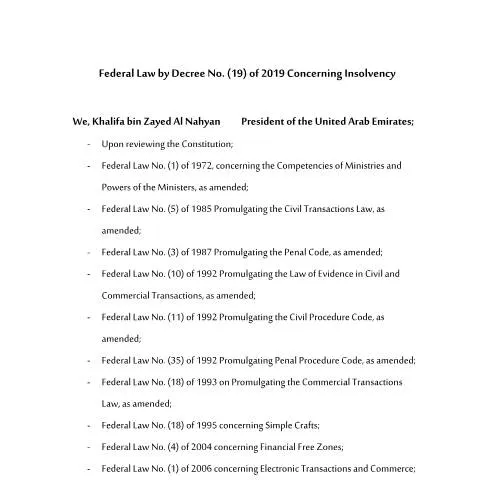
Understanding Federal Decree-Law No (19) of 2019 on Insolvency in the United Arab Emirates
The Federal Decree-Law No (19) of 2019, titled Federal Law on Insolvency, establishes a comprehensive legal framework to address situations where debtors face financial difficulties that threaten their ability to meet their obligations. This law aims to promote economic stability, facilitate restructuring, and provide legal protections for both debtors and creditors within the UAE's dynamic financial environment.
Scope and Objectives of the Law
This law applies to individuals and entities within the United Arab Emirates that encounter current or potential insolvency, provided they are not already governed by the provisions of Federal Law No (9) of 2016 concerning Bankruptcy. Its primary objective is to regulate the procedures for managing insolvency, including the initiation of settlement processes and the protection of debtor assets, with a focus on preserving economic activity and ensuring fair treatment of creditors.
Key Definitions and Concepts
The law introduces specific terminology essential to understanding its provisions:
- Debtor: The natural person or legal entity facing insolvency.
- Debtor's Debts: Financial obligations incurred prior to the insolvency proceedings.
- Insolvency: The state where a debtor is unable to settle debts due, or anticipated to be unable, in the foreseeable future.
- Assets: Movable and immovable properties that constitute the debtor's financial resources.
- Interested Party: Any individual or legal entity with a stake in the insolvency process.
- Scheme: A structured plan to settle debts, prepared in accordance with the law.
Procedures for Initiating Insolvency Settlement
Application Submission
The law empowers debtors to submit an application to the competent court to initiate insolvency procedures. This application must be accompanied by detailed documentation, including:
- A brief description of the debtor’s financial position, including income sources and liquidity forecasts for the next twelve months.
- A list of creditors, their contact details, outstanding debts, due dates, and any guarantees provided.
- An inventory of movable and immovable assets within and outside the UAE, with approximate values.
- Details of any ongoing legal or judicial proceedings affecting the debtor.
- A declaration confirming the debtor’s current or anticipated inability to meet financial obligations.
Assessment and Court Procedures
Upon receiving the application, the court evaluates the submitted documents and the debtor’s financial situation. If the application is deemed valid, the court may appoint a trustee from the roster of accredited experts to oversee the process. The trustee’s role includes managing assets, verifying claims, and facilitating negotiations between creditors and the debtor.
Legal Protections and Measures
The law provides mechanisms to safeguard the debtor's assets and ensure an equitable distribution among creditors. These include:
- Measures: Court-ordered actions to preserve or manage assets, such as freezing accounts or suspending legal actions against the debtor.
- Settlement Schemes: Restructuring plans aimed at settling debts, which may involve debt reduction, payment plans, or asset transfers.
- Protection of Debtor Assets: Ensuring that assets are not unlawfully seized or dissipated during the proceedings.
Implications for Debtors and Creditors
The enactment of this law introduces a structured approach to insolvency, offering debtors an opportunity to reorganize their financial affairs while providing creditors with a transparent process to recover dues. It emphasizes the importance of timely application and accurate documentation to facilitate effective resolution.
By establishing clear legal procedures and protections, Federal Decree-Law No (19) of 2019 aims to foster a resilient economic environment, encouraging responsible financial management and offering a pathway out of insolvency that balances interests across the UAE’s diverse economic sectors.