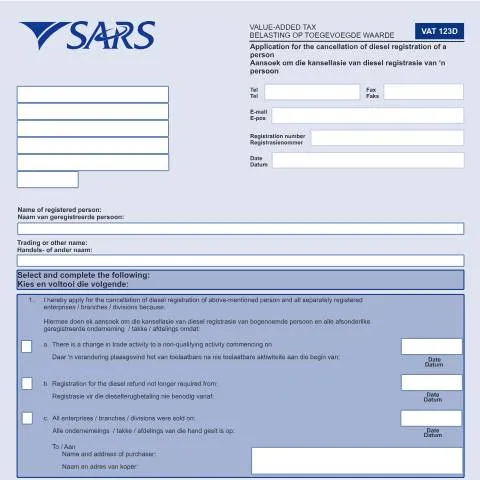
Understanding the VAT123D Form: A Vital Step in Diesel Registration Cancellation
Facing the need to cancel your diesel registration can be daunting, especially when navigating the various administrative processes involved. The VAT123D – Application for the Cancellation of Diesel Registration of a Person form is pivotal for individuals or businesses transitioning away from diesel-related activities. This document not only facilitates compliance with South African tax regulations but also ensures that you avoid unnecessary penalties and complications.
Who Initiates the VAT123D Process?
The VAT123D form is primarily initiated by registered individuals or entities that previously held a diesel registration number under the Value-Added Tax (VAT) system. This could include sole proprietors, partnerships, or companies that have either changed their trade activities or no longer require diesel refunds.
Scenarios Necessitating Cancellation
- Change in Trade Activity: If your business has shifted from qualifying activities—such as farming or specific transportation services—to non-qualifying activities.
- Discontinuation of Diesel Refund Registration: If your operations no longer warrant diesel refunds, you need to formally cancel this registration.
- Sale of Business Components: If all branches, divisions, or enterprises associated with your diesel registration have been sold, you must submit a cancellation.
Preparing to Fill Out the VAT123D Form
Completing the VAT123D form requires careful attention to detail. It’s essential to ensure that all information provided is accurate and up-to-date to avoid delays or rejections.
Key Information Required on the Form
- Personal Details: Include your full name, registration number, and contact information.
- Reasons for Cancellation: Clearly state the specific reason for the cancellation, selecting from options A, B, or C as provided on the form.
- Declaration of Unused Diesel: Accurately report the quantity of unused diesel that remains, as this must be accounted for formally.
Filling Out the VAT123D: A Step-by-Step Guide
Completing the VAT123D form involves several steps that must be followed meticulously to ensure a successful application.
Step-by-Step Process
- Section 1: Fill in your registered name and registration number.
- Section 2: Indicate your reasons for cancellation from the options provided (change in trade activity, non-qualifying registration, or sale of business).
- Section 3: Provide the date on which the changes took effect or the sale occurred.
- Section 4: Confirm the total liters of unused diesel that must be supplied as a result of the cancellation.
- Signature: Ensure that the form is signed and dated correctly to validate the application.
| Section | Details Required |
|---|---|
| 1 | Registered Person's Name and Registration Number |
| 2 | Reason for Cancellation (select one of three options) |
| 3 | Date of Activity Change or Sale |
| 4 | Liters of Unused Diesel |
| 5 | Signature and Date |
Submitting Your VAT123D Form: What to Expect
Once you have completed the VAT123D form, the next step is submission. It is crucial to follow the proper channels to ensure that your application is processed smoothly.
Where to Submit Your Application
The VAT123D form can typically be submitted directly to the South African Revenue Service (SARS) offices or through their online platform, where electronic submissions are encouraged.
Processing Times and Confirmation
After submission, you can expect varying processing times depending on the volume of applications being handled by SARS. It’s advisable to keep a copy of your submitted form and any correspondence for your records. You will receive confirmation of your cancellation, detailing any actions required on your part, especially regarding unused diesel.
Understanding the Implications of Cancellation
Canceling your diesel registration via the VAT123D form has significant implications for your business operations and tax responsibilities.
Financial Considerations
- Tax Liability: Ensure that the cancellation aligns with your current tax obligations. Cancelling the registration might change your tax status, affecting how you report your income and expenses.
- Unused Diesel Claims: You may be required to submit any remaining unused diesel for accounting purposes, impacting your financial records.
Future Business Operations
Post-cancellation, your business may shift focus, especially if you are pivoting to non-diesel-related activities. This transition could necessitate registration for different tax classifications or permits, reflecting your new operational status.
Special Circumstances: Navigating Complex Situations
There may be instances where individuals or entities face unique challenges when applying for diesel registration cancellation. Understanding these complexities is vital for a smooth process.
For Foreign Nationals
If you are a foreign national operating in South Africa, additional documentation may be required alongside your VAT123D form. This could include proof of residency or a valid work permit. Being aware of the additional information needed can prevent delays in processing.
Minors or Dependents
In cases where a minor is involved in the application process, it is essential to have a legal guardian fill out the form. Proper legal documentation must be provided to ensure compliance with South African laws regarding minors and their financial operations.
Gathering Supporting Documentation
To strengthen your VAT123D application, consider compiling relevant supporting documents that underscore your claims and reasons for cancellation.
Recommended Documents
- Proof of Business Activities: Documentation supporting your change in business activity (e.g., financial statements, letters from clients, etc.).
- Evidence of Sale: If cancelling due to a business sale, include the sale agreement or transfer documents.
- Previous Diesel Registrations: Keep records of past diesel registrations or refunds applied for to reference in your cancellation.
Final Thoughts: Your Path Forward After Submission
Once the VAT123D form is submitted and processing is underway, it’s crucial to stay informed about your application status. Monitoring your submission will help ensure that you remain compliant with tax obligations going forward.
Additionally, consider consulting with a tax professional or accountant who is familiar with South African tax law if you have any questions regarding the implications of your diesel registration cancellation. This proactive approach can prevent future complications and help align your business operations with South African tax regulations.
Understanding the VAT123D form’s role in the broader context of South African tax compliance empowers you to navigate the administrative landscape effectively, ensuring that your business can continue to thrive in a compliant manner.
Understanding the VAT123D Form: Purpose and Importance
The VAT123D form serves as a crucial tool for individuals and entities in South Africa who possess diesel registration and wish to formally cancel it. Understanding this form's purpose is essential for ensuring compliance with the South African Revenue Service (SARS) regulations. Diesel fuel is a key resource in transport and agriculture, and as such, it is heavily regulated under the Value-Added Tax Act. The cancellation of diesel registration can arise from various circumstances, such as the cessation of business activities, changes in operational status, or transitioning to a different fuel type.
Moreover, it is essential to highlight that maintaining accurate records with SARS concerning diesel usage is not only a legal requirement but also a means of mitigating potential penalties. Incorrect or outdated diesel registrations can lead to discrepancies in tax reporting, ultimately affecting an individual’s or business’s financial standing. Therefore, the VAT123D application process is not simply a bureaucratic step; it is designed to streamline compliance and ensure that taxpayers are reflecting their operational reality in their tax affairs.
Eligibility Criteria for Submitting VAT123D
Before embarking on the application process for the cancellation of diesel registration using VAT123D, it is vital to understand the eligibility criteria. Generally, the following categories of applicants may find themselves eligible:
- Individual Business Owners: If you are a registered individual who has been utilizing diesel for business operations but have ceased operations or changed your business model.
- Partnerships and Corporations: Entities that have previously registered for diesel usage but are no longer in need of such registration due to internal restructuring or liquidation.
- Farming and Agricultural Operations: Farmers who have switched to renewable energy sources or have ceased agricultural activities.
- Others: Any other entity or individual who has legitimate reasons for cancelling their diesel registration, such as change in operational costs or business direction.
It's crucial to ensure that you meet these criteria before submitting your application. A failure to comply with the designated criteria can lead to delays or rejection of your VAT123D form. Additionally, gathering supporting documents—like proof of previous diesel usage, business closure documents, or changes in operational structure—will bolster your application and facilitate a smoother cancellation process.
Step-by-Step Guidance for Completing VAT123D
Completing the VAT123D form requires careful attention to detail to ensure accuracy and compliance with SARS requirements. Below is a step-by-step guide to assist applicants through the process:
- Obtain the VAT123D Form: Start by downloading the VAT123D application from the SARS website. Ensure that you are using the most recent version of the form to avoid any issues caused by outdated formats.
- Personal and Business Information: Fill in your personal details, including your 13-digit South African ID number (formatted as YYMMDDSSSSCAZ), your business name, and registration number (if applicable). This information is crucial for SARS to identify your record accurately.
- Reason for Cancellation: Provide a clear explanation as to why you are seeking to cancel your diesel registration. This could include reasons such as business closure, a shift to alternative fuels, or a change in business activities.
- Supporting Documentation: Attach any relevant documents that substantiate your reasons for cancellation. This might include closure certificates, affidavits, or any correspondence with SARS regarding your business operations.
- Review and Submit: Double-check all entries for accuracy and completeness. Once satisfied, submit your completed VAT123D application to the nearest SARS branch or through the SARS online portal, depending on your preference.
After submission, it is advisable to keep a copy of your application and any supporting documents for your records. Acknowledgment of receipt from SARS can take a few weeks, and keeping track of your submission will help in future inquiries.