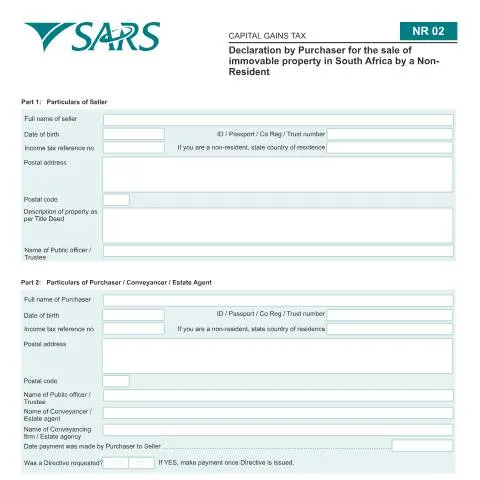
Navigating the NR02 Form: A Critical Step in Non-Resident Property Transactions
When a non-resident seeks to sell immovable property in South Africa, the implications of compliance with local tax laws cannot be overstated. Central to this compliance is the NR02 — Declaration by Purchaser for Sale of Immovable Property in SA by Non-Resident. This declaration stands as a crucial document in the broader landscape of property transactions, ensuring that the South African Revenue Service (SARS) receives the appropriate tax withholding due on such sales.
Understanding the Functionality of the NR02 Form
The NR02 form is not merely a bureaucratic necessity; it plays a pivotal role in the capital gains tax (CGT) framework, specifically concerning sales initiated by non-residents. Under Section 35A of the Income Tax Act, 1962, non-residents are subject to CGT on the disposal of immovable property located in South Africa if the disposal date is on or after September 1, 2007. This underscores the necessity of the NR02 form in ensuring tax compliance and transparency in property transactions.
The Tax Withholding Requirement
For any property transaction exceeding R2 million, the purchaser is obligated to withhold a specific percentage of the selling price as a prepayment towards the seller's income tax. Different rates apply based on the seller's classification:
- 7.5% for individuals
- 10% for companies
- 15% for trusts
This withheld amount must be reported via the completed NR02, reinforcing its integral role in the transaction process.
Distinguishing the NR02 from Similar Forms
It is crucial to understand how the NR02 form differs from other related forms in property taxation. While one might confuse it with the Z83 form, which deals with job applications within the public sector, or the NR01, which pertains to the declaration of sales by residents, the NR02 is uniquely tailored for non-residents engaged in the sale of immovable property. This specificity is vital for ensuring the correct application of tax obligations.
| Form | Purpose | Target Users |
|---|---|---|
| NR02 | Declaration for sale by non-residents | Non-residents selling property |
| NR01 | Declaration for sale by residents | Residents selling property |
| Z83 | Application for employment | Job seekers within the public sector |
The Chain of Transactions and Where the NR02 Fits In
The NR02 form is a cog in a larger machine that encompasses various stages of the property sale process. Once a buyer and seller agree on a sale, the following steps typically unfold:
- The buyer reviews the property's title deed and legal status.
- Both parties enter into a sale agreement, detailing terms including the sale price.
- The purchaser, aware of the seller's non-resident status, must calculate the tax withholding based on the agreed price.
- The NR02 form is completed and submitted to SARS, along with the withheld amount, within the stipulated time frame.
By understanding where the NR02 fits within this process, all parties can ensure a seamless transaction that complies with South African law.
Preparing for the NR02: Required Documentation and Steps
Completing the NR02 accurately requires careful preparation of supporting documentation. Here’s a breakdown of what to gather:
Documentation Checklist
- Seller's Information: Full name, ID/Passport number, income tax reference number.
- Purchaser’s Details: Full name, contact information, and tax reference number.
- Description of the Property: Title deed details, location, and selling price.
- Date of Payment: Clearly indicate when the purchase transaction was completed.
- Directive Request Confirmation: If applicable, note whether a directive was requested from SARS.
Meticulously assembling these documents aids in the efficient completion of the NR02 and mitigates potential issues during the submission process.
Understanding the Parties Involved: Buyers and Sellers
The NR02 form is pivotal not just for the seller, but for the buyer as well, particularly in understanding their obligations and liabilities. Here’s an exploration of the different profiles affected:
Non-Resident Sellers
Non-resident sellers are individuals or entities not residing in South Africa for tax purposes. They must be cognizant that any sale of immovable property may attract CGT obligations, thus necessitating the NR02 form for compliance.
Purchasers
The buyer, particularly if they are a non-resident themselves, must ensure they withhold the correct amount based on the selling price, as failing to do so could result in personal liability for the unpaid taxes. This is particularly critical in instances where the seller's non-resident status was not disclosed. In such cases, the buyer may be held accountable for not withholding the requisite amount and is expected to pay it directly to SARS.
Estate Agents and Conveyancers
These professionals play a supportive role in the transaction process. They are obligated to inform the buyer of the seller’s non-resident status, which could affect the buyer’s liability. Failure to communicate this information can result in shared liability for any unpaid withholding taxes, highlighting the importance of transparency in the transaction chain.
Complex Situations Requiring Special Attention
Certain situations might complicate the standard procedure, necessitating additional considerations when dealing with the NR02 form:
Foreign Currency Transactions
If the purchase price is in a foreign currency, the buyer must convert the amount into South African Rand (ZAR) at the current spot rate when submitting the withheld amount to SARS. This ensures compliance with local tax laws and avoids potential financial discrepancies.
Multiple Property Transactions
In cases where a non-resident is selling multiple properties, each transaction must be evaluated separately concerning the withholding requirement. Each NR02 form must reflect the individual property’s selling price and the corresponding withheld amount.
Trusts and Companies
Transactions involving trusts or companies may also require additional considerations. For example, if a trust is selling property, the withholding tax rate will differ from that applicable to individual owners. Understanding these nuances is crucial for compliance.
A Proactive Approach: Ensuring Compliance and Avoiding Pitfalls
To navigate the complexities of the NR02 filing process effectively, both buyers and sellers should adopt a proactive stance. Here are some practical recommendations:
- Early Engagement: Consult with a tax professional or legal advisor early in the transaction process to gauge your obligations.
- Document Verification: Ensure all documentation, including the sale agreement and property description, is accurate before completing the NR02.
- Timely Submission: Be mindful of the deadlines for submitting the NR02 and remitting the withholding tax to SARS — 14 days if the purchaser is a resident, and 28 days if a non-resident.
- Record Keeping: Maintain comprehensive records of all documents related to the transaction for future reference or in case of audits.
By following these strategies, parties can significantly mitigate risks and enhance the efficiency of their property transactions in South Africa.
Final Thoughts: The Importance of the NR02 in Property Sales
As real estate transactions involving non-residents become increasingly common in South Africa, understanding the intricacies of the NR02 form is essential. This declaration not only facilitates the correct application of CGT but also ensures that all parties are informed and compliant with local tax obligations. By appreciating the role and requirements of this form, buyers and sellers alike can navigate the South African property market with confidence.
Fill in your form directly online
No printing: type your details into the boxes of the official form, tick, then download the PDF ready to send.
- 1Type into the form boxes
- 2Tick in one click
- 3Save and download the PDF
Understanding the NR02 Declaration: Purpose and Importance
The NR02 Declaration by Purchaser is a pivotal legal document designed for non-resident purchasers involved in the acquisition of immovable property within South Africa. Its primary purpose is to ensure compliance with local tax regulations and to facilitate the accurate reporting of property transactions. This declaration serves as a safeguard for the South African Revenue Service (SARS) to track foreign investments in real estate, which is especially pertinent given the rising interest from international buyers in the South African property market.
This form is especially critical for non-residents, who may not be fully aware of the intricate tax implications and legal responsibilities associated with property ownership in South Africa. By requiring a declaration, the South African government is not only protecting its fiscal interests but also providing a framework that promotes transparency in property transactions. This is essential for maintaining the integrity of the real estate market and ensuring that non-resident buyers are adequately informed of their obligations before finalizing their purchases.
Completing the NR02: Step-by-Step Guide
Completing the NR02 Declaration form requires attention to detail and a clear understanding of the necessary information. Here’s a concise step-by-step guide to assist you in accurately filling out the form:
- Gather Required Information: Before starting, ensure you have all necessary documentation, including your 13-digit South African ID number (if applicable), passport details, and any relevant property transaction documentation.
- Section A: Purchaser Details: Fill in your full name, contact information, and residential address. If you are representing a legal entity, include the registered name and registration number of the entity.
- Section B: Property Details: Clearly specify the property’s address, description, and transfer date. This section may also ask for the property’s estimated market value, which should be based on current market analysis.
- Section C: Declaration of Tax Residency: Indicate your country of tax residency and provide your tax identification number (if applicable). This is crucial in determining your tax obligations in South Africa.
- Section D: Signature: Ensure that the declaration is signed and dated. If the form is filled on behalf of a trust or company, an authorized representative should also sign.
After completing the form, you may need to submit it alongside other required documentation to the relevant authorities, which usually include the Deeds Office, SARS, or your property attorney. It is advisable to keep a copy of the completed NR02 for your records, as this can be useful for future tax assessments or property inquiries.
Tax Implications and Responsibilities for Non-Residents
When purchasing immovable property in South Africa, non-residents must navigate various tax implications that arise from such transactions. Understanding these responsibilities is vital for ensuring compliance and avoiding potential penalties. Non-residents may be subject to the following taxes:
- Capital Gains Tax (CGT): Upon the sale of the property, non-residents may be liable for CGT, which is calculated based on the profit made from the sale. It is important for non-residents to consult with a tax advisor to understand how CGT applies to their specific situation.
- Transfer Duty: This tax is applicable on the transfer of property ownership and must be paid to SARS before the property transfer can be registered. The transfer duty is calculated based on the purchase price or the market value of the property, whichever is higher.
- Income Tax: If the property is rented out, non-residents are required to pay tax on the rental income generated. It is crucial for non-residents to register with SARS and obtain a tax reference number to ensure compliance.
Additionally, non-residents should also be aware of any potential inheritance tax implications if they plan to pass on the property to heirs. Seeking professional advice from a tax consultant or legal advisor with expertise in South African property law can help navigate these complexities and ensure compliance with all tax obligations.
Resources and Assistance for Non-Residents
Navigating the property acquisition process in South Africa can be daunting for non-residents. Fortunately, there are various resources and organizations that can provide assistance and guidance throughout the process:
- South African Revenue Service (SARS): The official SARS website offers comprehensive information regarding tax regulations affecting non-residents, including downloadable forms and guidelines on tax compliance.
- Department of Home Affairs (DHA): For those requiring residency status or additional legal documentation, the DHA can provide guidance and necessary forms to facilitate residency applications.
- Real Estate Agencies: Many real estate agencies in South Africa specialize in assisting foreign buyers. These agencies can provide expert advice on the local property market, help with paperwork, and offer insights into the buying process.
- Legal Advisors: Engaging a local attorney specializing in property law can be invaluable. They can assist with the legal aspects of the transaction, ensuring that all documentation is correctly prepared and filed.
Leveraging these resources can significantly ease the process of acquiring immovable property in South Africa, helping non-residents navigate legal requirements and ensuring compliance with local regulations.