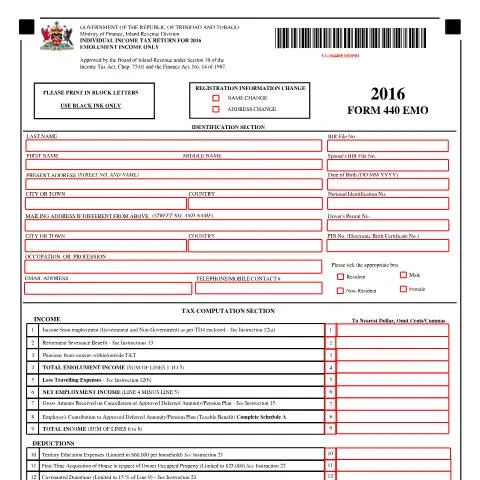
Understanding the [440-EMO] Emolument Income Earner Form: An Overview
The [440-EMO] Emolument Income Earner Form is a critical document within the income tax framework of Trinidad and Tobago, specifically designed for individuals earning income through employment. It serves to facilitate the reporting of emolument income to the Inland Revenue Division (IRD) and plays a pivotal role in calculating the tax liabilities of individual earners. With the specific code reference 440EMO, this form is instrumental for taxpayers navigating their fiscal responsibilities.
Who Needs to File the 440-EMO and When?
This form is primarily required for individuals who receive employment income, including government and non-government employment. Whether you are a full-time employee or part-time worker, if you derive your income from wages or salaries, you are obligated to file this form annually. Specifically, the deadline for submission is set for 30 April following the close of the fiscal year, aligning with the Trinidad and Tobago tax calendar.
- Annual Requirement: Each taxpayer must submit the 440-EMO form yearly, providing a detailed account of their earnings from the previous year.
- Fiscal Year Context: For the 2023 tax year, the form would need to be submitted by April 2024, covering all emolument income earned during the prior year.
The Role of the 440-EMO in the Taxation Process
The [440-EMO] form is not just a procedural formality; it is integral to assessing a taxpayer's overall tax liability. Upon submission, the IRD uses the information provided to calculate the amount of tax owed based on various income sources and deductions.
Here’s how the form interplays within the larger tax system:
- Data Collection: The information filled out by the taxpayer helps establish the gross income which is subjected to taxation.
- Tax Calculation: The IRD utilizes this information to compute the taxpayer's liability, factoring in deductions and allowances as stipulated by the Income Tax Act, Chap. 75:01.
- Compliance Monitoring: The details provided are verified against employer submissions (e.g., TD4 certificates) to ensure compliance and accuracy.
A Step-by-Step Guide to Completing the 440-EMO Form
Completing the [440-EMO] Emolument Income Earner Form accurately is crucial in ensuring that taxpayers fulfill their legal obligations while maximizing potential tax benefits. Below, we break down the completion of the form into manageable sections:
Identifying Information
At the top of the form, taxpayers must provide their personal details:
- Last Name, First Name, Middle Name: Ensure names are clearly printed in block letters using black ink.
- Contact Information: Include your current mailing address and telephone number for any correspondence.
- BIR File Number: This unique identifier for tax purposes must be included, along with the spouse’s BIR File Number if applicable.
Income Reporting Section
This section captures all sources of income:
- Employment Income: Accurately report all amounts from TD4 certificates.
- Retirement Benefits: If applicable, include severance or pension amounts as per instructions.
- Deductible Expenses: Document any traveling expenses and education expenses, keeping in mind the limits and necessary supporting documentation.
Deductions and Credits
Taxpayers should be mindful of the various deductions available:
- Personal Allowance: A standard allowance helps reduce taxable income; understand how it applies to your situation.
- National Insurance Contributions: Details about these contributions are imperative as they can affect the overall tax calculation.
Ensure that each deduction aligns with the instructions provided on the form to avoid delays in processing.
Submitting the 440-EMO Form: Key Considerations
Once the form is completed, the next critical step is its submission. The IRD accepts forms electronically via e-Tax portals, enhancing accessibility for all taxpayers. Alternatively, you can submit a hard copy directly to the IRD office.
Electronic Submission Process
Taxpayers can use their ttconnect ID to access the e-Tax portal:
- Login to e-Tax: Use your ttconnect ID for authentication.
- Upload Document: Ensure your completed 440-EMO form is in the correct format before uploading.
- Confirmation: After submission, you should receive a confirmation of receipt via email.
Paper Submission Process
If opting for paper submission, please adhere to the following steps:
- Hard Copy Completion: Make certain the form is filled out entirely and accurately.
- TIMELY Submission: Deliver the form to the correct IRD office location well before the deadline to avoid penalties.
After Submission: What Happens Next?
Following the submission of the [440-EMO] form, there are several possible outcomes that taxpayers should be aware of:
- Assessment Notice: The IRD will send an assessment notice indicating the amount of tax due based on the information provided.
- Refunds: If you have overpaid, expect a refund based on the calculations derived from your total income and deductions.
- Further Inquiry: The IRD may request additional information if discrepancies arise, thus keeping records and documentation handy is advisable.
- Penalties for Late Filing: Be aware that failing to submit on time can incur fines or interest on unpaid taxes.
Key Documents to Keep on Hand
To ensure compliance and prepare for potential inquiries from the IRD, it is essential to maintain a well-organized collection of supporting documents:
- TD4 Certificates: Keep copies of all employment income declarations provided by your employer.
- Proof of Deductions: Maintain receipts or documentation for any deductions claimed, such as educational expenses or medical contributions.
- Prior Year Returns: Having previous tax returns can facilitate accurate reporting and understanding of your financial evolution.
The Historical Context of the 440-EMO Form
The necessity for the [440-EMO] Emolument Income Earner Form arises from the legislative framework established under the Income Tax Act, Chap. 75:01. This framework has evolved post-independence, aiming to develop a robust tax system that aligns with international standards while considering local contexts.
Originally enacted as part of post-colonial reforms, the Income Tax Act has undergone several amendments, most notably through the Finance Act, No. 14 of 1987. These adjustments address economic fluctuations and ensure that tax regulations reflect current societal and economic realities.
Implications of Non-Compliance
Failing to accurately submit the [440-EMO] form can lead to significant repercussions:
- Financial Penalties: Late submissions attract fines, while inaccuracies can lead to increased scrutiny and potential legal action.
- Impact on Credit Rating: Unresolved tax issues may affect personal credit ratings and future financial endeavors.
- Difficulty in Accessing Financial Services: Banks and financial institutions often require clear tax records as part of loan application processes.
Final Thoughts: Preparing for the Future of Tax Compliance
With the increasing digitization of tax processes, it is advisable for all taxpayers in Trinidad and Tobago to familiarize themselves with online platforms like e-Tax. Being proactive about your tax responsibilities ensures smoother interactions with the IRD, minimizes the risk of fines, and enhances your understanding of personal financial management.
To navigate the complexities of tax compliance effectively, consider consulting with tax professionals or utilizing available resources through the IRD’s website (www.ird.gov.tt) for the most up-to-date information about forms, deadlines, and relevant guidance.
Understanding the Emolument Income Tax in Trinidad and Tobago
The Emolument Income Tax is distinctly tailored to address the earnings of individuals within the framework of income taxation in Trinidad and Tobago. This tax is pivotal for those who earn income that falls under the category of emoluments, typically derived from employment or service contracts. Navigating the specifics of this taxation can be daunting, so a comprehensive understanding of the various factors influencing your tax obligations is critical.
Emoluments typically include wages, salaries, bonuses, and allowances provided to employees in exchange for their labor. If you are an employee or contractor receiving such compensation, understanding your tax liabilities associated with these emoluments is fundamental. The basic rate of taxation on emolument income in Trinidad and Tobago is progressive, meaning that the more you earn, the higher your tax bracket may be. Therefore, accurately reporting your taxable income is essential to comply with the regulations set forth by the Board of Inland Revenue (BIR).
Moreover, it is essential to acknowledge that certain tax relief measures may apply to emolument income earners, allowing for deductions that could significantly reduce your overall taxable income. These may include contributions to pension funds, insurance premiums, and even approved charitable donations. It is advisable to maintain meticulous records of such expenditures, as they can aid in demonstrating your eligibility for deductions when filing your annual income tax return.
Special Considerations for Non-Residents and Expatriates
Working in Trinidad and Tobago as a non-resident or expatriate introduces additional layers of complexity in relation to the Emolument Income Tax. Non-residents may be subject to different tax rates and rules, which necessitates a keen understanding of the specifics surrounding their eligibility for local taxation. The tax implications for foreign workers can often be less favorable compared to local citizens, as non-residents are taxed solely on their income derived from Trinidad and Tobago sources.
It is crucial to register with the BIR to obtain a BIR number, which serves as your unique identifier within the tax system. The registration process involves submitting an 'Application for a BIR Number' (Form TD 4). Foreign workers should also be aware that their employment contracts may stipulate whether taxes will be withheld at the source or if they are responsible for self-reporting their income, which can significantly influence their cash flow and financial planning.
Furthermore, non-residents must familiarize themselves with the provisions of any double taxation agreements Trinidad and Tobago has with their home countries. Such agreements may provide relief from being taxed in both jurisdictions on the same income, thereby safeguarding against double taxation and promoting more favorable tax treatment for expatriates working in Trinidad and Tobago.
Navigating the Compliance Landscape
Compliance with the regulations surrounding the Emolument Income Tax is paramount for all taxpayers in Trinidad and Tobago. Each year, individual taxpayers are required to submit their annual tax returns by April 30th, following the end of the fiscal period. This deadline is crucial as failure to comply can result in penalties and interest accrual on any unpaid taxes. Most taxpayers utilize the digital platforms provided by the BIR through the e-Tax system, allowing for electronic submission of tax returns and payments.
Taxpayers should be keenly aware of their obligations concerning the reporting of all emolument income, irrespective of whether taxes were withheld by their employers. This includes any additional income that may not have been reported on a T.D. 1 form, often provided by employers to summarize the total income and taxes withheld. It is imperative to ensure accuracy and completeness in your tax filings to avoid any discrepancies that could trigger audits by the BIR.
In the event of discrepancies or concerns regarding your tax obligations, the BIR provides avenues for taxpayer assistance through its official communication channels. Engaging with the BIR proactively can prevent potential penalties and foster a cooperative relationship between the taxpayer and the authority. Furthermore, seeking professional advice from qualified tax consultants can be beneficial, particularly for individuals with complex tax situations or those navigating the intricacies of expatriate taxation.