Navigating the NI19A Form: An Essential Guide for Injury Benefits in Trinidad and Tobago
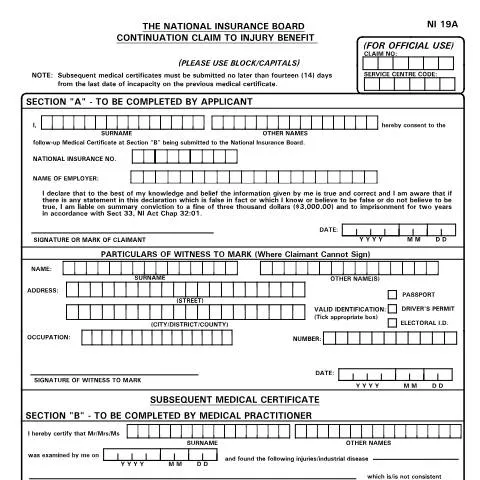
When a workplace incident leads to injury, the path to accessing support can be daunting. The NI19A form, specifically designed for continuation claims of injury benefits under the National Insurance Scheme, plays a pivotal role in this process. Understanding how to properly complete and submit this document is crucial for anyone navigating the complexities of the National Insurance Board (NIB) protocols.
Identifying Who Must Submit the NI19A Form
In the realm of workplace injuries, the NI19A form is primarily intended for employees who have sustained an injury while performing their work duties and are seeking to continue receiving benefits. This includes:
- Employees: Any individual covered under the National Insurance Act who has been injured at work.
- Dependent Individuals: In cases where the injured employee cannot complete the form themselves due to their condition.
- Employers: Certain sections must be filled out by the employer, confirming the injury and providing additional details on the incident.
Special cases may arise, such as when the claimant is a minor or lacks the capacity to sign. In such instances, a guardian or legal representative will be required to complete the form on their behalf.
Understanding the Timeline: Key Dates for NI19A Submissions
Timeliness is crucial when dealing with injury benefits. Here’s a detailed timeline for form submission and subsequent actions:
- Initial Submission: The form should be submitted no later than 14 days after the initial injury leave.
- Follow-Up Medical Certificates: Subsequent medical certificates must be submitted within 14 days from the last date of incapacity on the previous certificate.
- Assessment Period: The NIB will assess the claim and notify the applicant of the decision within a specified timeframe, typically no longer than 10 working days post-submission.
Failure to adhere to these timelines may result in delays or denial of benefits, emphasizing the importance of prompt action.
Breaking Down the Submission Process: How to Navigate the Channels
Submitting the NI19A form can be done through various channels, each with distinct procedures and nuances:
| Submission Channel | Description | Advantages | Considerations |
|---|---|---|---|
| Online Submission | Using the NIB's e-service portal, forms can be filled and submitted digitally. | Speed and convenience; instant confirmation of receipt. | Requires a ttconnect ID for access. |
| Forms can also be printed and mailed directly to the NIB. | Useful for those who prefer physical documents or lack internet access. | Longer processing times; risk of postal delays. | |
| In-Person Submission | Claimants can visit NIB service centers to submit forms directly. | Opportunity to clarify any doubts with staff immediately. | Potential wait times and may require travel. |
Step-by-Step Guidance: Completing the NI19A Form Accurately
Completing the NI19A form accurately is essential for a smooth claims process. Here is a breakdown of key sections to focus on:
- Section A: Personal Details
- Provide your full name and National Insurance Number.
- Include your employer's name and the service center code.
- Ensure your signature is included; if unable, a witness must sign as well.
- Section B: Medical Certification
- This section must be completed by a medical practitioner who has examined the claimant.
- The doctor must confirm the nature of the injury and any further incapacity.
- Section C: Employer's Responsibilities
- Employers must verify medical expenses and confirm the injury.
- Ensure the employer’s declaration is signed and stamped.
Accuracy in these sections will directly influence the speed and success of the claim. All information should be clear, legible, and truthful, as any inconsistencies can lead to complications.
What to Expect After Submission: Monitoring Your Claim's Progress
After the NI19A form is submitted, claimants can expect several stages of review and processing:
- Initial Acknowledgment: A notification will confirm receipt of the application.
- Review Period: The NIB will assess the claim and consult the submitted medical and employer information.
- Decision Notification: Claimants will receive notification of the decision via the method of submission, whether through mail or electronically.
It’s advisable to keep records of all communications and submissions for personal reference. Tracking claim status can be facilitated through the NIB e-services platform, allowing claimants to stay informed about their claim's progress.
Dealing with Denials or Issues: Next Steps if Your Claim is Rejected
Receiving a denial for a claim can be disheartening, but there are established procedures to contest such decisions:
- Understand the Reason: Carefully read the grounds for denial provided by the NIB.
- Gather Evidence: Compile additional documentation or medical evidence that supports your case.
- Submit an Appeal: Use the designated appeals process, including a written explanation of why you believe the decision should be overturned.
While the appeals process can take time, persistence and thorough documentation can significantly improve the chances of a successful review.
Essential Reminders: Key Points in Filling Out the NI19A Form
Before submitting your NI19A form, keep these essential reminders in mind:
- Double-check all information for accuracy, including names, dates, and identification numbers.
- Ensure that all required signatures are present, especially from medical practitioners and employers.
- Be aware of deadlines for submissions and follow-ups, as delays can jeopardize your benefits.
Following these guidelines will help streamline your experience with the NI19A form and the subsequent claims process, allowing for greater focus on recovery and rehabilitation.
Conclusion: Empowering Yourself in the Claims Process
Understanding the nuances of the NI19A form not only facilitates a smoother claims process but also empowers claimants in navigating their rights and responsibilities under the National Insurance Scheme. By being proactive, informed, and diligent throughout the submission and claims process, individuals can better secure the benefits they are entitled to during challenging times.
Understanding the NI19A Form: Purpose and Importance
The NI19A form, recognized as the 'Application for an NI Number,' is a pivotal document for individuals in Trinidad and Tobago applying for National Insurance coverage. This form plays a critical role in securing a National Insurance Number (NIN), which acts as a unique identifier for contributions made towards the National Insurance Scheme (NIS). The NIS is designed to provide social security benefits to workers, including sickness, maternity, and old-age pensions.
When an individual submits the NI19A form, it serves as a formal request to the National Insurance Board (NIB) to register them as a contributor. It is essential for both employees and the self-employed, as it ensures that they are covered under the national scheme and can access benefits when needed. The form requires various personal details, such as full name, date of birth, address, and details of employment or self-employment. Additionally, applicants must provide identification documents, such as a birth certificate or passport, to verify their identity.
Understanding the importance of the NI19A form extends beyond mere compliance; it reflects a citizen's engagement with the social security system and underscores their commitment to contributing to the welfare state. As such, the timely submission of this form is vital for ensuring that individuals can access necessary social services when the need arises.
Navigating the Application Process for NI19A
The process of applying for an NI Number using the NI19A form can be straightforward but requires careful attention to detail. Applicants can initiate the process online through the ttconnect platform, which provides a centralized access point for various government services. To begin, individuals must create a ttconnect ID, which will facilitate a smoother application experience.
Once logged into ttconnect, applicants can fill out the NI19A form electronically. It is crucial to ensure that all information provided is accurate and up-to-date, as discrepancies may lead to delays or rejection of the application. After completing the form, the next step is to gather all necessary supporting documents. These documents include proof of identity, such as a national ID card or passport, and proof of residence, like a utility bill or bank statement.
After compiling the required documents, applicants can submit their forms online or visit the nearest NIB office to submit them in person. If submitting online, a confirmation email is typically sent, providing a reference number that can be used to track the application status. For those submitting in person, it is advisable to keep copies of all documents for their records. Understanding the steps involved in navigating the application process not only enhances efficiency but also helps reduce anxiety associated with bureaucratic procedures.
Common Challenges and Solutions in Submitting the NI19A
While the NI19A form is essential for accessing crucial social security benefits, applicants often encounter challenges during the submission process. One common issue is the incomplete or incorrect submission of the form. Applicants may overlook critical details or fail to provide the necessary identification documents, resulting in delays or rejections. To mitigate this, it is advisable to thoroughly review the completed form and ensure that all required documents are attached before submission.
Another challenge pertains to the verification of identity. The NIB requires stringent identification checks to prevent fraud and ensure that benefits are allocated correctly. Applicants who have recently changed their name, for example, should provide legal documentation to support this change, such as marriage certificates or court orders. To prevent delays, individuals should be proactive in gathering all relevant documents that establish their identity and current status.
Lastly, some applicants may face difficulties due to a lack of familiarity with the online application system. For those who are not tech-savvy, navigating digital platforms can be daunting. To address this concern, the NIB offers assistance through their customer service channels. Individuals are encouraged to reach out for help, whether via phone, email, or in-person visits to NIB offices, where staff members are trained to assist with the application process. By being aware of potential challenges and knowing where to seek assistance, applicants can enhance their chances of successfully obtaining their National Insurance Number.