Understanding the IR8A Explanatory Notes for Employers in Singapore
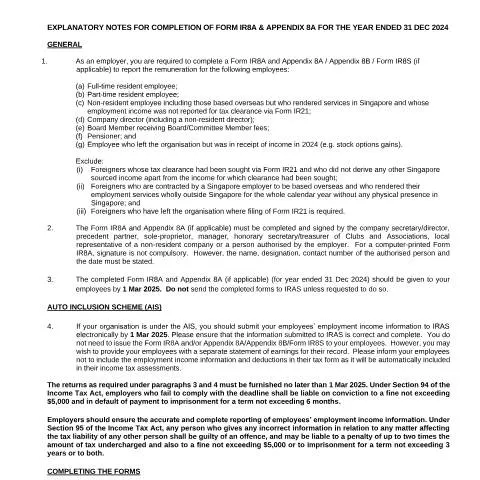
The IR8A explanatory notes serve as an essential guide for employers in Singapore responsible for completing and submitting employment income reports to the Inland Revenue Authority of Singapore (IRAS). These notes clarify the purpose, scope, and detailed procedures for accurately reporting employee remuneration for the year ended 31 December 2024, ensuring compliance with Singapore’s tax legislation.
Purpose of the IR8A and Appendix 8A
The primary function of the Form IR8A and its accompanying Appendix 8A is to provide IRAS with comprehensive details of an employee’s remuneration, including salary, bonuses, benefits-in-kind, and other income derived from employment. This information is crucial for the accurate calculation of individual income tax assessments. Employers must complete these forms for various categories of employees, including full-time and part-time residents, non-residents who rendered services in Singapore, company directors, board members, pensioners, and employees who left the organization during the year but received income.
Who Must Complete the IR8A and Appendix 8A?
Employers are required to complete and sign the IR8A and Appendix 8A for employees who fall into specific categories, such as:
- Full-time and part-time resident employees
- Non-residents with Singapore-sourced income
- Company directors and board members receiving fees
- Pensioners and employees who left during the year but received income
It is important to note that foreigners who have completed tax clearance via Form IR21 and did not derive additional Singapore-sourced income, or those who worked wholly outside Singapore, are generally exempt from this reporting requirement.
How to Complete the Forms Correctly
When filling out the IR8A and Appendix 8A, employers must ensure accuracy and completeness. The forms should include the employee’s date of employment commencement or cessation within 2024. If there are multiple employment periods within the year, the earliest start date and the latest end date should be indicated.
For amendments after submission, employers participating in the Auto Inclusion Scheme (AIS) are instructed to submit only the differences in income figures electronically via IRAS’s e-Submission portal. Non-AIS employers must prepare a revised or additional IR8A form, clearly marking it as “Revised” or “Additional,” and provide it to the employee for their records.
Reporting Income and Deductions
All gains, profits, and benefits received by an employee in relation to their employment are taxable unless specifically exempted. This includes monetary payments, benefits-in-kind, stock options gains, and any other form of remuneration. Employers must report the total employment income, including any fringe benefits, allowances, or bonuses, to ensure proper tax assessment.
Particularly for employees working outside Singapore, the IRAS notes specify that income and Central Provident Fund (CPF) contributions should be reported for the entire year if the posting is incidental to Singapore employment. For overseas postings not incidental, additional reporting guidance applies.
Important Deadlines and Penalties
Employers must provide completed IR8A and Appendix 8A forms to employees by 1 March 2025. These forms are not to be submitted to IRAS unless explicitly requested. Failure to comply with the submission deadline may result in penalties, including fines up to SGD 5,000, and, in default, imprisonment for up to six months, as stipulated under Section 94 of the Income Tax Act.
Moreover, providing incorrect or incomplete information can lead to penalties of up to twice the amount of tax undercharged, with fines up to SGD 5,000 or imprisonment for up to three years, under Section 95 of the same Act.
Summary
In summary, the IR8A explanatory notes guide Singapore employers through the process of accurately reporting employee remuneration for the 2024 fiscal year. Adherence to these guidelines ensures compliance with IRAS regulations, avoids penalties, and facilitates the correct assessment of individual income taxes.