Understanding the Sample Form SC for Estate Duty in Singapore
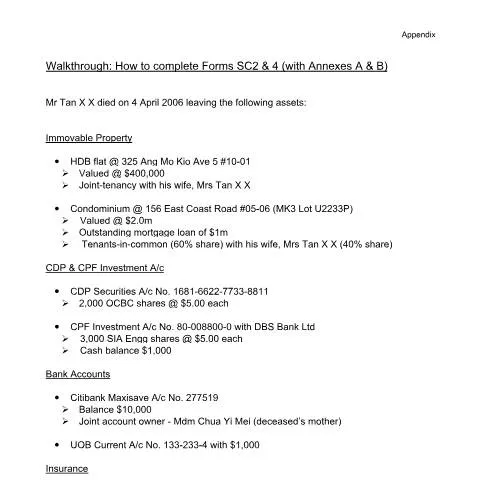
The Sample Form SC is an official document issued by the Inland Revenue Authority of Singapore (IRAS) to assist executors and administrators in declaring the estate of a deceased individual. This form is specifically designed for estates that fall under the estate duty regime, which was abolished in Singapore for deaths occurring after 15 February 2008. However, it remains relevant for estates of individuals who died before this date, especially when dealing with property and assets that may still be subject to estate duty assessments.
Purpose and Situations for Using the Form
The primary purpose of Form SC is to facilitate the declaration of a deceased person's estate, including immovable and movable assets, for estate duty assessment. Executors and administrators use this form to report properties passing on death, including real estate, bank accounts, investments, insurance policies, and other assets, to determine if estate duty is payable. It is crucial to complete this form accurately when the estate includes assets that could be subject to estate duty, especially for deaths prior to 2008.
This form is typically filed after the death of an individual when the estate is being administered. It is especially relevant if the estate's total value exceeds the estate duty exemption thresholds that were applicable before the abolition, or if the estate includes assets held jointly or as tenants-in-common that may trigger estate duty considerations.
Key Sections and Information Required
Part A: Basic Information and Declarations
Part A requires details about the deceased, including the date of death, NRIC number, and a series of questions to determine whether estate duty applies. Executors must answer questions regarding the nature and value of the estate, such as ownership of property, shares, or other assets, and whether the estate involves property transferred or sold within five years prior to death.
If the estate involves property valued above certain thresholds or transfers that could trigger estate duty, the executor must file additional forms, such as the Estate Duty Return (Form ED), and obtain clearance before proceeding with the estate distribution.
Part B: Property Passing on Death
This section focuses on assets that pass directly to beneficiaries or are deemed to pass on death, including joint bank accounts, estate shares, and assets held outside Singapore. Executors must declare all relevant property passing to beneficiaries, whether through the deceased's will or intestate succession.
Part C: Income Tax Considerations
If the estate is expected to generate taxable income, such as rental income or interest, the executor must file an Income Tax Form T with IRAS. This ensures proper tax compliance and reporting during estate administration.
Points of Attention and Practical Tips
- Accuracy is crucial: Executors should verify the value of all assets, including property, investments, and cash, to ensure correct reporting and avoid penalties.
- Timely filing: The form should be submitted promptly after the death, especially if estate duty assessments are required or if estate assets are substantial.
- Legal considerations: For estates involving property or assets abroad, additional declarations or forms may be necessary, and professional advice is recommended.
- Use of digital services: IRAS encourages the use of their e-Services portal for filing and managing estate-related documents, facilitating a streamlined process.
- Consultation with professionals: Given the complexity of estate duty and tax laws, engaging legal or tax professionals can help ensure compliance and proper estate management.
Transmission and Submission of the Form
Form SC is primarily submitted electronically through IRAS's e-Services portal, or in some cases, via paper if specifically required. Executors must authenticate using Singpass or other secure authentication methods to access the portal. When submitting, ensure all relevant sections are completed accurately, and supporting documents, such as property valuations or wills, are attached if necessary.
In situations where estate duty is applicable, the estate duty return (Form ED) must be filed and clearance obtained before distributing the estate. For estates not subject to estate duty, a simple declaration via Form SC may suffice, provided all questions are answered with 'No.'
Conclusion
The Sample Form SC serves as an essential tool for estate administrators in Singapore, ensuring proper declaration of assets and compliance with legal obligations related to estate duty and tax. Accurate and timely completion of this form helps facilitate smooth estate administration, avoiding delays and penalties. Executors are advised to familiarize themselves with the form's requirements and seek professional guidance when necessary to navigate complex estate matters effectively.