Understanding the Property Tax GIRO Application Form for Businesses in Singapore
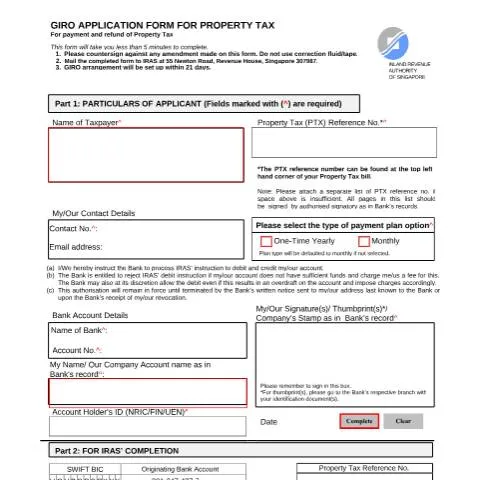
The Property Tax GIRO Form for Businesses issued by the Inland Revenue Authority of Singapore (IRAS) is a vital document designed to facilitate the automatic payment of property taxes through the GIRO banking arrangement. This form streamlines the process for businesses to manage their property tax obligations efficiently, ensuring timely payments and reducing administrative burdens.
Purpose and Scope of the Form
This application form allows businesses to authorize their bank to process recurring or one-time payments of property tax via the GIRO scheme. It is applicable for businesses holding property in Singapore and wishing to automate their property tax payments to IRAS. The form covers the collection of necessary banking and property details, ensuring that payments are made accurately and securely.
Key Sections and Their Functions
Part 1: Particulars of the Applicant
This section requires the taxpayer to provide essential details, including:
- Name of the Taxpayer: The business or individual responsible for the property tax.
- Property Tax Reference Number: Found at the top left of the property tax bill, this unique identifier links the application to the specific property.
- Contact Details: Phone number and email address for correspondence.
It is crucial that the details entered are accurate to avoid delays or rejection of the application.
Part 2: Bank Details and Authorization
This part authorizes IRAS to instruct the business's bank to debit or credit the specified bank account for property tax payments. Key points include:
- Bank Account Details: The account name, account number, and SWIFT/BIC code are required.
- Signature or Thumbprint: The authorized signatory must countersign against any amendments, with no correction fluid or tape allowed.
- Authorization Validity: The agreement remains in force until explicitly revoked by the business or the bank.
Businesses should ensure that the bank account details are correct and match the bank's records to prevent rejection.
Part 3: Bank’s Completion
This section is completed by the bank, confirming the account details and verifying the authorization. The bank’s authorized officer signs and dates this part, indicating approval or rejection of the application based on the provided information.
Important Procedures and Deadlines
Once the completed form is submitted to IRAS at 55 Newton Road, Revenue House, Singapore 307987, the GIRO arrangement will typically be established within 21 days. During this period, IRAS reviews the application, verifies details, and sets up the payment plan as per the applicant’s selection.
Applicants should ensure that their bank accounts have sufficient funds for the initial and subsequent payments, especially if opting for recurring plans such as monthly or yearly payments. The form allows the selection of payment frequency, with the default being monthly if no option is specified.
Post-Submission and Payment Management
After the GIRO arrangement is active, the bank will process payments automatically based on the schedule. It is advisable for businesses to monitor their bank statements and property tax bills to confirm that payments are debited correctly. Any discrepancies or rejection notices from the bank or IRAS should be addressed promptly.
In case of changes to bank details or termination of the GIRO arrangement, businesses must notify IRAS and their bank in writing to prevent missed or incorrect payments.
Additional Considerations
Applicants should note that amendments to the form must be countersigned, and correction fluid or tape should not be used. For thumbprint-based signatures, applicants are advised to visit their bank branch with valid identification documents.
It is recommended to retain copies of the completed form and confirmation notices for record-keeping and future reference.
Conclusion
The Property Tax GIRO Form for Businesses is a straightforward yet essential document that enables seamless, automated property tax payments in Singapore. By accurately completing and submitting this form, businesses can ensure timely compliance with IRAS requirements while enjoying the convenience of automatic banking arrangements.