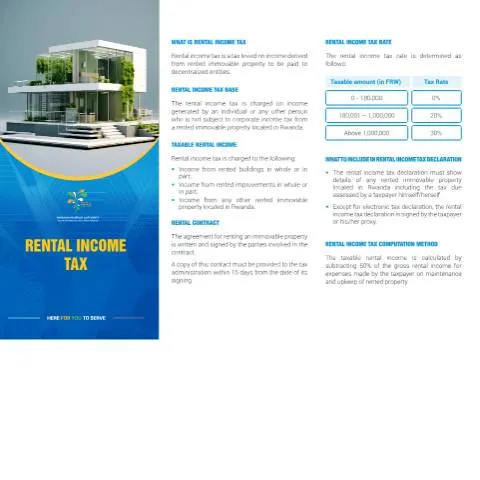
Understanding Rental Income Tax in Rwanda: A Comprehensive Overview
Rental income tax is an essential aspect of property management for landlords in Rwanda. As it applies to income derived from rented immovable property, understanding the nuances of this tax can help property owners navigate their financial responsibilities effectively. This guide dives into the key components of the Brochure Rental Income Tax 2024 to equip landlords with the knowledge needed for compliance.
Defining Rental Income and Tax Responsibilities
Rental income tax is levied specifically on the income derived from renting properties. This includes:
- Income from rented buildings, either in whole or in part.
- Income from rented improvements on properties.
- Any other form of rented immovable property located within Rwanda.
It’s crucial for landlords to recognize that this tax applies not only to residential properties but also to commercial real estate assets. The tax must be paid to the relevant decentralized entities in Rwanda, ensuring that local governments receive their fair share to support community development.
Who Needs to File a Rental Income Tax Declaration?
Any individual or entity earning rental income must declare this income for tax purposes. This requirement extends to those who are not subject to corporate income tax. Landlords should be aware that failure to file a declaration can lead to penalties and interest on unpaid taxes.
Rental Contracts: Essential Documentation
Every rental agreement must be documented through a formal contract signed by both parties involved. This contract is not only a legal requirement but serves as proof of the rental arrangement for tax purposes. Within 15 days of signing, a copy of this contract must be submitted to the tax administration. Keeping accurate records of all rental agreements is fundamental for compliance and minimizes the risk of disputes or misunderstandings later on.
Calculating Your Taxable Rental Income
To compute the rental income tax, landlords must first determine their gross rental income. However, the law allows a reduction of this income by a certain percentage for maintenance and upkeep expenses. Specifically, landlords may deduct 50% of their gross rental income before calculating the tax owed.
This means that landlords should keep meticulous records of all maintenance expenses, as these can significantly reduce taxable income. Additionally, if there are bank interests related to loans taken for the rental property, these can also be deducted, provided proof is available.
Example Calculation
To illustrate the calculation of rental income tax, consider the following case:
Mrs. Jane owns a residential house in Kigali that generated a rental income of FRW 4,800,000 in the year 2023. She incurred FRW 500,000 in bank interest associated with the construction loan for this property. The taxable amount would be determined as follows:
- Calculate gross rental income: FRW 4,800,000
- Deduct 50% for maintenance: FRW 2,400,000
- Subtract bank interest: FRW 2,400,000 - FRW 500,000 = FRW 1,900,000
This taxable amount of FRW 1,900,000 is then subject to the applicable rental income tax rates.
Understanding Tax Rates: How Much Will You Pay?
The rental income tax rates in Rwanda are structured progressively based on the taxable amount:
| Taxable Amount (in FRW) | Tax Rate |
|---|---|
| 0 - 180,000 | 0% |
| 180,001 – 1,000,000 | 20% |
| Above 1,000,000 | 30% |
Using the earlier calculation for Mrs. Jane, the total tax due can be computed based on these rates:
- For the first FRW 180,000: 0%
- For the amount between FRW 180,001 and FRW 1,000,000: (1,000,000 - 180,000) * 20% = FRW 164,000
- For the amount above FRW 1,000,000: (1,900,000 - 1,000,000) * 30% = FRW 270,000
Adding these amounts gives her a total rental income tax liability of FRW 434,000.
Filing Deadlines: When to Act
Landlords must file their rental income tax declaration by January 31 of the following year. This requirement emphasizes the importance of timely documentation and adherence to deadlines to avoid late fees or other penalties. It is advisable to prepare this declaration well in advance of the deadline to ensure all information is accurate and complete.
Online Submission through Irembo
In Rwanda, the Irembo platform facilitates the electronic submission of tax declarations, simplifying the process for landlords. By utilizing this online service, landlords can file their rental income tax declarations quickly and efficiently, minimizing the risk of errors associated with manual submissions.
Landlords are encouraged to familiarize themselves with the Irembo platform as it also provides them with access to a variety of e-services related to tax and administrative processes.
Interdependencies with Other Tax Documents
Rental income tax declarations may also interact with other tax obligations. For instance, landlords who operate rental properties as businesses might also be subject to corporate taxes, depending on the structure of their operations. Furthermore, maintaining accurate records in compliance with rental income tax requirements can support other tax filings and obligations, ensuring a comprehensive approach to financial governance.
Critical Insights and Cautions
While it may seem straightforward, the rental income tax landscape in Rwanda can be nuanced. Landlords should be particularly cautious about several aspects:
- The importance of submitting rental contracts on time to avoid penalties.
- Understanding deductions available and ensuring proper documentation is maintained.
- The necessity of adhering to tax filing deadlines to prevent additional fees.
Additionally, landlords should stay informed about any legislative changes that could impact their tax obligations or rates.
Further Resources and Support
For additional information and assistance, landlords can reach out to the Rwanda Revenue Authority via the following:
- Call Center: 3004
- Website: www.rra.gov.rw
Utilizing these resources ensures that landlords can access up-to-date information and guidance, supporting them in fulfilling their rental income tax obligations effectively.
Understanding Rental Income Tax Obligations in Rwanda
The Rental Income Tax in Rwanda is a crucial aspect of the taxation framework, and it's essential for landlords to grasp their responsibilities under the current laws. The Rwanda Revenue Authority (RRA) stipulates that individuals or entities earning income from renting properties are liable to this tax. The tax is evaluated based on the net income derived from rental activities, which is generally calculated as total rental income minus any allowable expenses directly related to the property management.
To ensure compliance, property owners must maintain meticulous records of their rental income and expenses. This includes keeping track of receipts for repairs, maintenance, utilities, and other costs associated with the rental properties. The law defines specific deductions that can be claimed, and understanding these can greatly reduce the taxable income, thereby lowering the overall tax liability. It is advisable for landlords to consult the RRA guidelines or engage with a tax professional to navigate through the details of allowable deductions.
Furthermore, with the fiscal year spanning from July to June, landlords must be acutely aware of the tax declaration deadlines and payment schedules. Typically, tax returns for rental income must be submitted within a specified period following the end of the fiscal year. Staying informed about these deadlines can prevent unnecessary penalties for late submissions or payments.
The Role of Digital Platforms in Managing Rental Income Tax
With Rwanda's commitment to enhancing public service delivery through digital transformation, the Irembo platform has become a vital tool for landlords managing their rental income tax obligations. This online portal facilitates various administrative services, allowing users to submit tax declarations, pay taxes, and access information regarding their tax status with ease.
Landlords can navigate the Irembo platform to find the 'Rental Income Tax Declaration' service, where they can prepare and submit their tax returns electronically. This digitization simplifies the process, reducing the need for physical visits to RRA offices, thus saving time and resources. Users are encouraged to create an account on Irembo, where they can manage all their activities related to tax payments and submissions from a single interface.
Moreover, the platform is regularly updated to include relevant information, guidelines, and any changes in tax legislation, ensuring that landlords stay informed about their obligations. Engaging with Irembo not only enhances compliance but also provides an accessible way to resolve any queries or issues that may arise concerning rental income tax.
Common Pitfalls to Avoid in Rental Income Tax Compliance
Landlords must be aware of several common pitfalls that can lead to issues with rental income tax compliance. One of the most significant mistakes is the failure to report all rental income accurately. Even if a property is rented out informally or through short-term rentals, all income should be declared, as the RRA has mechanisms in place to identify discrepancies.
Moreover, many landlords overlook the importance of understanding tax implications related to different types of rental arrangements. For instance, the tax treatment of income from commercial properties may differ from that of residential leases. Hence, it’s essential for landlords to familiarize themselves with the specific regulations governing different property types.
Another common oversight is the neglect of tax deduction opportunities. Landlords may miss out on substantial savings by failing to claim eligible expenses or by not keeping adequate records to support their claims. Engaging with a tax advisor who understands the local landscape and the nuances of rental taxation can provide invaluable guidance and help avoid these pitfalls.
Lastly, staying informed about updates or changes in tax laws is critical. The RRA periodically revises tax regulations, and landlords who are unaware of these changes risk non-compliance. Subscribing to RRA newsletters or participating in local workshops can help landlords stay abreast of relevant updates.