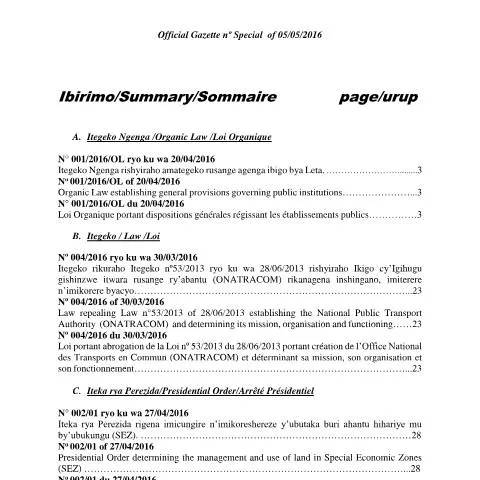
Understanding the Ministerial Orders on Pension Benefits and Registration Procedures in Rwanda
The official publication in the Rwanda Official Gazette, specifically the Special of 05/05/2016, provides critical guidance on the regulation and management of pension schemes for public sector employees. These ministerial orders are essential for ensuring transparency, efficiency, and legal compliance within the pension system, which is a vital component of Rwanda's social security framework.
Scope and Purpose of the Ministerial Orders
The orders issued in this gazette serve to delineate the modes of payment for pension benefits and establish the procedures for registration within the pension scheme. Their primary goal is to streamline processes, safeguard the rights of beneficiaries, and align pension management with the legal framework established by Law No. 22/2018 related to civil, commercial, labour, and administrative procedures.
Specifically, these orders aim to:
- Define clear methods for disbursing pension benefits to eligible individuals.
- Set standardized procedures for registering contributors and beneficiaries in the pension scheme.
- Ensure compliance with national laws and regulations governing social security and pension management.
Who Is Affected by These Orders?
The regulations primarily concern public servants, government employees, and other contributors to the national pension scheme. This includes personnel working within various government ministries, agencies, and public institutions that are subject to the provisions of Law No. 22/2018.
Additionally, pension scheme administrators, financial institutions involved in the disbursement of benefits, and the Rwanda Social Security Board (RSSB) are directly impacted by these orders, as they are responsible for implementing the prescribed procedures.
Key Provisions and Procedures
Modes of Payment of Pension Benefits
The orders specify the acceptable modes of pension disbursement, which include bank transfers, mobile money transactions, and other electronic payment methods authorized by the relevant authorities. These measures are designed to promote efficiency, reduce delays, and enhance security in pension payments.
Registration in the Pension Scheme
Registration procedures outlined in the orders emphasize the importance of accurate and timely registration of contributors and beneficiaries. The process involves:
- Submission of registration forms through the designated online platform, primarily Irembo, ensuring citizen-centric digital access.
- Verification of identity through the National Identification Number (NIN), which is central to the registration process.
- Confirmation of employment status and contribution history by relevant public institutions and the Rwanda Social Security Board (RSSB).
Legal and Institutional References
The ministerial orders are grounded in the legal framework established by Law No. 22/2018, which governs civil and administrative procedures, as well as the general provisions for public institutions outlined in Organic Law No. 001/2016/OL of 20/04/2016.
Fill in your form directly online
No printing: type your details into the boxes of the official form, tick, then download the PDF ready to send.
- 1Type into the form boxes
- 2Tick in one click
- 3Save and download the PDF
These regulations are overseen by the Ministry of Local Governance (MINALOC) and the Rwanda Social Security Board (RSSB), which are responsible for implementing, monitoring, and updating pension-related procedures to reflect best practices and legal compliance.
Conclusion
The ministerial orders published in the official gazette of May 2016 are a significant step towards modernizing Rwanda’s pension system. By establishing clear modes of payment and streamlined registration processes, they aim to enhance the efficiency, transparency, and security of pension benefits for public sector employees. Citizens and public institutions are encouraged to utilize online platforms such as Irembo for registration and benefit management, ensuring a citizen-centric approach aligned with Rwanda’s broader digital transformation agenda.