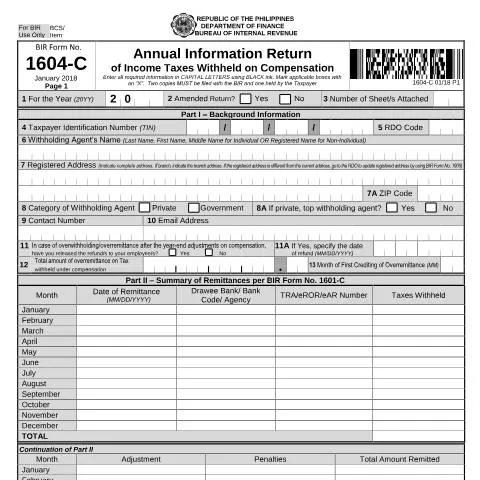
Navigating the BIR Form No. 1604-C: A Crucial Component of Income Tax Compliance
In the complex landscape of tax compliance in the Philippines, the BIR Form No. 1604-C stands out as an essential document for employers and withholding agents. This form serves as the Annual Information Return of Income Taxes Withheld on Compensation, a critical tool for reporting the income taxes that have been withheld from employees’ compensation over the course of the fiscal year. Understanding the intricacies of this form is vital for ensuring compliance with the Bureau of Internal Revenue (BIR) regulations, minimizing potential liabilities, and facilitating smooth tax filing processes.
The Regulatory Framework: Context and Compliance Standards
The BIR Form No. 1604-C is governed by the provisions of the National Internal Revenue Code, as amended, alongside the guidelines set forth in the Administrative Code of 1987. Specifically, this form aligns with the stipulations of withholding tax regulations that mandate employers to withhold a certain percentage of their employees' compensation for tax purposes. The legal backing ensures that both the filing and the withholding processes are systematically aligned with the country’s fiscal policies.
According to the Bureau of Internal Revenue, all withholding agents must comply with the annual requirement to submit this form, providing a comprehensive report of the amounts they have deducted from employee salaries. Failure to do so not only exposes the employer to penalties but complicates the employees' tax situations as well, potentially leading to issues with the BIR.
Unpacking the Structure: Key Components of Form No. 1604-C
The BIR Form No. 1604-C is meticulously designed with segmented parts that facilitate the categorization and reporting of withholding taxes. Here’s an overview of its essential sections:
- Part I – Background Information: This section captures vital details such as the Taxpayer Identification Number (TIN), Registered Name, Address, and the nature of the withholding agent, whether private or government.
- Part II – Summary of Remittances: This part requires the reporting of the monthly remittances made through BIR Form No. 1601-C. It includes fields for each month’s amounts withheld, dates of remittance, and totals derived from these figures.
Each of these sections is crucial, as they help the BIR track compliance and ensure that taxes withheld are accurately reported for each employee. Notably, the form also touches on specific situations such as over-remittance, providing a complete picture of the withholding agent’s tax obligations.
Timelines and Submission Protocol: Meeting Deadlines
The importance of timelines cannot be overstated when it comes to tax compliance. The BIR Form No. 1604-C must be filed within the first quarter of the year following the tax year it corresponds to. Specifically, the deadline for submission falls on April 15 of the following year. Failure to meet this deadline results in penalties that can increase significantly over time.
Once submitted, employers should retain a copy of the form for their records and be prepared to address any queries from the BIR. The form's submission not only serves as a compliance measure but also reinforces the withholding agent’s credibility and commitment to upholding tax laws.
Electronic Filing Options: Streamlining the Submission
The advent of technology has transformed the way tax documents are filed in the Philippines. Employers have the option to submit the BIR Form No. 1604-C electronically through the eBIRForms system. This avenue is particularly beneficial as it minimizes paperwork and expedites the filing process.
Additionally, the eGovPH application facilitates the submission of various tax forms, including the 1604-C, further simplifying the compliance landscape. This digital approach ensures that the forms are submitted efficiently and securely, providing real-time confirmation of receipt by the BIR.
Comparative Analysis: BIR Form No. 1604-C vs. Related Forms
| Form Name | Purpose | Frequency of Filing | Filing Deadline |
|---|---|---|---|
| BIR Form No. 1604-C | Annual Information Return of Income Taxes Withheld on Compensation | Annual | April 15 of the following year |
| BIR Form No. 1601-C | Monthly Remittance Return of Income Taxes Withheld on Compensation | Monthly | On or before the 10th day of the following month |
| BIR Form No. 1700 | Annual Income Tax Return for Individuals | Annual | April 15 of the following year |
This comparative analysis highlights the specific role of BIR Form No. 1604-C within the broader context of tax compliance forms. While both the 1604-C and the 1601-C are interconnected, the former serves as a summary of all monthly remittances made under the latter form.
Filling Out the Form: Precision is Key
Completing the BIR Form No. 1604-C requires meticulous attention to detail to avoid errors that could lead to penalties or delayed processing. Here are steps to consider when filling out the form:
- Gather Necessary Information: Before starting, ensure all relevant information, such as TIN, remittance amounts, and employee details, are readily available.
- Use Capital Letters: All entries should be written in capital letters and in black ink to maintain legibility.
- Check Applicable Boxes: Ensure to mark applicable boxes with “X” as required in various sections of the form.
- Review for Completeness: Double-check all sections for accuracy and completeness before submission to prevent avoidable errors.
This attention to detail not only enhances compliance but also aids in establishing a transparent relationship with tax authorities.
Post-Submission: What Happens Next?
After the BIR Form No. 1604-C is submitted, the withholding agent must be prepared for a potential audit or inquiry from the BIR. It is crucial to maintain copies of all submitted documents, as these may be requested during an audit. Compliance with the submission also opens the door for employees to accurately file their individual income tax returns, ensuring that all withholdings have been accounted for and applied correctly to their tax liabilities.
In cases of overwithholding, the employer should follow the necessary procedures to issue refunds to employees promptly. The timing of these refunds, as indicated on the form, must be communicated clearly to affected employees.
Key Takeaways for Withholding Agents
For employers and withholding agents in the Philippines, the BIR Form No. 1604-C is more than just a compliance obligation; it is a reflection of their commitment to fulfilling tax responsibilities. Understanding the nuances of this form, including its legal underpinnings, filing protocols, and post-submission processes, is essential for effective tax management.
Employers are encouraged to invest in training for their accounting and payroll staff to ensure that they are well-versed in the requirements surrounding the BIR Form No. 1604-C. By doing so, they can enhance compliance, improve operational efficiency, and foster a culture of transparency within their organizations.
Understanding the Importance of BIR Form No. 1604-C
Form No. 1604-C, formally known as the Annual Information Return of Income Taxes Withheld on Compensation, is crucial for both employers and the Bureau of Internal Revenue (BIR) within the Philippine tax system. This form serves as an annual report that employers must file, detailing the total amount of income taxes withheld from their employees’ compensation throughout the calendar year. By using this form, employers not only comply with their tax obligations under the law but also contribute to the BIR’s efforts to maintain an accurate and comprehensive database of income tax collections.
The timely submission of Form No. 1604-C ensures that the BIR can effectively assess tax liabilities and monitor compliance rates across various sectors. Moreover, this form provides employees with the official documentation needed to validate the taxes withheld from their salaries, which can be particularly important during tax return filing or in securing financial services requiring proof of income tax payments. Therefore, understanding and accurately completing this form can have significant implications for both employers and employees.
Eligibility and Filing Requirements for BIR Form No. 1604-C
Employers must determine their eligibility to file Form No. 1604-C based on specific criteria set forth by the BIR. Generally, all employers who are required to withhold income taxes from their employees are obliged to file this annual return. This includes both government and private sector employers, regardless of the number of employees. Even if an employer has not withheld any taxes, they are still required to file the form, indicating zero withholding if applicable.
The filing period for Form 1604-C corresponds with the end of the calendar year, with the due date typically falling on the last day of February of the following year. To facilitate compliance, employers must gather and organize data regarding the total compensation paid to each employee, the income taxes withheld, and any tax-exempt income or benefits that may affect the calculation. Failure to file this form by the due date can result in penalties, so it is essential for employers to maintain accurate records throughout the year to simplify the preparation of this return.
Common Errors and How to Avoid Them When Filing Form No. 1604-C
Filing Form No. 1604-C can be straightforward, yet various common errors may lead to compliance issues or penalties from the BIR. One prevalent mistake is providing incorrect or incomplete employee information. Employers must ensure that the Tax Identification Numbers (TIN) of employees are accurate and current. Additionally, using outdated compensation figures can lead to discrepancies that affect the total taxes reported.
Another frequent error arises from miscalculating the total income taxes withheld. It is crucial for employers to regularly update their payroll systems, reflecting changes in tax rates or laws that may impact withholding. Employers should also be aware of any exemptions or deductions that apply to specific employees, as failure to account for these correctly can result in incorrect filings.
To mitigate these risks, employers should consider implementing regular internal audits of payroll processes and offer training sessions for HR personnel involved in tax compliance. Utilizing the BIR's e-filing platforms can also assist in minimizing errors, as these digital tools often include validation checks and prompts to ensure accurate submission.