Navigating the Exempt Employee Share Scheme: Your Essential Guide
When managing employee benefits, particularly in the realm of share schemes, the Exempt Employee Share Scheme (Exempt ESS) takes center stage. This scheme allows employers to grant shares to employees with specific tax exemptions, encouraging ownership and engagement within the workforce. However, diving into this administrative task requires not only an understanding of the processes involved but also a meticulous approach to completing the IR1212 form correctly.
Understanding Your Obligations Under the Exempt ESS Framework
The Exempt Employee Share Scheme is rooted in New Zealand’s commitment to fostering employee ownership. To leverage this scheme effectively, companies must understand both their responsibilities and the regulatory landscape. This knowledge base is crucial for ensuring compliance with the Inland Revenue Department (IRD) guidelines.
The Legislative Background
The Exempt ESS framework is governed by specific provisions that facilitate employees' ability to receive shares without being heavily taxed. These provisions aim to promote long-term retention and alignment of employee interests with corporate success. The essential legislation surrounding this scheme is encapsulated in various tax regulations enforced by the IRD.
Who Should Fill Out the IR1212 Form?
This form is designed for employers who wish to report on their Exempt Employee Share Scheme contributions. Specific scenarios where the IR1212 comes into play include:
- Companies issuing shares as part of a remuneration package
- Start-ups looking to attract talent through equity compensation
- Established businesses seeking to bolster employee loyalty and performance
It’s essential to note that not every company will need to fill out this form. Understanding your company's eligibility is key. For instance, if your business does not participate in the Exempt ESS, the IR1212 form will not be applicable.
Key Profiles for Participants
Within the context of Exempt ESS, the individuals involved may vary significantly based on the company’s structure and employee engagement strategy. Here are profiles that typically interact with this form:
- Small Business Owners: Often looking to motivate a small team with an ownership stake.
- HR Managers: Responsible for communicating the benefits and ensuring compliance with tax obligations.
- Finance Officers: Tasked with reporting financial implications to the IRD.
Decoding the IR1212: Each Section and Its Importance
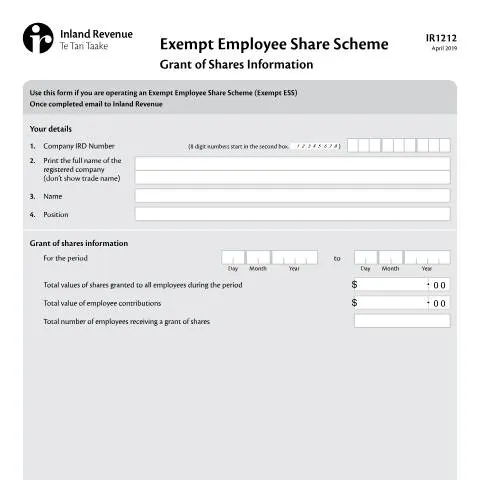
Completing the IR1212 form accurately is paramount for avoiding penalties or delays in the processing of your Exempt ESS report. Below is a breakdown of the form's components:
| Section | Description | Common Pitfalls |
|---|---|---|
| Your Details | Includes company IRD number and full registered name. | Failing to provide the correct IRD number format can lead to rejection. |
| Grant of Shares Information | Details the periods and total value of shares granted. | Incorrectly calculating the total value of shares can result in discrepancies. |
| Employee Contribution Information | Records total employee contributions during the period. | Omitting any employee contributions will affect overall tax calculations. |
Completing Each Section: A Step-by-Step Guide
As you navigate through the IR1212, it’s important to pay attention to detail:
- Company IRD Number: This is a unique identifier. Ensure it’s an 8-digit number and begins in the designated format.
- Registered Company Name: Avoid using trading names. Provide the full legal name.
- Dates of Share Grants: Clearly specify the start and end date for the share grants.
- Values: Accurately state the total values. Double-check your math to avoid errors.
What Happens After Submission of the IR1212?
Once the IR1212 form has been completed and submitted, the next steps focus on awaiting responses from the IRD. Here’s what to expect:
- Processing Time: The IRD typically processes submissions within a set timeframe, but this can vary based on the volume of applications.
- Potential Queries: Be ready for the IRD to reach out with questions or requests for clarification.
- Confirmation of Compliance: After review, you will either receive a confirmation of compliance or notification of any issues needing resolution.
Next Steps If Issues Arise
In the event of a rejection or request for additional information, swift action is crucial:
- Review Feedback: Understand the reasons behind any rejection or request for clarification.
- Gather Required Information: Address any missing pieces or errors outlined in the IRD’s communication.
- Resubmit: Once corrections are made, resubmit your IR1212 form promptly.
Addressing Common Complexities and Unique Situations
Completing the IR1212 form might seem straightforward, yet unique circumstances can complicate the process. Consider the following scenarios:
- Changes in Company Structure: Mergers or acquisitions could necessitate a reconsideration of how shares are granted.
- Multiple Share Classes: If your company has different classes of shares, careful classification will be required on the form.
- Employee Departures: If an employee leaves the company during the grant period, balancing their share allocation and contributions becomes vital.
Clarifying the Distinction: IR1212 vs. Other Forms
It’s essential to differentiate the IR1212 from similar forms used in employment and taxation contexts. For instance:
| Form | Purpose | Similarities and Differences |
|---|---|---|
| IR1212 | Report on Exempt Employee Share Scheme grants. | Specific to share grants; focuses on employee ownership. |
| IR330 | Tax code declaration for employees. | Relates to ongoing employee tax obligations rather than equity grants. |
| IRD 101 | Income tax return form for businesses. | More comprehensive; covers overall business income rather than specific employee share grants. |
Understanding these distinctions ensures that you file the correct paperwork for the relevant purposes, minimizing administrative confusion and potential penalties.
Final Thoughts on the IR1212 Process
Filing the IR1212 form can be a nuanced process, but understanding each step, from preparation to submission, equips employers to manage their Exempt Employee Share Scheme effectively. Careful attention to detail and prompt responses to any IRD queries will facilitate a smooth experience, fostering a positive relationship with your employees and the regulatory authorities alike.
As you embark on this administrative journey, stay informed and proactive. Mastering the intricacies of the IR1212 form not only demonstrates your compliance but also reinforces your commitment to employee engagement through equitable practices.