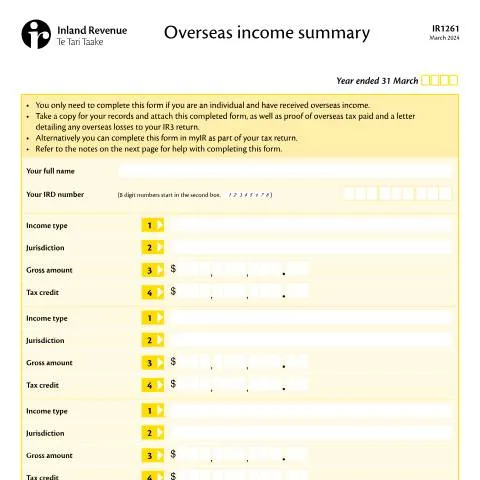
Navigating the Overseas Income Summary (IR1261): Your Essential Guide
Understanding tax obligations can be daunting, especially when it comes to overseas income. For New Zealand residents, the Overseas Income Summary (IR1261) plays a critical role in ensuring compliance with the Income Tax Act. Let’s delve into the nuances of this form, specifically designed for individuals with overseas income, and break down its importance, completion process, and potential outcomes.
When Overseas Income Beckons: Scenarios Requiring IR1261
Imagine you’ve just wrapped up a project abroad, or perhaps you’ve received dividends from an overseas investment. In such instances, the IR1261 form becomes essential. If you are a New Zealand resident taxpayer and your overseas income exceeds the tax-free threshold, the IR1261 is your tool for reporting that income.
Who Needs to Complete the Form?
- If you have received income types such as interest, dividends, or salaries from another jurisdiction, you’re required to complete the IR1261.
- Even if your overseas income comes from the same country but different sources, each income type must be reported separately on the form.
- Foreign pensions and rental income from property abroad also necessitate this form.
The Role of IR1261 in Your Tax Return Process
The IR1261 is not a standalone document; it’s a crucial part of your overall tax return. Specifically, this form must accompany your IR3 return if you’re self-filing. Let’s explore the process:
Chronological Steps: From Trigger to Submission
- Identify Your Overseas Income: Gather all documentation of income received from abroad during the fiscal year (1 July to 30 June).
- Complete the IR1261: Accurately fill out the form with details of each income type and its corresponding jurisdiction.
- Attach Required Documents: Include proof of overseas taxes paid and any letters detailing overseas losses.
- Submit Your IR3 Return: Make sure the IR1261 is attached when you file your IR3 return.
Filling Out the IR1261: A Step-by-Step Approach
Completing the IR1261 form might seem straightforward, but attention to detail is crucial. Here’s a breakdown of the key sections you’ll encounter:
Section Breakdown of the Form
| Field | Description |
|---|---|
| Your Full Name | As registered with the Inland Revenue Department (IRD). |
| Your IRD Number | An 8-digit number starting in the second box. |
| Income Type | Select from categories like interest, dividends, or foreign employment. |
| Jurisdiction | The country from which the income is derived. |
| Gross Amount | Report the total income earned in NZD. |
| Tax Credit | Enter claimable tax credits for overseas taxes paid. |
Post-Submission: What Comes Next?
Once your IR1261 form is submitted alongside your IR3 return, the Inland Revenue Department (IRD) will process your application. You can expect the following:
Anticipating the Outcomes
- Tax Assessment: The IRD will assess your overseas income and tax credits to determine your final tax obligations.
- Refunds or Additional Payments: Depending on the overall assessment, you may either receive a refund or be required to make additional payments.
- Record Keeping: Always retain copies of your IR1261 and supporting documents for at least seven years in case of audits.
Dealing with Errors or Missing Information
Mistakes happen, and sometimes you may find that incorrect information has been submitted or that certain documents were inadvertently left out. Here’s how to navigate these challenges:
Steps to Take if Issues Arise
- Contact the IRD: If you notice an error, reach out to the IRD immediately to discuss potential corrections.
- Provide Documentation: Be ready to submit any necessary documents that support your claim or correction.
- Amendments: If your tax return needs to be amended, follow the IRD’s guidelines for submitting corrections.
Special Circumstances: Navigating Complex Situations
Not all taxpayers have straightforward income situations. Some may encounter unique challenges, such as:
Handling Unique Scenarios
- Foreign Residents: If you are not a New Zealand resident but you have overseas income, different rules may apply.
- Minors: If a minor earns overseas income, a guardian usually needs to fill out the IR1261 on their behalf.
- Urgent Situations: If you’re under time constraints due to travel or other emergencies, you might need to file your IR1261 and IR3 return sooner than usual. Engage with the IRD for potential expedited processing.
Understanding the Broader Implications of the IR1261
Completing the IR1261 is not merely a bureaucratic exercise; it carries significant implications for taxpayers:
Benefits and Obligations
- Tax Credits: Properly reporting your overseas income allows you to claim tax credits, reducing your overall tax liability.
- Legal Compliance: Fulfilling this obligation prevents potential penalties associated with non-disclosure of income.
- Future Impacts: Accurately reporting income can affect your long-term relationship with the IRD and your future tax returns.
Maximizing Your Use of the IR1261 Form
To truly leverage the benefits of the IR1261, consider the following best practices:
Best Practices for Effective Reporting
- Stay Informed: Regularly check the IRD’s website for updates on tax regulations that may affect your overseas income.
- Consult a Tax Professional: If your situation is complex or you are unsure about certain aspects, seeking expert advice can save you time and money.
- Utilize Online Resources: The IRD provides various tools and resources to assist you in understanding how to fill out the IR1261 accurately.
Final Thoughts on Completing IR1261
Engaging with tax obligations surrounding overseas income may feel overwhelming, but with the right tools and knowledge, you can navigate the process smoothly. The IR1261 is not just a form—it’s a gateway to ensuring you meet your tax responsibilities while making the most of the benefits available to you. Remember to maintain accurate records, engage with the IRD proactively, and consult professionals when needed. Your financial compliance today lays the foundation for a more secure fiscal future.
Understanding Tax Obligations for Overseas Income
When you are a tax resident of New Zealand, you are subject to tax on your worldwide income. This includes any earnings you may receive from overseas. However, the nuances of taxation on overseas income can vary depending on your residency status, the nature of the income, and any tax treaties that New Zealand holds with other countries. It’s essential to understand the key aspects of what constitutes overseas income and how to declare it correctly to the Inland Revenue Department (IRD).
Firstly, the IRD classifies income from overseas into several categories, including wages, dividends, interest, rental income, and business profits. Each of these categories may have different implications for taxation. It's crucial to keep detailed records of all overseas income, including the source, the amount earned, and any taxes withheld by the foreign government. This documentation is vital not only for accurate reporting but also for claiming any potential tax credits or exemptions if applicable.
Another important factor to consider is the residency test. If you are a tax resident, you are liable for tax on all income, including overseas income. However, if you are deemed a non-resident, you are only taxed on income sourced in New Zealand. The IRD provides specific guidance on how to determine your residency status, focusing on your physical presence in the country and your intentions regarding your stay.
Claiming Tax Credits for Foreign Tax Paid
One of the challenges faced by New Zealand residents earning overseas income is the potential for double taxation. This occurs when a foreign government taxes your income, and New Zealand also taxes you on the same income. To mitigate this issue, New Zealand has entered into Double Tax Agreements (DTAs) with numerous countries. These agreements provide mechanisms to relieve or eliminate the incidence of double taxation.
If you have paid tax on your overseas income to a foreign government, you can claim a tax credit for this amount when you file your New Zealand tax return. This tax credit can significantly reduce your New Zealand tax liability if you meet the necessary criteria. To claim this credit, you will need to provide evidence of foreign tax paid, such as tax statements, withholding certificates, or other relevant documentation from the foreign tax authority.
It’s also worth noting that the amount of the foreign tax credit is generally limited to the New Zealand tax that would have been payable on the same income. This means you cannot claim a credit that exceeds the New Zealand tax liability on that income. To ensure you are claiming the correct amounts, consult the IRD guidelines on the Foreign Tax Credit and consider seeking advice from a tax professional familiar with international taxation issues.
Common Mistakes to Avoid When Reporting Overseas Income
One of the most significant aspects of ensuring compliance with New Zealand tax laws regarding overseas income is accurately reporting all earnings. However, several common pitfalls can lead to errors that could result in penalties or fines. Being aware of these mistakes can help you navigate your tax obligations more effectively.
Firstly, failing to declare all overseas income is a critical error. Some individuals may assume that small amounts of income do not need to be reported, but the IRD requires that all income, regardless of size, be disclosed. This includes any cash earnings, freelance income, or side business profits. Secondly, misunderstanding the timing of income recognition can lead to inaccuracies. For instance, some taxpayers may mistakenly report income in the year it is received rather than the year it is earned.
Another frequent mistake is not keeping thorough records of overseas income and foreign taxes paid. As mentioned earlier, accurate documentation is essential for claiming deductions or tax credits, and lack of proper records can lead to a denial of claims. Furthermore, be cautious with currency conversion. The IRD requires that income be reported in New Zealand dollars (NZD), so it is crucial to use the correct exchange rates for the year in which the income was received.
Lastly, do not overlook the importance of deadlines. Tax returns in New Zealand are typically due on 7 July for individuals, but if you are self-employed or have other complex situations, you may need to file earlier or engage a tax agent. Ensure that you are aware of the deadlines applicable to your specific circumstances to avoid unnecessary penalties.