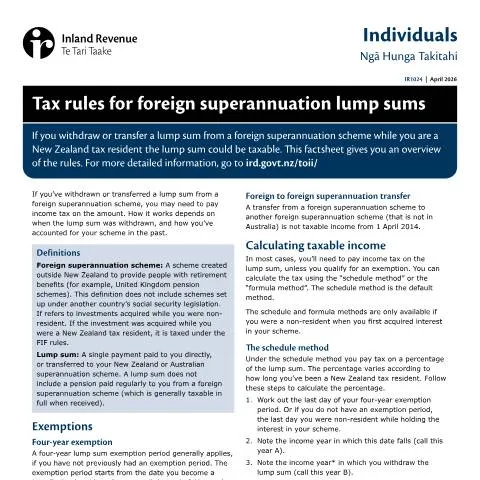
Navigating the Tax Landscape: Understanding IR1024 for Foreign Superannuation Lump Sums
For many individuals who have recently relocated to New Zealand, understanding the complexities of tax regulations surrounding foreign superannuation can be daunting. The IR1024 document is crucial for those who have withdrawn or transferred a lump sum from a foreign superannuation scheme while residing in New Zealand. This guide sheds light on the essential aspects of filling out this form and its implications on your tax obligations.
Distinguishing Features of IR1024: What Sets It Apart?
The IR1024 isn't just any tax form; it specifically addresses unique situations that arise from foreign superannuation schemes. While many might confuse it with other income tax forms, here are key elements that differentiate IR1024:
- Focus on Foreign Schemes: Unlike typical local income tax documents, IR1024 deals exclusively with taxation linked to foreign superannuation funds.
- Exemption Rules: The document outlines specific exemption periods applicable to new tax residents, a factor not generally covered in standard tax forms.
- Calculation Methods: It details two distinct methods for calculating taxable income—schedule and formula methods—tailored to the unique nature of foreign superannuation funds.
Eligibility and Key Steps in the Application Process
Individuals who need to complete the IR1024 are primarily New Zealand tax residents who have either withdrawn from or transferred a lump sum from a foreign superannuation scheme. To ensure a smooth application process, understanding the following steps is vital:
- Assess Your Residency Status: Confirm your tax residency status to determine if the IR1024 is applicable to you. This document is specifically for those considered New Zealand tax residents.
- Review the Exemption Period: Familiarise yourself with the four-year exemption rule that begins upon your residency commencement date. If you are in this period, you may not owe taxes on your lump sum.
- Gather Necessary Information: Before filling out the form, collect all relevant documents including proof of your superannuation scheme, dates of withdrawals, and previous tax residency details.
- Calculate Your Taxable Amount: Depending on your situation, choose between the schedule method or the formula method to determine how much tax you owe.
- File the IR1024: Once completed, ensure you submit your IR1024 with your income tax return (IR3) by the due date.
Understanding Exemptions: The Four-Year Rule
One of the most beneficial aspects of IR1024 is its inclusion of the four-year exemption period. This exemption can significantly affect your tax obligations:
- Duration: The exemption starts from the date you become a New Zealand resident and lasts until the end of 48 months from the start of the month following your residency commencement.
- Eligibility: If you receive a lump sum during this initial four years, it is generally exempt from income tax.
- Implications of Exceeding the Period: If your lump sum is withdrawn after the exemption period ends, you will be taxed based on the applicable percentage depending on how long you’ve been a resident.
Calculating Your Taxable Amount: Schedule vs. Formula Method
The approach to calculating how much tax you owe on your superannuation lump sum is crucial. Choosing between the schedule method and the formula method depends on your specific circumstances:
The Schedule Method
This method is the default choice for most individuals. It involves the following steps:
- Determine the last day of your four-year exemption period.
- Identify the year when this date falls (Year A).
- Identify the year in which you withdraw your lump sum (Year B).
- Calculate the difference (Year B - Year A) to find the applicable year for the percentage table.
- Use the percentage table provided in the IR1024 to find the tax rate that corresponds to your calculated year.
| Year | Percentage (%) |
|---|---|
| 1 | 4.76 |
| 2 | 9.45 |
| 3 | 14.06 |
| 4 | 18.60 |
| 5 | 23.07 |
| 6 | 27.47 |
| 7 | 31.80 |
| 8 | 36.06 |
| 9 | 40.26 |
| 10 | 44.39 |
| 11 | 48.45 |
| 12 | 52.45 |
| 13 | 56.39 |
| 14 | 60.27 |
| 15 | 64.08 |
| 16 | 67.84 |
| 17 | 71.53 |
| 18 | 75.17 |
| 19 | 78.75 |
| 20 | 82.28 |
| 21 | 85.74 |
| 22 | 89.16 |
| 23 | 92.58 |
| 24 | 95.83 |
| 25 | 99.08 |
| 26+ | 100.00 |
The Formula Method
This method is tailored for individuals with a defined contribution scheme. It’s slightly more complex and involves:
- Determining the gains on your foreign superannuation scheme interest from the time your four-year exemption expires until you receive the lump sum.
- Calculating the taxable amount based on these realized gains.
Due to its complexity, seeking advice from a tax professional is recommended when opting for the formula method.
Real-Life Scenarios: Case Study Illustrations
To grasp the implications of IR1024 fully, consider the following scenarios:
Scenario 1: New Resident Within Exemption
Maria becomes a New Zealand tax resident on 1 January 2023. She withdraws $50,000 from her UK pension scheme on 15 April 2023. Because she is within her four-year exemption period, she doesn’t have to pay any taxes on the withdrawal. Maria simply files her IR3 return without including this amount.
Scenario 2: Resident Exceeding Exemption Period
Peter arrived in New Zealand on 1 June 2020. On 30 September 2024, he withdraws $30,000 from a foreign superannuation scheme. Since Peter's four-year exemption period expires on 30 June 2024, he must calculate his taxable income. According to the schedule method, with the withdrawal occurring in Year 5 (2024-2025), he refers to the percentage table and finds a rate of 23.07%. Therefore, Peter includes $6,921 (23.07% of $30,000) as income for the 2024-2025 tax year.
Tax Obligations: Consequences of Non-Compliance
Neglecting to file the IR1024 or failing to accurately report your foreign superannuation withdrawal can lead to significant consequences:
- Penalties: The Inland Revenue Department may impose penalties for late submissions or inaccuracies in reporting.
- Interest on Unpaid Taxes: If your tax obligation is not fulfilled, interest may accrue on the outstanding amount.
- Impact on Future Applications: Non-compliance could affect your ability to apply for other tax-related services or credits in New Zealand.
Conclusion: Ensuring Compliance and Maximizing Exemptions
Understanding the nuances of the IR1024 form is essential for any New Zealand tax resident who has dealings with foreign superannuation schemes. By recognizing the differences between the schedule and formula methods, adhering to the four-year exemption rule, and accurately reporting your withdrawals, you can navigate your obligations efficiently. Take the time to consult with tax professionals if needed, ensuring your tax filings remain compliant and advantageous.
Understanding Foreign Superannuation Lump Sums
When you receive a foreign superannuation lump sum, it can raise many questions about tax implications in New Zealand. Generally, foreign superannuation schemes are those set up outside of New Zealand. It’s crucial to understand the specific rules that apply to these lump sums as they are treated differently from local superannuation payments. The key areas to consider include residency status, the nature of the payments, and the double tax agreements (DTAs) New Zealand holds with various countries.
If you are a tax resident in New Zealand when you receive your foreign superannuation lump sum, you may be taxable on that amount. However, if you are a non-resident, different rules may apply, and it could be that your foreign superannuation is not subject to New Zealand tax.
Residency and Tax Implications
Your residency status plays a vital role in determining how your foreign superannuation lump sum is taxed. In New Zealand, a person is generally considered a tax resident if they reside in the country for more than 183 days in any 12-month period or have a permanent place of abode in New Zealand.
For tax residents, the foreign superannuation lump sum is typically included in your assessable income and taxed at the applicable income tax rates. Conversely, for non-residents, the foreign superannuation may be excluded from New Zealand tax under certain conditions, particularly if there is a DTA in place with the country of origin. It is essential to assess whether the lump sum qualifies as a foreign superannuation payment or if it can be classified differently, affecting its tax treatment.
Double Tax Agreements (DTA) and their Relevance
New Zealand has entered into several DTAs with other countries to avoid double taxation on income, including superannuation payments. These agreements typically provide guidelines on how different types of income are taxed and can offer relief from being taxed in both countries on the same income.
Before receiving your foreign superannuation lump sum, it is wise to review the specific DTA that New Zealand has with the country where your superannuation is held. This review determines which country has taxing rights over the lump sum and whether any tax credits or exemptions are available to mitigate the overall tax burden. For instance, if both countries tax the lump sum, the DTA may allow you to claim a credit for the tax paid to the foreign government when filing your New Zealand tax return.
Consulting the IRD's resources or seeking professional advice can help clarify how these agreements apply to your specific situation and ensure compliance with tax regulations.