Navigating the Research and Development Loss Tax Credit Registration (IR1239)
Submitting the IR1239 form is a crucial step for companies engaged in research and development (R&D) activities in New Zealand. The Research and Development Loss Tax Credit Registration offers invaluable support to eligible businesses by allowing them to claim tax credits for their R&D expenditures. This tax credit not only aids in financial recovery but also encourages innovation and development across various sectors.
The Importance of R&D Tax Credits in New Zealand
The New Zealand government recognizes the pivotal role that research and development play in enhancing the country's economic growth and technological advancement. The R&D Loss Tax Credit aims to promote investment in R&D activities by offering a financial incentive to eligible companies. This encouragement is vital for maintaining New Zealand's competitive edge in the global economy.
By registering, businesses can recoup a portion of their losses incurred during R&D activities. This is particularly significant for start-ups and SMEs that may not yet be profitable but are investing heavily in innovation.
Eligibility Criteria for Successful Registration
Before diving into the registration process, it’s essential to understand the eligibility criteria dictated by the Inland Revenue Department (IRD). Companies must meet the following conditions:
- Eligibility as a Company: Only businesses registered as companies in New Zealand can register for this tax credit.
- Engagement in Eligible Activities: The company must be actively engaged in R&D activities that meet the definitions outlined by the IRD.
- Eligible Expenditures: Expenditures claimed must align with the parameters set forth by the IRD, focusing on costs directly linked to R&D activities.
- Wage Intensity Criteria: Companies must demonstrate a certain level of R&D wage intensity, indicating that a significant portion of their workforce is dedicated to R&D tasks.
Steps to Properly Fill Out the IR1239 Form
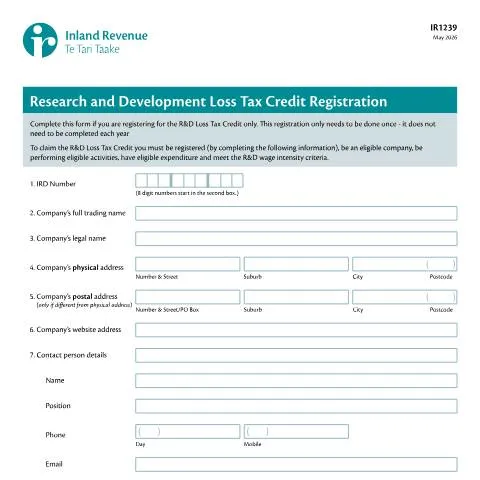
Completing the IR1239 form is a straightforward process provided you have all the necessary information on hand. Below is a detailed breakdown of the required sections on the form:
- IRD Number: An 8-digit number that serves as your company's unique identifier with the IRD. Ensure that you enter this number in the second box.
- Company’s Full Trading Name: This is the name under which your business operates.
- Company’s Legal Name: If different from the trading name, this is the official registered name of the business.
- Company’s Physical Address: Provide the complete physical address, including the street, suburb, city, and postcode.
- Company’s Postal Address: Fill in only if this differs from the physical address.
- Company’s Website Address: A link to your company’s official website can be beneficial for verification purposes.
- Contact Person Details: Include the name, position, phone number (day and mobile), and email address of the primary contact for the registration process.
Submission Channels: Online vs. Paper
Understanding the available submission channels can facilitate a smoother registration process. You can choose to submit your IR1239 form via email or use traditional postal services. Here’s a comparison of the two methods:
| Method | Advantages | Considerations |
|---|---|---|
| Email Submission |
|
|
| Postal Submission |
|
|
After Submission: What to Expect?
Once you've submitted your IR1239 form, anticipation builds as you await confirmation of your registration. The IRD aims to respond within five working days; however, delays can occur. Here’s what you can do during this waiting period:
- Check Your Email: Keep an eye on your inbox for any communications from the IRD.
- Contact IRD if No Response: If you haven’t received a response after five working days, reach out to the IRD directly using the contact details provided in your submission confirmation email.
- Prepare for Next Steps: Start gathering the necessary documentation for your R&D claim submission, which can be prepared concurrently with waiting for the IR1239 response.
What If Your Application is Rejected?
Even with careful preparation, there’s always the possibility of an application being rejected. Familiarizing yourself with the potential reasons for rejection can help you mitigate risks:
- Ineligibility: Submission by a company that does not fit the required criteria.
- Incomplete Information: Missing sections or incorrect details can lead to automatic rejection.
- Failure to Meet R&D Criteria: Not demonstrating sufficient R&D activities or expenditures as defined by the IRD.
In case of rejection, the first step is to carefully review the feedback provided by the IRD. You may be able to rectify the issues identified and resubmit your registration.
Understanding Your Place in a Larger R&D Landscape
This form, while vital, is part of a broader framework that supports innovation in New Zealand. Companies often undergo a series of processes when dealing with R&D tax credits:
- Research Assessment: Before filling out the IR1239, it’s crucial to assess whether your activities qualify as R&D under the relevant guidelines.
- Financial Planning: Understand the potential financial impacts of your R&D investment and how the tax credit can offset losses.
- Claim Preparation: After registration, prepare for a more detailed claim submission, providing all supporting documentation and justifications.
The IR1239 form thus acts as a gateway to a more extensive support system designed to encourage and facilitate R&D efforts.
Differences Between IR1239 and Similar Forms
It's essential to distinguish the IR1239 from other forms related to business tax credits.
- IR1238: This form is for the R&D Tax Incentive claim which covers a broader range of R&D expenses.
- IRD 1234: This is a general business tax credit registration, not specifically tailored for R&D activities.
- R&D Grant Applications: These applications may involve different criteria and processes separate from the tax credit registrations.
Understanding these key differences ensures that businesses apply for the correct incentives tailored to their R&D activities.
The Regulatory Backdrop: Why the IR1239 Exists
The establishment of the IR1239 form is rooted in New Zealand's commitment to fostering innovation through supportive tax policies. The Official Information Act 1982 and the more recent Plain Language Act 2022 emphasize transparency and accessibility in governmental communication. This regulatory backdrop aims to create an environment where businesses can thrive and confidently engage in R&D.
Moreover, the IRD continually reviews and updates the guidelines and eligibility criteria to reflect the evolving nature of research and development fields, ensuring that the system remains relevant and beneficial for companies.
Conclusion: Maximizing Your R&D Potential
Successfully navigating the IR1239 registration process can unlock substantial financial support for your R&D activities. By ensuring eligibility, accurately completing the form, and understanding the broader context within which this registration exists, businesses can maximize their potential for innovation and development. Remember, the journey doesn’t end with registration; it’s just the beginning of a process that can significantly impact your company’s growth trajectory.
Understanding the R&D Loss Tax Credit Eligibility Criteria
Before diving into the application process for the Research and Development (R&D) Loss Tax Credit, it's crucial to understand the eligibility criteria that your business needs to meet. This tax credit is designed specifically for entities that are engaged in eligible R&D activities as defined under the Income Tax Act 2007.
Your business must be a New Zealand resident company, a partnership of resident partners, or an eligible Māori authority. It's essential to hold a valid New Zealand Business Number (NZBN) and maintain proper tax compliance with the Inland Revenue Department (IRD).
Moreover, the R&D activities must meet specific definitions set forth by the IRD. Generally, these activities should aim to generate new knowledge or develop new products, processes, or services. R&D activities should entail a degree of technological uncertainty; in other words, your team must be attempting to solve a problem where the solution is not readily available based on existing knowledge.
Here are some key aspects to consider:
- Eligible Expenditures: The expenses you incur related to your R&D activities can include wages for researchers, costs for materials, and overhead costs directly associated with R&D projects.
- Project Documentation: Keeping comprehensive records of your R&D projects is essential. Documentation should include project plans, technical reports, experiment results, and evidence of expenditures. This will assist in demonstrating that your activities fit within the scope of eligible R&D as defined by the IRD.
- Continuous vs. Discrete Research: R&D activities can be continuous (ongoing and iterative) or discrete (specific projects with defined start and end dates). Both may qualify, but it’s important to categorically outline the nature of your R&D when applying.
In summary, understanding the eligibility criteria and maintaining meticulous records is critical for successfully registering for the R&D Loss Tax Credit. If your business satisfies these criteria, you can proceed confidently with your application.
Navigating the R&D Loss Tax Credit Application Process
The application process for the R&D Loss Tax Credit can seem daunting, but breaking it down into manageable steps will help streamline your efforts. The application primarily occurs online through the IRD portal, leveraging their user-friendly interface.
First and foremost, you will need to gather all necessary documentation before beginning the online application. This includes:
- Detailed Project Descriptions: Clearly articulate your R&D projects, including objectives, methodologies, and expected outcomes.
- Financial Records: Prepare statements that detail all R&D expenditures, ensuring they align with the eligibility criteria mentioned previously.
- Personnel Information: Provide information regarding the qualifications and roles of individuals directly involved in the R&D activities.
To initiate your application:
- Access your IRD account using your RealMe digital ID. If you do not have an account, it’s advisable to set one up ahead of time.
- Navigate to the specific section for R&D tax credits. This will contain guidelines as well as the application form, often referred to as IRD Form R&D 1001.
- Follow the instructions carefully, filling out the required fields with accurate information. This includes declaring all eligible R&D activities and expenditures.
- Submit your application and ensure to save a copy of the confirmation for your records.
After submission, the IRD may take several weeks to process your application. During this time, they might reach out for additional information or clarification. Being prompt in your responses can aid in the efficient processing of your application.
Finally, once the IRD approves your application, you will receive a credit that can be used against your tax liabilities or refunded depending on your business's specific circumstances. Keep in mind that annual submissions are necessary to maintain your tax credit eligibility.
Common Pitfalls in R&D Loss Tax Credit Claims
While the R&D Loss Tax Credit can offer significant financial advantages, there are common pitfalls that businesses often encounter during their claims. Understanding these can help you avoid costly mistakes that could jeopardize your application.
One significant pitfall is the failure to understand the definition of eligible R&D activities. Often, businesses mistakenly categorize their routine operational activities as R&D. It’s essential to ensure that the nature of your work involves uncertainty and a quest for new knowledge, rather than merely improving existing processes. If you are unsure, consult with tax professionals who specialize in R&D tax credits.
Another common mistake is the inadequate documentation of R&D projects. The IRD requires comprehensive evidence that substantiates your claims. Ensure that all relevant records, such as meeting notes, technical documents, and financial statements, are organized and easily accessible.
Additionally, businesses sometimes overlook the importance of consultation with tax advisors before submitting their applications. Engaging with a tax advisor who understands the nuances of the R&D Loss Tax Credit can help ensure that you maximize your claim while remaining compliant with IRD requirements.
Lastly, some businesses fail to maintain a consistent R&D strategy. The R&D Loss Tax Credit is not a one-time application; it requires ongoing engagement in qualifying activities. Establish a clear strategy that outlines your R&D objectives and the related activities, as this will aid in future claims and ensure a steady stream of financial support.
By recognizing these pitfalls and implementing proactive measures, your business can enhance its chances of successfully claiming the R&D Loss Tax Credit and ultimately benefiting from the financial relief it provides.