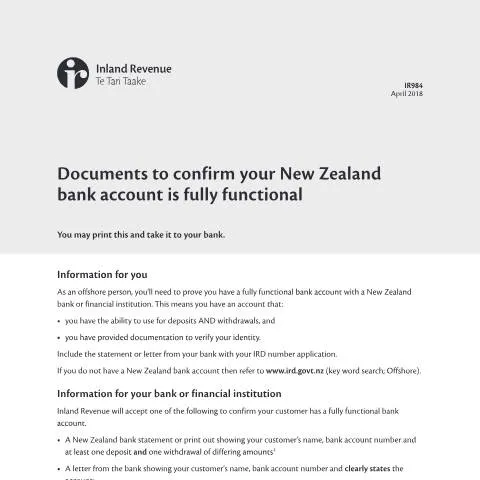
Understanding the Essential Role of IR984 in Your Financial Obligations
When navigating the intricacies of New Zealand’s tax system, certain documents become crucial. One such document is the IR984, also known as the Proof of a Fully Functional NZ Bank Account. For individuals, especially those offshore seeking to comply with tax obligations, this document is more than a mere formality; it lays the groundwork for a smooth interaction with the Inland Revenue Department (IRD).
As an offshore person, you must demonstrate that you possess a fully operational New Zealand bank account. This account must allow both deposits and withdrawals while confirming your identity through relevant documentation. A failure to provide this proof could hinder your ability to engage with New Zealand’s financial systems and tax requirements effectively.
Who Needs the IR984? A Deep Dive into User Profiles
The IR984 is particularly relevant for a variety of users. Understanding these profiles can help clarify whether you need to submit this form and under what circumstances:
- Offshore Individuals: If you are living outside New Zealand but have financial interests within the country, you will need to prove ownership of a bank account. This is crucial for fulfilling your tax obligations.
- New Residents: New Zealanders returning after an extended time may need to demonstrate their banking capabilities, especially if they intend to engage in local employment or business.
- Foreign Investors: Individuals or entities planning to invest in New Zealand businesses will require a functional bank account to facilitate transactions.
By understanding these user profiles, individuals can better prepare themselves for the requirements laid out in the IR984.
Navigating the Form: Key Components and Their Significance
Completing the IR984 form requires attention to detail. Each section is designed to capture vital information about your bank account, and understanding these components will help you avoid errors.
Required Information
- Your Name: Ensure that your full name matches the name registered with your bank to prevent discrepancies.
- Bank Account Number: Double-check the number for accuracy, as errors could lead to delays.
- Deposits and Withdrawals: It’s not just about having an account; you need to provide proof of both a deposit and a withdrawal of different amounts. Failing to do so could lead to the assumption that your account is inactive or closed.
Each of these elements plays a critical role in confirming the functionality of your bank account. Missing or incorrect information can lead to complications in the processing of your tax applications.
Step-by-Step Process: From Preparation to Submission
Preparing and submitting the IR984 involves multiple steps. Understanding this process can simplify what may seem like a daunting task:
- Gather Necessary Documentation: Before filling out the IR984, collect all relevant documents, including your bank statement and identification.
- Fill Out IR984: Carefully complete the form, ensuring all information is accurate and matches your bank records.
- Submit to Your Bank: Depending on your bank’s requirements, you may need to take the form in person or submit it electronically.
- Receive Confirmation: After your bank has processed your request, you'll receive a bank statement or letter confirming the status of your account.
- Attach to Your IRD Application: Include the confirmation with your application to the IRD to complete your tax obligations.
By following these steps, you can navigate the requirements of the IR984 with greater ease.
The Timeline: Critical Dates and Expectations
Timing is everything when it comes to managing your tax obligations. Here’s how the timeline for submitting your IR984 typically looks:
| Action | Timeframe |
|---|---|
| Initial Gathering of Documents | 1-2 weeks |
| Completion of IR984 Form | 1-2 days |
| Submission to Bank | Varies by bank |
| Receive Confirmation | 1 week after submission |
| Attach to IRD Application | Immediately after receiving confirmation |
Being aware of these timeframes allows you to plan ahead and avoid potential delays in your dealings with the IRD.
Assembling Your Supporting Documents: What to Prepare
Documentation is a cornerstone of the IR984 process. Here's a detailed breakdown of the key documents you'll need to prepare:
Essential Documents
- Bank Statement: A recent statement showing your name, account number, and both a deposit and a withdrawal of differing amounts.
- Bank Letter: If you prefer, a letter from your bank confirming your account as functional. This letter should explicitly state the account is active.
- Identification: A government-issued ID, such as a passport or driver’s license, to verify your identity.
By ensuring you have these documents prepared in advance, you can expedite the process and ensure that your submission is complete.
Understanding the Administration Process: What Happens Next?
Once you've submitted the IR984 along with the required documentation, it’s essential to understand what the administrative process looks like:
Processing Your Application
The IRD will review the submitted information to confirm that your bank account is indeed fully functional. Here’s what you can expect:
- Verification: The IRD validates the details provided against your bank’s confirmation.
- Potential Follow-Up: If any discrepancies arise, the IRD may reach out for clarification or additional information.
- Final Notification: Once processed, you will receive notification of your application status, which will inform you about any additional steps needed to fulfill your tax obligations.
Understanding this process helps you stay informed and prepared for any further requirements from the IRD.
Proactive Steps: How to Track and Manage Your Submission
After submitting your IR984, it’s wise to stay engaged with the process. Here are proactive steps you can take:
- Maintain Communication: Keep in touch with your bank and the IRD to stay updated on the status of your application.
- Document Everything: Save copies of all submitted documents and correspondence. This information will be invaluable in case of any follow-up.
- Set Reminders: Create reminders for yourself regarding the timelines for follow-ups, especially if you haven’t received confirmation within the expected timeframe.
By being proactive, you can navigate the complexities of the tax system more effectively, ensuring compliance and peace of mind.
Understanding the Types of Bank Accounts in New Zealand
In New Zealand, there are several types of bank accounts that you might encounter. Understanding these options is crucial, especially when you need to provide proof of a fully functional account. Here are the main types:
- Transaction Accounts: These accounts are designed for everyday banking activities, such as deposits, withdrawals, and bill payments. They usually come with a debit card and online banking facilities.
- Savings Accounts: Ideal for those looking to save money and earn interest. These accounts may have restrictions on the number of transactions allowed to benefit from higher interest rates.
- Term Deposits: A fixed-term investment where you deposit a lump sum for a specific period. While they typically offer higher interest rates than savings accounts, accessing the funds before maturity can incur penalties.
- Joint Accounts: Designed for two or more individuals, these accounts can be useful for couples or groups who want to share finances, such as household expenses.
When opening a bank account in New Zealand, it's essential to choose one that fits your financial needs. Each type has different features, fees, and rules regarding how and when you can access your funds. Knowing the right type can save you from future inconveniences regarding proof of account functionality.
Steps to Open a Bank Account in New Zealand
Opening a bank account in New Zealand is generally straightforward, but there are essential steps to ensure that you have a fully functional bank account that meets all requirements. Here’s a brief guide:
- Choose the Right Bank: Research various banks to find one that aligns with your financial goals. Consider factors such as fees, interest rates, and digital services.
- Gather Required Documentation: Typically, you will need to provide proof of identity and address. This may include your passport, a New Zealand driver’s license, or utility bills.
- Fill Out the Application Form: Most banks offer online applications, but you can also visit a local branch. Ensure you fill in all required fields accurately.
- Deposit Initial Funds: Many banks require an initial deposit to activate your account. Be aware of the minimum deposit requirements.
- Receive Confirmation: Once your application is approved, you will receive confirmation and your bank details. Ensure to verify that your online banking is set up and functional.
Keeping your bank account functional is important, especially for international transfers or transactions. Always ensure that you comply with the bank's terms and conditions to avoid complications.
Using RealMe for a Smooth Banking Experience
RealMe is New Zealand’s digital identity verification service that streamlines various processes, including banking. By using RealMe, you can simplify the account opening process and access online services securely. Here’s how to leverage RealMe for your banking needs:
- Identity Verification: RealMe allows you to verify your identity online, reducing the need to visit a bank branch physically. This is especially convenient for newcomers and those busy with work commitments.
- Easy Access to Multiple Services: Once you have a RealMe account, you can use it not only for banking but also for accessing other government services, enhancing your overall experience in New Zealand.
- Secure Transactions: RealMe provides an extra layer of security, ensuring that your transactions are protected, which is crucial when managing your finances online.
To use RealMe, you'll need to create an account. The process includes providing some personal information and verifying your identity through various means, such as using your passport or driver's license. Once set up, you can easily link your banking services to your RealMe account.