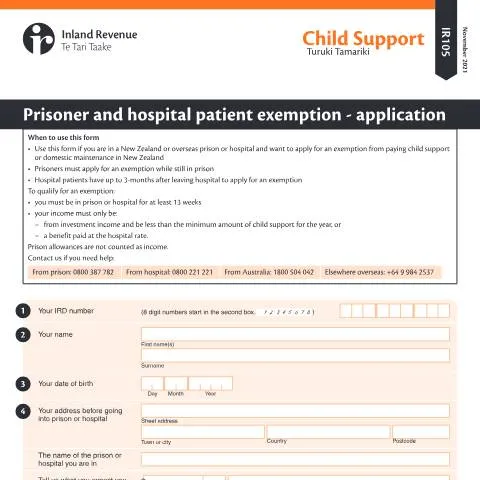
Navigating the IR105: A Crucial Step for Prisoners and Hospital Patients
Imagine being in a situation where your circumstances prevent you from fulfilling your child support obligations. The IR105 form, officially titled the Prisoner and Hospital Patient Exemption Application, is tailored specifically for individuals who find themselves in either a New Zealand prison or hospital setting. This document serves a critical function: it allows eligible individuals to apply for exemptions from payment of child support or domestic maintenance while they are unable to generate income due to their circumstances.
Understanding the Context: Why This Form Matters
The IR105 form operates within the framework of New Zealand's Child Support Act 1991, a key piece of legislation that governs child support obligations in the country. The necessity for the IR105 arises from the recognition that individuals incarcerated or hospitalised may face unique financial difficulties. Created in recognition of the rights of parents and the welfare of children, this exemption process is pivotal in ensuring that individuals do not face undue financial strain during a time of crisis.
Prisoners must apply for the exemption while still incarcerated, whereas hospital patients have a grace period of up to three months after leaving the hospital to submit their applications. This distinction is vital as it underscores the urgency of completing the application process effectively and timely.
Eligibility Criteria: Who Can Apply?
To qualify for the exemption under the IR105 process, applicants must meet specific criteria:
- Currently incarcerated or hospitalised for a minimum of 13 weeks.
- Income sources are limited to either:
- Investment income that is less than the annual minimum child support amount, or
- A benefit paid at the hospital rate.
Importantly, prison allowances do not count as income, which can be a significant relief for many applicants.
Gathering Documentation: What's Needed
The success of the application heavily relies on the accurate completion of the IR105 and the necessary supporting documents. Here’s a breakdown of what’s required:
- IRD Number: This 8-digit number is mandatory and should be readily available.
- Personal Information: Include your full name, date of birth, and previous address before incarceration or hospitalisation.
- Details of Current Facility: Provide the name of the prison or hospital where you are located.
- Income Projections: Clearly state any expected income during your time in the facility, including sources like investments.
- Authorisation (if applicable): If someone else is filling out the form on your behalf, an authorisation letter must accompany the application.
Preparing these documents ahead of time can streamline the application process significantly.
Step-by-Step Completion of the IR105
Completing the IR105 requires attention to detail. Below is a breakdown of key sections of the form:
| Section | Details | Common Pitfalls |
|---|---|---|
| IRD Number | Enter your 8-digit IRD number accurately. | Missing or incorrect IRD number can delay processing. |
| Personal Details | Provide full name and date of birth. | Check for spelling errors; they can lead to misidentification. |
| Income Declaration | State expected income accurately. | Failure to disclose other income sources can terminate the exemption. |
| Declaration | Sign and date the form to confirm accuracy. | Unsigned forms will not be processed. |
Submitting the IR105: Where and How
Once the IR105 form is completed, it must be submitted to the New Zealand Child Support office. You have a couple of options:
- Mail: Send to Child Support, PO Box 39010, Wellington Mail Centre, Lower Hutt 5045, New Zealand.
- Email: If you are completing the form overseas, you can email it to [email protected].
Regardless of the submission method, ensure that you keep a copy of your application and any supporting documents for your records.
After Submission: What to Expect
The processing of your IR105 application is typically followed by a notification from the Child Support office. Here’s what happens next:
- If your application is accepted, you will receive an updated child support payment letter outlining your new obligations or confirming your exemption.
- If declined, a letter will detail the reasons for the denial, providing you with an opportunity to address any issues or misunderstandings.
It's pivotal to monitor your mailbox and email for these communications, as they will guide your next steps.
Dealing with Denials and Miscommunication
Receiving a denial for your exemption application can be disheartening. Common reasons for denial include exceeding income limits or incomplete information on the application. If you find your application denied, consider the following actions:
- Review the reasons provided by Child Support carefully.
- Gather any additional evidence necessary to support your case.
- Consider contacting Child Support directly for clarification or further guidance.
- There may be an option to appeal the decision, so familiarize yourself with the specifics of the appeal process outlined in your denial letter.
Taking swift action can often resolve misunderstandings and lead to a favorable outcome.
Maintaining Communication: Keeping Your Status Updated
It is crucial to keep the Child Support office informed about any changes in your situation. This includes:
- Leaving the prison or hospital: You must inform the Child Support office immediately upon your release.
- Changes in income: If your financial situation changes, report this as it can impact your exemption status.
- Any issues with receiving communications from the Child Support office should also be addressed promptly.
Maintaining an open line of communication can prevent any misunderstandings and ensure that your child support obligations remain clear and manageable.
The Bigger Picture: Child Support and Parental Responsibility
The IR105 form represents a vital link in the larger framework of parental responsibilities and child support obligations. It aims to balance the need for financial contributions to child welfare with the realities faced by individuals during periods of incarceration or hospitalisation. This form not only facilitates financial relief but also contributes to the overarching goal of supporting children's needs while considering extenuating circumstances faced by their parents.
In summary, understanding the ins and outs of the IR105 form can empower those in difficult situations to navigate their obligations effectively. By approaching the process with diligence and awareness, applicants can ensure they secure the necessary exemptions and continue to support their children to the best of their ability, even in challenging times.
Understanding the Exemption Process for Prisoners and Hospital Patients
In New Zealand, the exemption application process for prisoners and hospital patients is a unique aspect of the regulatory framework that aims to ensure fair treatment for individuals who are unable to fulfill certain obligations due to circumstances beyond their control. This can include those who are incarcerated or receiving medical treatment in a hospital. It is essential to understand the different contexts and implications surrounding these exemptions.
Under the Income Tax Act 2007 and the relevant guidelines set by the Inland Revenue Department (IRD), prisoners may apply for exemptions related to tax obligations. This process recognizes that their ability to earn income and manage finances is severely limited. Specifically, prisoners may seek exemption from filing tax returns for the duration of their incarceration, which can streamline the administrative burden on both the individual and the IRD.
Similarly, hospital patients, particularly those undergoing long-term treatment or rehabilitation, may face challenges in managing their affairs. In this context, patients can apply for exemptions regarding certain tax obligations, allowing them to focus on their health recovery without the added stress of financial responsibilities. This is particularly important for patients who may not have a support system readily available to assist with their financial matters.
Eligibility Criteria for Exemption Applications
To successfully apply for an exemption, applicants must meet specific eligibility criteria that can vary depending on their situation. For prisoners, it is crucial to establish proof of incarceration. This typically involves demonstrating that one is currently serving a sentence in a correctional facility. Documentation that confirms the length of the sentence and the expected release date may also be required.
For hospital patients, eligibility revolves around the nature and duration of their medical treatment. Applicants must provide evidence of their hospitalization, which may include discharge summaries, medical certificates, or any official documents indicating their treatment plan. Additionally, those seeking exemptions must demonstrate that their condition prevents them from managing their tax obligations. This might involve detailed medical reports from treating physicians or specialists.
It’s worth noting that both prisoners and hospital patients should consider applying for exemptions as early as possible to mitigate any potential penalties or interest that might accrue due to failure to meet tax obligations during their absence.
Steps for Completing the Exemption Application
The process of applying for an exemption, whether as a prisoner or a hospital patient, is straightforward but requires careful attention to detail. Here are the general steps involved:
- Gather Required Documentation: Start by compiling all necessary documents that prove your current status, such as prison records or medical certificates.
- Complete the Exemption Application Form: The IRD provides specific forms for various exemption requests. Make sure to select the correct one based on your unique situation.
- Provide Supporting Evidence: Along with your application form, submit any supporting documents that validate your circumstances. This could include letters from your legal counsel for prisoners or medical professionals for hospital patients.
- Submit Your Application: Applications can often be submitted online through the IRD’s digital platform or via traditional mail. Be sure to check the submission guidelines to ensure you follow the proper procedures.
- Await Confirmation: After submitting your application, you will receive a confirmation from the IRD. It’s important to allow time for processing, as this could vary depending on the department's workload.
After receiving a decision, if the exemption is granted, it is crucial to keep a record for your personal files, as this may be required for future reference or related tax matters.