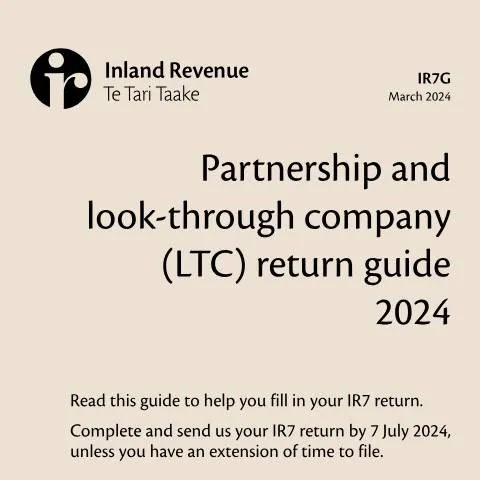
Understanding the IR7G Partnership and Look-Through Company Return Guide
In the dynamic realm of New Zealand’s tax regulations, the Partnership and Look-Through Company (LTC) Return Guide (IR7G) is an essential resource for partnerships and LTCs. This guide meticulously outlines the requirements for filing an IR7 return, which is critical for fulfilling tax obligations while ensuring compliance with the Income Tax Act. As a partnership or LTC, understanding the intricacies of this guide can significantly impact your financial obligations and tax liabilities.
Scope and Limitations of the IR7G Guide
The IR7G serves as a comprehensive instruction manual detailing the types of income and expenses partnerships and LTCs must report. Notably, it covers:
- Income types: This includes New Zealand interest, dividends, rental income, and income from business activities.
- Expenses: Detailed guidelines on allowable deductions, which are crucial for determining taxable income.
- Filing deadlines: Key dates that parties must adhere to, ensuring timely submissions to the Inland Revenue Department (IRD).
However, the IR7G is not an exhaustive legal document. It does not delve into the broader implications of tax legislation, such as international tax treaties or unique tax statuses. Users should be aware of its focus on general partnerships and LTCs and consult with a tax professional for personalized advice, particularly in complex scenarios.
Identifying Your Audience: Who Benefits from the IR7G?
The guide targets a diverse audience, including:
- Partnerships: Groups of individuals or entities engaged in business ventures collaboratively.
- Look-Through Companies: Entities that pass income directly through to their shareholders, avoiding corporate taxation.
- Tax Advisors: Professionals assisting clients with their tax returns and compliance.
Each of these groups can leverage the guide to enhance understanding of their tax reporting responsibilities. For instance, a partnership may utilize the guide to navigate their shared income declarations, while an LTC can clarify how to report their income without incurring corporate tax.
Real-World Scenarios Requiring the IR7G
Consider a partnership composed of several contractors providing specialized services. Each contractor’s share of income needs to be accurately reported to the IRD. The IR7G outlines how to determine total income, allocate it among partners, and ensure each member is compliant with their tax obligations. Additionally, if this partnership has incurred expenses, the guide provides the necessary framework to claim these deductions, optimizing their overall tax position.
Key Concepts for Effective Tax Reporting
To utilize the IR7G effectively, familiarize yourself with several crucial concepts:
- Attribution of Income/Loss: Understanding how income or losses are attributed to partners or shareholders is fundamental. Each entity must report their share of the income on their individual returns.
- Tax Credits: The guide elaborates on various tax credits that partners may be eligible for, which can reduce overall tax liabilities.
- Nil Returns: Even if a partnership or LTC has no income to report, completing a nil return is mandatory to maintain compliance.
Having a grasp of these core concepts will help navigate the filing process more smoothly and avoid potential pitfalls.
Step-by-Step Utilisation of the IR7G
Effective use of the IR7G involves a series of methodical steps:
- Gather Financial Records: Collect all relevant financial documents, including income statements, expense receipts, and bank statements.
- Identify Income Streams: Refer to sections of the IR7G that detail different income types, ensuring that all sources are accounted for.
- Calculate Deductions: Use the expense guidelines provided to ascertain which deductions are applicable, helping to reduce taxable income.
- Complete the IR7 Return: Follow the format outlined in the IR7G, ensuring that all required information is accurately presented.
- Submit the Return: Ensure that the return is submitted by the due date, typically 7 July, unless an extension has been officially granted.
Each step is accompanied by specific instructions within the IR7G, making it a powerful tool for ensuring compliance and accuracy.
Avoiding Common Interpretation Pitfalls
Misinterpretation of tax guidelines can lead to costly errors. Here are some common pitfalls to avoid:
- Misunderstanding Deductions: Some partnerships may overlook allowable deductions, believing that all expenses are non-deductible. The IR7G clarifies which expenses qualify, ensuring maximum compliance.
- Incorrect Attribution: Failing to properly attribute income/loss among partners can lead to discrepancies in personal tax returns. Each partner must ensure their portion of the income is accurately reported.
- Submission Errors: Incorrectly filled returns can delay processing. Double-checking information against the guide can mitigate these errors.
By being aware of these pitfalls, partnerships and LTCs can take proactive steps to maintain accuracy and compliance.
Special Considerations for Final Returns
When a partnership or LTC ceases operations, specific reporting requirements come into play. The IR7G outlines necessary steps, including:
- Final Accounts: Providing a complete set of accounts up to the date the partnership or LTC ceases is crucial.
- Asset Distribution: Detailing the distribution of assets and liabilities among partners is mandatory.
- GST Registration: If the partnership or LTC was registered for GST, completing a Business cessation - IR315 form is necessary to finalize tax records.
Understanding these final steps can prevent complications during the closure process and ensure that all tax obligations are settled appropriately.
Resources and Support
The IRD provides a wealth of additional resources to assist partnerships and LTCs in navigating their tax responsibilities. From calculators to detailed forms available at ird.govt.nz/forms-guides, the IRD encourages users to leverage digital tools for efficiency.
For more complex issues or personalized guidance, consulting with tax professionals can provide tailored advice that aligns with specific business circumstances.
Conclusion: Embracing Compliance for Financial Health
In a landscape where compliance with tax regulations is paramount, the IR7G serves as a cornerstone for partnerships and look-through companies in New Zealand. By understanding the guide's content and adhering to its instructions, entities not only comply with legal requirements but also position themselves for greater financial health and operational success.
By viewing tax compliance not as a burden but as an integral component of business management, partnerships and LTCs can thrive within New Zealand's evolving economic framework.
Understanding the Tax Obligations of Partnerships in New Zealand
Partnerships in New Zealand are a popular business structure due to their flexibility and tax transparency. Under New Zealand law, partnerships themselves do not pay income tax. Instead, the partners are taxed individually on their share of the profits, as stipulated in the Income Tax Act 2007. This means that each partner must declare their earnings on their personal income tax returns, typically using the IRD's Individual Tax Return (IR 3).
When managing a partnership, it’s crucial to keep clear and detailed records of all income and expenses. Partners should agree on how profits and losses are shared, which can be documented through a partnership agreement. This agreement should cover aspects such as how decisions are made, how profits are distributed, and what happens if a partner wishes to exit the partnership. Having a written agreement is not just a recommendation; it’s a best practice that can help prevent disputes and misunderstandings in the future.
Furthermore, partnerships must file an annual partnership tax return using the IRD’s Partnership Tax Return (IR 7) to report the total income and expenses of the partnership, even though the partnership itself does not incur tax liability. This return is due by 7 July following the end of the fiscal year, and it’s essential for partners to ensure that all contributions to the return are accurate and submitted on time to avoid penalties.
Look-Through Companies: A Unique Tax Structure
Look-through companies (LTCs) represent a distinctive form of company structure in New Zealand that provides flexibility in taxation. They are typically preferred by small businesses and allow for tax transparency similar to partnerships. This means that the income of an LTC is passed through to its shareholders, who then report their share of the income on their individual tax returns. This approach helps avoid the double taxation of corporate profits and individual income.
To qualify as a look-through company, certain criteria need to be met. The company must have no more than 5 owners, all of whom must be individuals or trustees. Importantly, the company's shareholders must have agreed to the look-through company status, which should be documented appropriately. Each shareholder will also need to complete a Look-Through Company Shareholder Declaration to formally opt-in to this tax treatment. It’s vital to keep abreast of the IRD’s guidelines regarding LTCs to ensure compliance and to benefit from potential tax advantages.
Another significant consideration with LTCs is the treatment of losses. Losses incurred by an LTC can generally be used to offset other income earned by the shareholders, reducing their overall tax liability. However, there are specific rules regarding the carry-forward of losses, and shareholders should be aware of how these rules apply to their individual situations.
Practical Steps for Filing Partnership and LTC Returns
Filing tax returns for partnerships and look-through companies can seem daunting, but breaking the process down into manageable steps can help ease the burden. Here’s a practical guide to ensure compliance:
- Gather Documentation: Collect all necessary financial records, including income statements, receipts for expenses, and any prior year tax returns. Accurate documentation is critical for an effective tax filing process.
- Determine Profit Sharing: Review your partnership agreement (if applicable) to confirm how profits and losses are to be shared among partners or shareholders of the LTC.
- Complete the Appropriate Tax Returns: Partners should complete the IR 7 for the partnership, while LTC shareholders must ensure accurate completion of the Look-Through Company Tax Return. Detailed instructions are available through the IRD’s official website.
- Submit Returns On Time: Be mindful of the filing deadlines: for partnerships, this is typically 7 July following the end of the fiscal year, while LTCs follow a similar timeline. Late submissions may incur penalties.
- Consult a Tax Professional: If you encounter complexities in your financial situation, consider seeking advice from a tax professional familiar with New Zealand tax regulations. They can provide tailored advice and help navigate any intricate scenarios.
By following these steps, partners and LTC shareholders can streamline their tax filing process and minimize potential errors, ensuring compliance with New Zealand’s tax obligations.