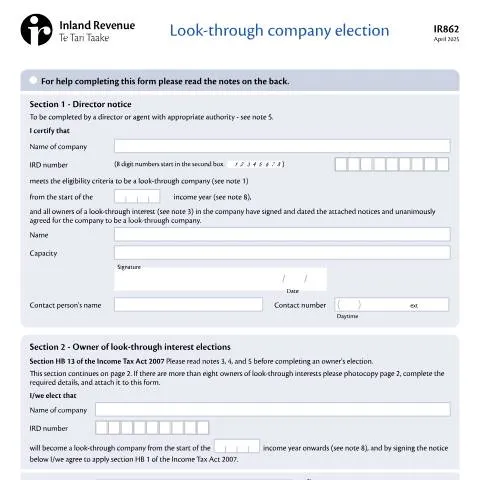
Understanding the IR862 April 2025: A Vital Step for Look-Through Companies
Navigating through the intricate web of New Zealand's taxation system can be daunting, especially for directors and owners of look-through companies (LTCs). The IR862 April 2025 form plays a pivotal role in this process, guiding businesses on their journey to electing or re-electing LTC status. This isn’t just another piece of paperwork; it is a significant step that can shape the financial and operational landscape of a business.
Key Dates and the Timeline of the IR862 Process
The timeline for submitting the IR862 form is crucial for compliance. The form must be filed at the beginning of the income year—specifically from 1 July to 30 June of the following year, aligning with New Zealand’s fiscal year. To ensure compliance and avoid any penalties, understanding the timeline surrounding this form is essential.
- Filing Period: The IR862 must be submitted within the first month of the income year to ensure that the company is recognised as a look-through company from the start.
- Post-Submission Response: Once submitted, the IRD will process the application and inform the company of its LTC status. Typically, this takes about 20 working days, but delays can occur during peak periods.
Understanding these time frames is not just about compliance; it influences financial planning, as the status can affect taxation and distributions throughout the year.
Decoding the Role of IR862 in the Look-Through Company Framework
The IR862 form is not merely a bureaucratic requirement—it is integral to the functionality of LTCs within the New Zealand tax system. This document serves as an official declaration that a company meets the eligibility criteria to be classified as a look-through company.
To qualify as an LTC, certain conditions must be met:
- Eligibility Criteria: The company must have no more than five look-through counted owners, and all owners must unanimously agree on the election.
- Unified Ownership: If any owner revokes their election, the company loses its LTC status, impacting tax obligations.
The IR862 thus functions as a foundational tool, signalling the company's intent to comply with specific tax regulations and benefit from the LTC framework.
Breaking Down the Sections of the IR862 Form
Completing the IR862 requires an understanding of its sections. Each part of the form has specific requirements and implications that need careful attention.
Section 1: The Director Notice
This section must be filled out by a director or agent with the appropriate authority. It certifies that the company meets the eligibility criteria for LTC status.
- Required Information:
- Company Name
- IRD Number
- Start Date of the Income Year
- Signatures: All owners of the look-through interests must sign to confirm their agreement.
Failing to complete this section correctly may lead to delays in processing or a denial of the election altogether.
Section 2: Elections by Owners of Look-Through Interests
This section details the elections made by each owner. If there are more than eight owners, additional pages must be photocopied and attached.
- Information Required:
- Owner’s Name
- Signature
- IRD Number
- Trustee Owners: Special considerations apply to trustee owners, who must provide their IRD number and details.
Incorrectly filling out this section can cause legal and financial complications, as it directly affects the status and operation of the LTC.
Practical Implications of Submitting the IR862
The successful filing of the IR862 has numerous implications for a business. Beyond merely achieving LTC status, the form can open avenues for tax efficiencies and operational flexibility.
- Tax Benefits: LTCs can pass income directly to owners, avoiding double taxation. This can significantly improve cash flow for small companies.
- Operational Flexibility: With LTC status, the company can operate with more agility in terms of distributions and financial decisions.
However, it is crucial to keep track of compliance with the LTC criteria throughout the income year. Any changes in ownership or structure could jeopardise this status.
Common Pitfalls in Completing the IR862
Despite the straightforward nature of the IR862 form, many potential pitfalls could derail the process. Recognising these common mistakes can save time and prevent headaches.
- Inaccurate Information: Ensure all details, particularly the IRD numbers, are accurate. Errors here can lead to processing delays.
- Signature Oversights: Missing signatures from owners or directors can result in incomplete submissions. It’s essential to confirm all necessary parties have signed off.
- Timing Issues: Submitting the form late can mean losing the eligibility for LTC status for the entire year.
Awareness and attention to detail during the completion of the IR862 can mitigate these risks significantly.
Comparative Overview: IR862 vs. Other Forms
In the landscape of New Zealand taxation, the IR862 may be confused with several other forms. Understanding its unique role is essential.
| Form | Purpose | Key Differences |
|---|---|---|
| IR862 | Election for Look-Through Company status. | Specific to LTCs; involves owner agreement. |
| IR4 | Company tax return. | Filing for taxes post-income year; not an election. |
| IR590 | Individual tax return. | Designed for personal tax obligations; unrelated to company structure. |
This table clearly outlines how the IR862 stands apart from other forms, emphasizing its specific role in establishing and maintaining LTC status.
The Bigger Picture: IR862 in the Context of Business Operations
The filing of the IR862 is just one step in a larger picture of business compliance and operation in New Zealand. This form interacts with various aspects of business structure and taxation.
- Integration with Other Compliance Documents: The IR862 should be filed alongside other essential documents, such as annual returns and regular tax submissions, to maintain a compliant business operation.
- Long-Term Planning Implications: Businesses considering filing for LTC status should also factor in future ownership changes or potential expansions, as these can affect eligibility and operational decisions.
In conclusion, understanding the IR862 form is not merely an academic exercise; it is a fundamental aspect of business strategy for companies operating under the look-through regime in New Zealand. By approaching this form with the necessary attention to detail and awareness of its implications, business owners can position themselves for success in a complex tax environment.
Understanding the IR862 Form: Key Features and Requirements
The IR862 form, officially known as the 'Income Tax Return for Individuals', plays a crucial role in New Zealand's tax system. Understanding its features and requirements is essential for both residents and non-residents who earn income in New Zealand. This comprehensive overview will provide insights into who should file the form, the necessary documentation, and the common pitfalls to avoid.
First and foremost, the IR862 is designed for individuals who earn income that may not have had tax withheld. This includes self-employed individuals, freelancers, and those who have income from rental properties or investments. It's important to note that the deadline for submitting this form typically aligns with the end of the fiscal year, which is 30 June. For those who file their returns electronically, the deadlines may differ slightly, offering more flexibility.
When preparing to fill out the IR862, individuals should gather all necessary documentation. This includes, but is not limited to, proof of income (such as payslips, bank statements, or rental agreements), details of any expenses that may be claimed (like business-related costs, travel expenses, etc.), and information regarding any tax credits or deductions they may be eligible for. By ensuring all information is accurate and complete, taxpayers can minimize the risk of delays or audits from the Inland Revenue Department (IRD).
Common pitfalls include failing to declare all income sources, not providing sufficient documentation for claimed expenses, and missing the submission deadline. To mitigate these risks, it's advantageous to maintain thorough and organized financial records throughout the year, making the completion of the IR862 form a more straightforward task. Additionally, taking advantage of tools such as RealMe digital ID can streamline the online filing process, making it more user-friendly.
Filing Options: Online vs. Paper Submission
Another critical aspect of the IR862 form is the method of submission. Taxpayers in New Zealand have the option to file their returns either online or via paper submission, each method carrying its own set of advantages and considerations.
Online filing is highly encouraged by the IRD due to its efficiency and speed. By utilizing the IRD’s online services, taxpayers can complete their form, submit it instantly, and receive immediate confirmation of their filing. Moreover, the online system offers built-in checks to ensure that all necessary fields are completed, reducing the likelihood of errors. For those who prefer filing online, creating a RealMe account is the first step, allowing for secure access to the IRD's services. Online filers may also benefit from extended deadlines, depending on their specific tax situation.
On the other hand, some individuals may choose to submit their IR862 form via traditional paper methods. While this route may feel more familiar to some, it can introduce delays due to postal processing times and the potential for human error during manual data entry by IRD staff. Additionally, taxpayers submitting paper forms should ensure they allow ample time for delivery, especially as the deadline approaches.
Ultimately, the choice between online and paper submission will depend on individual preferences and circumstances. Those who are comfortable with technology and have access to reliable internet services will likely find online filing to be the most efficient option.
Seeking Help: Professional Assistance for Your IR862 Return
For many individuals, navigating the complexities of the IR862 form can be daunting. Fortunately, there are numerous resources available for those seeking professional assistance. Engaging a tax advisor or accountant who specializes in New Zealand tax law can provide peace of mind and ensure compliance with IRD requirements.
When considering professional help, it's essential to choose an advisor who is registered with the New Zealand Institute of Chartered Accountants or a similar professional body. These professionals are typically well-versed in the nuances of the tax system and can provide tailored advice based on individual circumstances. They can assist with everything from assessing tax obligations to identifying potential deductions and credits, which can significantly impact the amount of tax owed or refunded.
Furthermore, professional advisors can be instrumental in year-round tax planning. This proactive approach allows individuals to make informed financial decisions throughout the year, helping mitigate tax liabilities and ensuring compliance with New Zealand's tax regulations.
For those who prefer to navigate the process independently but still require guidance, the IRD offers various resources, including guides, webinars, and helplines, which provide valuable insights into completing the IR862 form accurately. These resources are particularly useful for first-time filers or those who have experienced changes in their income situation.