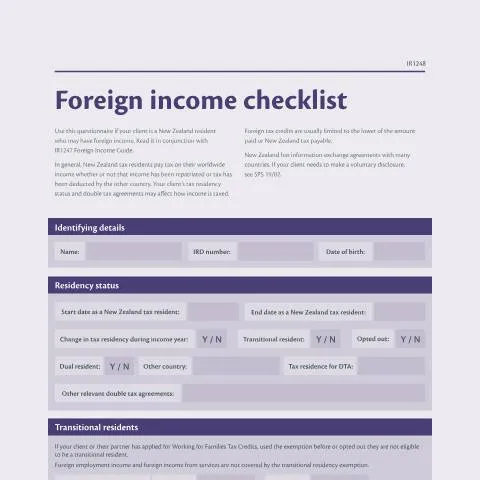
Navigating the IR1248: Understanding the Foreign Income Checklist
The IR1248, known as the Foreign Income Checklist, is a pivotal document for residents of New Zealand who may have foreign income. The importance of this checklist cannot be overstated, as it serves as a tool to facilitate the accurate reporting of foreign earnings, ensuring compliance with New Zealand's tax regulations. In this context, understanding your obligations and the nuances of the form is crucial for taxpayers.
The Role of the Foreign Income Checklist in Taxation
Understanding the function of the IR1248 is essential for individuals classified as tax residents in New Zealand. The checklist primarily assists in identifying foreign income sources and determining their tax implications. Generally, New Zealand tax residents are liable to pay tax on their worldwide income, regardless of whether that income has been repatriated or taxed in another jurisdiction.
Who Should Complete the IR1248?
This checklist is designed for New Zealand residents who might receive foreign income. It is particularly relevant for those with complex financial arrangements or multiple sources of income from abroad. The IRD (Inland Revenue Department) mandates that the checklist be used in conjunction with the IR1247, the Foreign Income Guide, which provides a detailed overview of foreign income taxation.
Key Information Required
To properly fill out the checklist, individuals must provide specific identification details:
- Name
- Date of Birth
- IRD Number
Additionally, the form requires details about the residency status, including the start date as a New Zealand tax resident, any changes in tax residency during the income year, and specifics about being a transitional resident.
Filling Out the IR1248: A Step-by-Step Guide
Completing the IR1248 involves several steps, each of which is crucial for ensuring that the information is accurate and comprehensive. Here is a chronological breakdown of the process:
1. Gather Necessary Information
Prior to starting the checklist, ensure you have all pertinent documents and data, such as:
- Details of foreign employment income
- Financial arrangements related to foreign currency accounts
- Information regarding pensions or superannuation schemes from abroad
2. Completing the Checklist
As you proceed to fill out the form, pay close attention to the following sections:
Residency Status
Clearly state your residency status, including:
- Whether you are a transitional resident
- Any previous exemptions applied
- Dual residency details, if applicable
Income Sources
List all foreign income types, including:
- Employment income
- Pensions
- Dividends from foreign companies
- Business income
3. Review and Ensure Accuracy
Once completed, it is important to review the checklist for completeness and accuracy. Errors or omissions can lead to complications when the IRD processes your income tax return.
Coping with Potential Challenges: What If Things Go Awry?
Despite careful completion, individuals may face issues such as rejected submissions, incomplete forms, or queries from the IRD. Understanding the steps to take in these situations is vital.
Handling Rejections and Errors
If your checklist submission is rejected, you will receive a notification detailing the reason. Common issues include:
- Missing identification information
- Inconsistencies between reported income and available records
- Unclear residency status
In such cases, promptly address the concerns raised by the IRD. You may need to provide additional documentation or clarification to rectify the situation.
Voluntary Disclosure Options
If you believe you have underreported your foreign income, New Zealand's tax laws allow for voluntary disclosure. The IRD has guidelines for making such disclosures, which can mitigate penalties for previous inaccuracies. Refer to the IRD's SPS 19/02 for detailed procedures.
The Timeline: Key Deadlines and What Happens Next
When dealing with foreign income, timing is crucial. The fiscal year in New Zealand runs from July 1 to June 30. Understanding this timeline helps in grasping when to file and what to expect after submission.
When to Submit the IR1248
For taxpayers, the IR1248 checklist should ideally be submitted alongside your annual income tax return by the designated filing deadline. Late submissions can incur penalties or interest on any owed taxes.
Post-Submission Process
Once the IRD processes your checklist, they will assess your foreign income and determine your tax liability. This process may take several weeks, during which the IRD may request additional information. It is vital to remain proactive in addressing any queries to avoid delays.
Potential Consequences of Non-Compliance
Failing to accurately report foreign income has serious implications. New Zealand's tax system is built on self-assessment, but non-compliance can lead to:
- Financial penalties
- Interest on unpaid taxes
- Legal repercussions, including audits or investigations
The importance of accurately completing the IR1248 cannot be overstated, as it ensures compliance and protects against unnecessary penalties.
Understanding Exceptions: Who Might Benefit?
There are specific cases where exemptions or special considerations may apply when completing the IR1248. These exceptions are often related to transitional residency and the nature of foreign income.
Transitional Residents
Transitional residency is a critical aspect to consider. Individuals who qualify as transitional residents are exempt from some tax obligations for up to 48 months. However, there are restrictions, particularly concerning:
- Foreign employment income
- Income received from foreign superannuation schemes
If you or your partner has previously received Working for Families Tax Credits, you may not qualify for transitional residency.
Special Cases of Dual Residency
Individuals classified as dual residents must navigate a complex landscape of tax obligations. Under certain double tax agreements (DTAs), you may be able to claim exemptions on specific types of income, thus reducing your overall tax liability. It’s advisable to consult the IRD's guidelines on relevant DTAs for your country of residence.
Final Insights: Navigating Your Financial Obligations
Completing the IR1248 is not just a bureaucratic task; it represents your responsibility as a tax resident of New Zealand to declare your foreign income accurately. Understanding the nuances of the process, from gathering the right information to addressing potential challenges, is key to complying with your tax obligations.
While the IRD provides tools and resources to assist, seeking professional advice for complex financial situations can often be beneficial. In this way, you can ensure that your foreign income is reported correctly, safeguarding your financial interests in New Zealand.
Understanding Tax Residency in New Zealand
Before diving into the intricacies of foreign income reporting, it's crucial to understand the concept of tax residency in New Zealand. According to the Inland Revenue Department (IRD), your tax residency status determines how your foreign income is taxed.
You are considered a tax resident if you meet either of the following conditions:
- You have a permanent home in New Zealand.
- You have been in New Zealand for more than 183 days during the past 12 months.
If you qualify as a tax resident, your worldwide income, including income earned from foreign sources, comes under taxation. However, if you are a non-resident, you will only be taxed on your New Zealand-sourced income.
For those who may not be certain about their tax residency status, the IRD provides a useful online tool for determining your residency. Understanding your status is critical, as it will impact your obligations regarding foreign income reporting.
Foreign Income Types and Reporting Requirements
New Zealand tax law distinguishes between various types of foreign income, each with specific reporting requirements. The most common categories include:
- Employment Income: If you work overseas, your employment income is generally taxable in New Zealand if you are a tax resident. You will need to declare this income on your tax return.
- Investment Income: This includes dividends, interest, and rental income from overseas properties. Tax residents must report this income, and any foreign tax paid may be eligible for a foreign tax credit.
- Capital Gains: While New Zealand typically does not tax capital gains, exceptions exist, particularly if you are engaged in a business that involves buying and selling assets.
When reporting these income types, it's essential to ensure you have proper documentation. This may include payslips, bank statements, and tax documents issued by foreign tax authorities. Accurate reporting will not only keep you compliant with New Zealand tax laws but also help in claiming any applicable deductions or credits to mitigate double taxation.
Using RealMe Digital ID for Streamlined Reporting
The New Zealand government places a strong emphasis on utilizing technology to make administrative processes smoother and more efficient. One such tool is the RealMe Digital ID, which provides a secure way to access various government services online.
When dealing with your foreign income reporting, having a RealMe account can simplify your interactions with the IRD. You can file your tax return, check your account details, and communicate with the IRD all from one secure platform. This digital approach not only saves time but also reduces the probability of errors in submitting paperwork.
To set up your RealMe account, you will need to verify your identity, which can often be done online. Once registered, you can link your IRD number to your RealMe account, facilitating a seamless experience when reporting your foreign income.
Additionally, using RealMe allows you to keep track of your obligations and deadlines, ensuring that you remain compliant with tax regulations regarding foreign income.