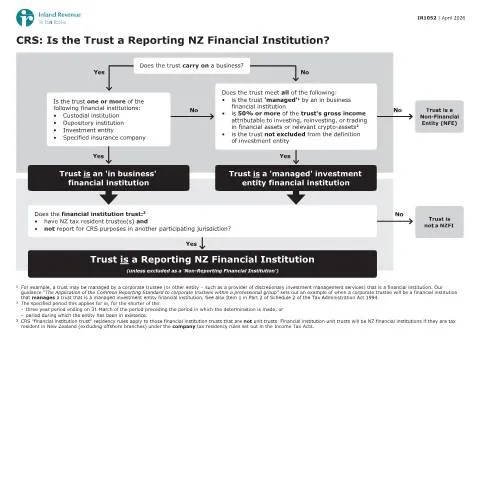
Navigating the Complexities of IR1052: A Crucial Step for Trusts in New Zealand
In the intricate landscape of New Zealand’s financial reporting and compliance, the IR1052 form, titled "CRS: Is the Trust a Reporting NZ Financial Institution?", emerges as a pivotal document for various trusts. For trustees involved in the management of trusts, comprehending the nuances of this form is not merely an administrative task; it encapsulates their responsibilities and obligations under the Common Reporting Standard (CRS).
Understanding the Implications of Trust Classification
The classification of a trust as a Reporting New Zealand Financial Institution (NZFI) is essential for compliance with international financial standards. This classification influences the reporting obligations of the trust and may significantly impact its operations. The IR1052 form is designed to facilitate this classification through a series of straightforward questions, guiding the trust to determine its status under the CRS.
Trust Types and Their Relevance to IR1052
Different types of trusts may be affected differently by the requirements in the IR1052. Understanding these classifications is crucial:
- Family Trusts: Often used for estate planning, family trusts must determine if their management qualifies them as financial institutions.
- Charitable Trusts: These trusts may qualify for non-reporting status, depending on their income and asset structure.
- Foreign Trusts: The reporting obligations for foreign trusts can be particularly complex, requiring careful analysis under the CRS guidelines.
- Unit Trusts: These may fall under specific rules that dictate their reporting status, necessitating a thorough completion of the IR1052.
Step-by-Step Guidance for Completing the IR1052 Form
Completing the IR1052 form may initially seem daunting. However, breaking it down into manageable steps can simplify the process:
- Determining the Nature of the Trust: The first section of the form asks if the trust carries on a business. If the answer is 'Yes', further questions regarding the type of financial institution must be addressed.
- Evaluating Financial Institution Status: The form contains specific criteria to determine if the trust operates as a custodial institution, depository institution, investment entity, or specified insurance company.
- Assessing Income Sources: Trusts need to evaluate whether 50% or more of their gross income is generated from financial assets. This assessment can determine if they meet the criteria of a managed investment entity.
- Residency Rules: It is essential to disclose if the financial institution trust has New Zealand tax resident trustees and whether it is reporting for CRS purposes in another participating jurisdiction.
The Submission Process: Where and How to Submit IR1052
Once the IR1052 is filled out, the submission process must be followed diligently to ensure compliance with New Zealand's tax regulations:
- Online Submission: The IRD encourages electronic submissions through their platform, enabling quicker processing times.
- Deadlines: Adhering to submission deadlines is critical, typically aligned with the end of the fiscal year (30 June). Trusts must ensure timely completion to avoid penalties.
After submission, the IRD may take some time to process the form. It is advisable for trustees to maintain records of the submission for reference.
Post-Submission: What Happens Next?
Upon submitting the IR1052, trustees should anticipate a follow-up or confirmation from the IRD regarding their trust's status. The processing may vary based on the complexity of the information provided. During this period:
- Tracking the Status: It is recommended to utilize the IRD’s online services to check the status of the submission.
- Responding to Queries: If the IRD seeks additional information, timely responses are crucial to prevent any disruptions in reporting compliance.
- Potential Reclassification: If the IRD identifies discrepancies, the trust may be reclassified, which could have significant implications for tax obligations.
The Consequences of Non-Compliance: A Risky Gamble
Failing to accurately complete and submit the IR1052 form can lead to serious repercussions for trusts:
- Financial Penalties: Non-compliance can result in hefty fines imposed by the IRD.
- Loss of Trust Status: Inaccurate reporting may jeopardize the trust's status as a Reporting NZFI, leading to adverse tax implications.
- Legal Ramifications: Trustees may face legal consequences if non-compliance is deemed intentional or negligent.
It is essential for trustees to treat the completion of the IR1052 as a priority to safeguard their trust's legitimacy and financial health.
Distinguishing IR1052 from Related Documentation
In the realm of trust documentation, the IR1052 may often be confused with other forms. Clarifying these distinctions is vital:
| Form | Purpose | Applicability |
|---|---|---|
| IR1052 | Determining if a trust is a Reporting NZFI | Trusts with potential financial institution status |
| IR1051 | CRS Self-Certification form | Individuals and entities clarifying tax residency |
| IRD 404 | Tax return for trusts | All trusts required to report taxable income |
Understanding the unique role of the IR1052 in the broader context of trust documentation ensures that trustees complete the correct forms for their specific situations.
Essential Supporting Documents for IR1052
While the IR1052 primarily serves as a self-assessment tool, additional supporting documents may be necessary to substantiate the information provided in the form:
- Trust Deed: A comprehensive copy of the trust deed is essential to demonstrate the trust’s operational structure.
- Financial Statements: Recent financial statements provide clarity on the trust's income and assets, supporting the classification process.
- Tax Residency Documentation: To confirm the residency status of trustees, relevant tax documents may be requested by the IRD.
Preparing these documents in advance can streamline the completion process and enhance the trust's compliance posture.
Final Thoughts: Embracing the CRS Framework
Navigating the complexities of the IR1052 is unequivocally a responsibility that every trustee must take seriously. As New Zealand aligns itself with international standards under the CRS, understanding the implications of this form will not only ensure compliance but will also foster transparency and trustworthiness in financial dealings. It is an essential part of being a conscientious trustee in an evolving regulatory landscape.
Understanding the CRS and Reporting Financial Institutions in New Zealand
The Common Reporting Standard (CRS) is an international standard for the automatic exchange of financial account information between governments. It was developed by the Organisation for Economic Co-operation and Development (OECD) and is designed to combat tax evasion and promote tax compliance globally. In New Zealand, the Inland Revenue Department (IRD) is the key authority overseeing the implementation and adherence to CRS regulations.
Under the CRS framework, a Reporting Financial Institution (RFI) is required to identify and report financial accounts held by foreign tax residents to the IRD. This responsibility applies to various entities, including banks, investment funds, and certain trust establishments. However, not all trusts are automatically classified as RFIs. Factors determining whether a trust qualifies include its structure, the beneficiaries, and the types of accounts held.
To ascertain if a trust is classified as a Reporting Financial Institution, it is essential to analyze the trust’s activities and the role it plays in wealth management. Trusts that primarily act as passive investment vehicles for foreign beneficiaries often fall under the RFI category. Conversely, a trust engaged in active business operations may not meet the criteria.
Moreover, New Zealand’s approach to CRS emphasizes the importance of transparency and compliance, and trusts must maintain comprehensive records detailing their financial activities and beneficiaries. This documentation is not only crucial for CRS compliance but also supports the trust's credibility and operational integrity.
Key Responsibilities of Trustees under CRS Guidelines
For trustees of entities that may be deemed as Reporting Financial Institutions, there are specific obligations that must be adhered to under the CRS guidelines. These responsibilities include due diligence procedures aimed at identifying the tax residency of the beneficiaries. Trustees must implement a robust verification process to ascertain the tax status of each beneficiary, which may involve collecting self-certifications and other relevant documentation.
Trustees are also tasked with ensuring that the trust is compliant with any reporting obligations set forth by the IRD. This includes submitting accurate and timely information regarding reportable accounts to the IRD, typically on an annual basis. The deadlines for these submissions align with New Zealand’s fiscal year, running from 1 July to 30 June. Failure to comply with these obligations can result in penalties, making diligence in this area paramount.
Furthermore, it is critical for trustees to engage in continuous monitoring of their financial accounts to ensure ongoing compliance with any changes in the beneficiaries' tax status or financial holdings. The need for adaptability in compliance is further underscored by the evolving nature of international tax regulations and local legislative changes, such as those introduced by the Official Information Act 1982 and the Plain Language Act 2022.
Exemptions and Special Considerations for Trusts in New Zealand
While many trusts may fall under the Reporting Financial Institution category, there are certain exemptions and considerations specific to New Zealand trusts that can influence their reporting obligations. For instance, certain types of trusts such as charitable trusts or those that are deemed to have low-risk profiles may be exempt from CRS reporting obligations. However, it is paramount that trustees adequately document the basis for their exemption status to avoid potential scrutiny from the IRD.
Additionally, trusts that have local beneficiaries or are structured primarily for the benefit of New Zealand tax residents may not qualify as RFIs. This distinction is essential, as it directly affects the trust's compliance requirements and reporting obligations under the CRS framework.
It is also important for trustees to stay informed about potential changes in the international tax landscape that could affect their reporting responsibilities. The CRS is subject to updates and revisions by the OECD, and any changes in guidelines may impact how trusts are classified and managed within New Zealand. Therefore, engaging with tax professionals or legal advisors to navigate the complexities of CRS compliance can provide significant advantages for trustees seeking to ensure full compliance with New Zealand’s regulatory framework.